Nymphus rediscovered
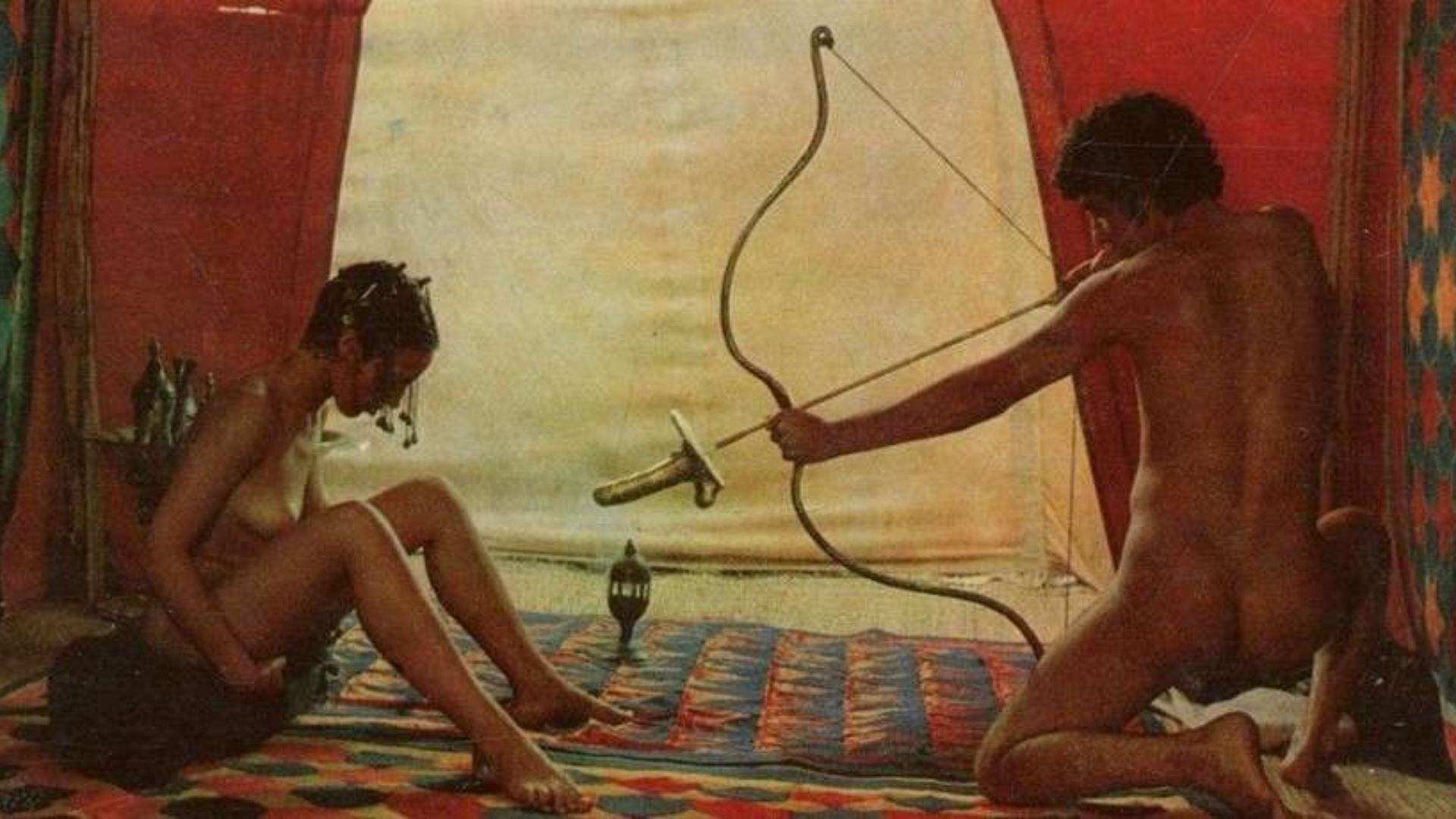
Il fiore delle mille e una notte, 1974
Pier Paolo Pasolini
The second Mithrasic degree was Nymphus, called the Bride. Although the planet of this degree, Venus, seems to require a feminine imagery, Perses, assigned to the Moon, has no parallel feminine image. The seeming incongruity of this female imagery in a religion which excluded women has been discussed. Suffice it here to note the planetary and stellar references which drove that imagery. The devices of the degree were the bridal veil or diadem, the mirror or torch, and the lamp. The constellation of the degree was probably Spica, the wheat ear: held by Virgo. This constellation and perhaps its planet, Venus, is what made the feminine images of the degree necessary.
The feminine imagery deriving from the astrological attributes of the degree, also ties in with an interest the Mithrasians had in the myth of Cupid and Psyche, a story particularly popular in the second century C.E. Reliefs of the couple have been found in Mithraea. As we can see from Lucius Apuleius' work, The Golden Ass, the myth was considered an initiatory story, an interpretation which fits well with the symbolism of the Nymphus degree. Taken as an allegory of the discovery of the soul of a man (and used as such in The Golden Ass), the myth recounts a story of self-discovery and introspection. All the devices of the Nymphus degree have a similar theme.
The diadem and veil relate to the veiling of the bride. a custom continued even today. It is significant that the word “nyrnphus” means not only bride, but secret. The task of the Nymphus was thus to uncover internal secrets.
The Nymphus sought the internal world, the world normally hidden behind a veil. The Nymphus carries a lamp, to assist in its task of illuminating or shedding light on the inner world. In this context. the image of Venus, the third brightest object in the heavens after the Sun and the Moon. is most appropriate. The Nymphus also carries a mirror: the symbol of self-examination—of looking into one’s internal self. In other words, by the light of teachings (the lamp), the Nymphus would look into himself (the mirror), and see himself as he really was rather than how he wished to be seen (the veil). In this process of self-discovery, the major virtue attributed to brides was emphasized: patience in the pursuit of self-understanding.
In this context, the Nymphus learned Mithrasian theology and the responses required by ritual. Indeed, the Nymphuses seemed to have formed a kind of sacred chorus, at least at Dura-Europas where as many as sixteen are portrayed in a single relief-the only case of multiple members of any degree other than Corax and Leo.
A surviving text by Firmicus Maternus can be interpreted as indicating such a chorus. Unfortunately the key word of the text is disputed-the Greek text could read either “aide” or “ide,” translating respectively as “sing” or “behold.” If the correct translation is “sing,” then the text reads “Sing, Nymphus, hail Nymphus. Hail new light.”2 I think this interpretation is correct because the meaning seems to be not the Nymphus being hailed, but the Nymphus doing the hailing of the new light. This new light included the light of knowledge. At this stage, the inner secrets of the Mithrasian community almost certainly were not revealed. By parallel with the Golden Dawn, in the early degrees, the student was given nothing that could not have been found in books commonly available. What differed was that these various elements were drawn together in an entirely new way, giving them a coherence and unity they had previously lacked. Investiture with the various devices of the degrees doubtless provided great opportunity to impart to the initiate knowledge of their relevance to Mithrasian doctrine. The Golden Dawn and the Freemasons both use investiture in initiation in this manner.
References
- Quoted In Vermaseren. Mithras, p. 143. Also appears In Franz Cumont, "The Dura Mlthraeum", Mithralc Studies, trans. and ed. John R. Hinnells (Manchester: Manchester University Press, 1975), pp. 200·201. ↑