The Chaldean Oracles: A different perspective
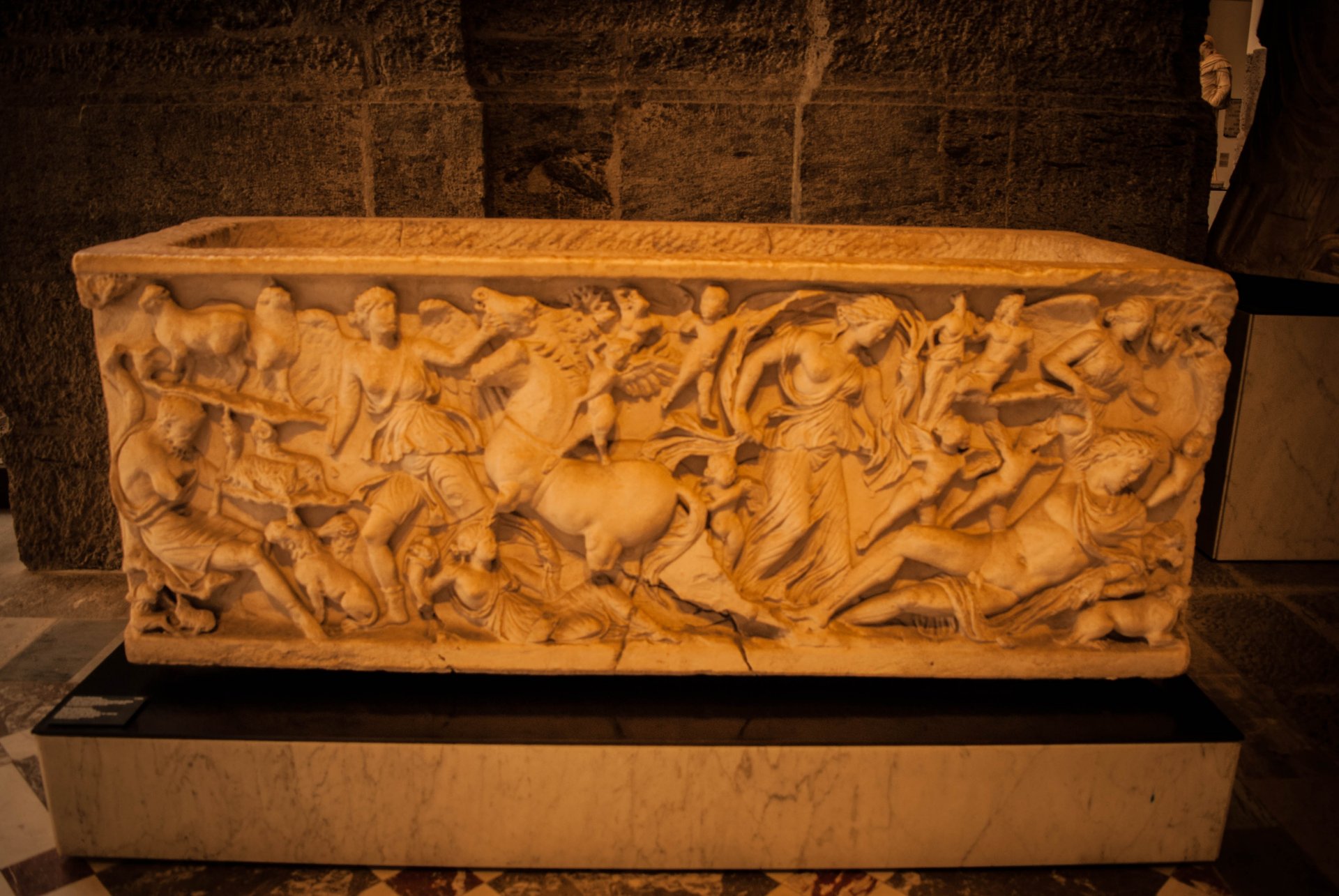
Sarcophagus with Selene and Endymion, 220-250 AD, III century, marble sculpture. Italy, Campania, Naples, National Archaeological Museum of Naples
Mateusz Zalewski-Grzelak
In the year 2023, I was invited to deliver a lecture before an informal Thelemic group. Although I am not myself bound unto Thelema—having been at one time a satellite of a certain camp in Poland, as well as participating in volunteer work at the Boleskine House Foundation in 2019 (a satellite disinterested in the Minerval degree, functioning rather as a “befriended dark mascot”)—I have for many years engaged in the study of diverse mystery traditions, primarily those pertaining to the antiquities of the Mediterranean basin, and so I resolved to accept the invitation. Ultimately, the lecture did not transpire owing to organizational difficulties; hence I chose to preserve my labor and render it accessible unto interested souls.
Dear children, there shall now proceed a discourse upon the Chaldean Oracles, which—out of love for Neoplatonism and the theurgy of Iamblichus—I have studied from Alpha to Omega. Though I may not claim the mantle of an academic authority, I trust I have plumbed the lion’s share of that which I wish to impart today. It shall be, therefore, in part a reading and in part an expository lecture. I invite you through an initial axiom drawn from Wilfried Schmidt-Biggemann: I propose that we capture the potency of the image and in some manner participate, or desire to participate, in the beliefs of those who were fascinated by them and devoted unto them. For a brief moment, let us adopt the perspective of the Chaldeans, the Chaldean theurgists, and the Neoplatonists; let us give rein to our imagination and engage ourselves with these matters.
The fundamental premise distinguishing us from atheists is the recognition of an essential axiom and power: the gods and goddesses exist. From this foundation we begin to erect the entire temple—hypothesis beside hypothesis, argument beside argument, deduction beside deduction. All of this is raised through reason, through a noble intellect, like unto the columns of the Parthenon—proportional and harmonious, such that the intervals constitute a harmonic procession, a melody, a rhythm reflecting most faithfully the realms of the gods and their cosmic realization upon the earth. Should we assume, however, that this axiom be false—which remains possible—then all that we have constructed beneath the stars, all our temples dedicated unto the gods and goddesses, would be mere playthings and experiments of a human mind beguiled by its own projections. Here I have paraphrased a passage from De Mysteriis Aegyptiorum by the master Iamblichus.
Dramatis personae:
- Apuleius, author of the treatise On the God of Socrates, as well as the Metamorphoses (124–170 CE).
- Plotinus, a man of immaculate reputation in Rome—that city of lions—who throughout his life enjoyed unblemished renown, escaping criticism from all, an achievement truly arduous in the Rome of that era. Born in 204–205 CE in Lycopolis, he passed away in Campania in 270 CE.
- Celsus, a pupil of Plotinus, born in the first half of the 2nd century CE.
- Chalcidius, 3rd–4th century CE.
- Julian the Theurgist, referenced chiefly in the 2nd century CE, son of Julian, who according to legend invoked an Archangel to incarnate within his son. Thus he was born with a daimonion—that is, with the genius of that Archangel.
- Philo of Alexandria.
- Iamblichus of Chalcis, born near modern Qinnasrin in Syria in 245 CE, dying presumably in 325 CE.
- Porphyry Malchus, born in Tyre in Phoenicia, who died in Rome.
- Julian Flavius, the Emperor, born in 331 CE in Constantinople, termed “the Apostate” by Christians, though from his twelfth year he was a pagan under the guardianship of the senatorial wing of old pagan lineages. He fell at the hands of a soldier—a Christian fanatic—during the Persian campaign. The entire tale that at the moment of his death he uttered, “Thou hast conquered, O Galilaean,” was interpolated later by his adversaries, the Christians.
- Maximus of Ephesus, the great teacher of the Emperor Julian, slain by command of his successor, Flavius Valens.
- Sosipatra the Theurgist of Ephesus, first among the priestess-magicians and theurgists of that era, second half of the 4th century CE, disciple of two Chaldean master-magicians.
- Hypatia of Alexandria, a Neoplatonist born around 350 CE, who in 415 CE was murdered by Christians in the Serapeum. Remarkably, though her written works have not survived, we know she was the first to establish that planetary orbits about the Sun are elliptical rather than spherical.
The powers as objective ontological forces
Now, by way of introduction, I shall describe the powers as objective ontological forces. Is it possible to recognize such entities as a priori ideas functioning as forces that exist independently of our concepts? This represents a form of pansophy—here a gesture toward the Fraternitas Saturni. For we may treat powers as active, inactive, passive, reactive, variable, or immutable—as entities akin to cosmic vāsanās (energies imbued with specific attributes) that impart their hue unto pure śakti power, the Soul of the World (Anima Mundi), which is the generative energy. Parmenides maintained that dualism does not exist, and that agency, potentiality, and actualization constitute a single unity. It is worth recalling his journey unto the goddess Nyx, during which it was declared that all human concepts regarding the gods and goddesses are mere doxology—that is, opinion. Nyx herself “spoken” unto Parmenides, asserting that the views of mortals concerning the gods are generally of negligible value. Anaxagoras, conversely, held that the collision of opposites engenders action. The principle of the predominance of dispersion or concentration of forces—that is, their quantitative transmission—causes powers to spread throughout space, existing as vortices of opposites that divide and transform themselves. All forces within the universe are active and potential; thus they do not exist immutably, but operate within a specific continuum. Plato evaluated their functionality: what do they do? They act, they are active, and they undergo action. Forms and ideas are likewise categories of power, and the operational nature of action together with the individualization of forces demonstrate that no forces exist other than those possessing real efficacy. The Eleatic principle dictates: “x” is a being if and only if “x” possesses a certain power. Modal logic posits that so long as a given value “p” (such as invisible unicorns) contains no internal contradiction, “p” is logically possible, even if empirically false. Aristotle, our categorical friend, asserted that forces act causally in concert, one triggering another, where potentiality and actualization remain distinct. Forces may be known through their manifestations, yet their nature and structure remain concealed behind a veil—perhaps the veil of Isis? Powers activate one another when the defining conditions of their attributes and parameters are fulfilled—through the necessity of active and passive power operating together, yielding conditional necessity. Forces realize themselves within the nature of their operation; they are co-determined in covariation, coexisting as pros ti—that is, “toward something,” akin to inclination or karma in Hinduism. Ontologically interdependent and teleologically directed toward purpose, they reach fulfillment in co-actualization, in systemic realization—albeit upon a cosmic scale.
Levels of reality
At this juncture, I should like to touch upon Hinduism, for Hellenistic beliefs stood in harmonious alignment with Hinduism and Buddhism. There existed even Bactrian kings who synthesized faith in the Hellenic gods and goddesses, mystery-wisdom, and Buddhist tenets. An exemplar is the Indo-Greek king Menander I Milinda—a consummate illustration of the concordance between Hellenistic teachings and Hindu-Buddhist traditions.
Now I wish to delineate a three-tiered reality. When someone declares that “reality is an illusion,” they typically lose touch with reality to some degree—for they forget that there exist three distinct levels: the conventional, the absolute, and the illusory. We commence with paramārthika—the absolute, non-dual reality. Paramārthika represents the supreme, ultimate level of reality, frequently identified with Brahman—the immutable, transcendent, and formless principle underlying all existence. It is considered the sole true and eternal reality, transcending time, space, and causality. It is likewise non-dual (advaita), signifying an absence of internal distinctions or dualism. Further Platonizing Hinduism, we proceed to vyavahārika. This is conventional, everyday reality—the level experienced routinely, empirical, practical, and transactional. Within this sphere, distinctions and dualisms exist, and entities are perceived as separate from one another. Time, space, and causality perform an essential role in fashioning conventional reality. Though vyavahārika is regarded as valid for practical ends, it is understood as a lower, intermediate level relative to the absolute reality of Brahman. Next is prātibhāsika, or illusory reality. Most individuals who claim the world is an illusion are stranded upon this very level. Prātibhāsika is the reality associated with illusions, dreams, and subjective perceptions; it is considered a fleeting, deceptive reality arising from individual experiences and interpretations. That which appears real within this realm proves unreal upon deeper scrutiny. Examples of prātibhāsika include dreams and hallucinations. However, as Synesius wrote in De Insomniis—dedicated unto his teacher Hypatia—diverse visions permeate through dreams: partially dreamed in private, partially generated by the subconscious, and partially issuing from astral, transcendent, or magical realms. All these blend within the cauldron of vision, where things seem real during the experience, yet upon awakening or sober reflection we recognize them as illusions.
Iamblichus’s theology of arithmetic, or rather the Pythagorean theology of arithmetic
Now I would present a general introduction unto Iamblichus’s theology of arithmetic, or rather the Pythagorean theology of arithmetic. The geometric-arithmetic procession endeavors to map the perfect realm, whereof the phenomenal world—known to us as conventional reality—is but a shadow. It is an attempt to grasp the Pythagorean-Platonic world—the Platonized Pythagoras—the operation of a priori, ontologically objective powers continuously clothed within the universe. To seek the source of the theology of arithmetic and geometry is simultaneously an attempt to reconstruct the process of the co-arising of the universe—from pre-formative eras down to its manifest generation. This is a titanic undertaking, not merely as an exercise of imagination, but as a reconstruction of a profound metaphysical grammar understood as the “Intellect.” In the philosophy of mathematics we find the concept of a type, as well as the signs or tokens of that type acting as traces of the Arche. In like manner, a priori forces, metaphysically understood, constitute a type, while all phenomena occurring within the universe are their derivative instantiations. The passages from the Monad unto the Decad shall here be paraphrased upon the basis of Robin Waterfield’s 1988 translation, published by Phanes Press.
The Monad—the beginning—creates itself, containing within itself many monads, generating within the proportions of the scope of its foundation and power. The Monad is characterized by creativity, intelligence, and self-sufficiency, being self-derived. Divinity co-manifests from the Monad; it is the beginning and the end. It imparts cohesion unto phenomena and causes them to unite with one another without departing from their own principle. Hence it is sometimes termed chaos as a generator, but also light, a mixture of power, the cause of truth (veritas), exemplar, and simplicity—being order and harmony. In Egypt it was called Proteus, for it assumes every form.
The Dyad. The Monad opens unto the Dyad, which is courage, audacity, impulse, motion, energy, generation, and form. It finds fellowship through all and between all. It is called infinitely divisible, like unto Erato, separating and joining, introducing the Monad into substance. It is endurance in strength, labor. Duality may be named the longing for the Unity of the Monad, or the bow of Artemis. It is called justice, for it possesses perfect scales.
The Triad is the next bridge. Just as the Monad contains the Dyad, so the Dyad contains the Triad. It is the first oddness, and simultaneously perfection, proportion, limitation, yet also unification. It symbolizes prudence, wisdom, eyes peering into the future—somewhat like Horus the Elder. It is likewise humility, piety, awe, which through its sanctity brings thrice-blessed happiness. From it emerge the three transcendent worlds present in Chaldean beliefs, permitting a comparison with the worlds of Kabbalah: Ain, Ain Soph, and Ain Soph Aur. One must remember, however, that the Kabbalists—10th-century Jews who, through Judeo-Arabic contact in Spain, borrowed this cosmology, including the concept of Meś, the Sumerian tree of life incarnated in king and queen through Nun.Gal.Meś and Axis Mundi—adopted this idea from the Chaldeans. The Triad is the fulfillment of all things through friendship, harmony, and unanimity.
The Tetrad and the Pentad. The thread of the Pentad passes through three figures and opens the gates of the Tetrad—that is, multiplicity emerging from the Triad. The impulse is transferred into stability, becoming at once the guardian of nature—that which endures because it preserves. Four monads are contained within the first, and all monads balanced relative to one another open the gates of the Pentad. Here appears the pentagram, wherein the universe is enclosed and sealed within the Decad, initiated by the Monad and set in motion by the impulse of the Dyad. Everything here is characterized by an absence of friction, alteration, and mutability, being at the same time an understanding of justice that permeates all things. The Pentad is the harmony and composition of all elements in proper proportions; hence it is named Nemesis—justice (dikaiosynē)—and also Providence, for it eliminates inequality and excess. It is likewise designated as marriage (epithalamios), being androgenous; it is termed a demigod, the immortal twin of Pallas, because it reveals the fifth element. It resembles the heart in relation unto living beings. It is an intriguing detail that the pentagram, which symbolizes essential spirit and elements, was not inverted by Satanists, but by Christians; for them, it signified the incarnations, as well as the five wounds of Jesus. It accrued to Satanists only later. In certain churches, inverted pentagrams to this day symbolize the five wounds of the crucified Galilaean.
The Hexad—the next mutation in this procession—is androgenous and symbolizes marriage. It is the cause and condition of life. The Pythagoreans after Orpheus termed it the fullness of parts, peace, and reconciliation. It is sometimes named the spear-brandisher, and in the divine realm Hekate corresponds unto it, guarding the crossroads, wherein justice dwells. It bears the names Thaleia and Panacea, for it harmonizes disparate matters. It is wisdom overseeing all virtues (aretai), intermingling with them.
The Heptad (the seven)—whether as a heptagon or a seven-pointed star—is a virgin, for it issues from no mother. It is a huntress, for it gathers matters in a manner reminiscent of unity. The Heptad is indissoluble except by itself. It represents the guardian protecting the eternal stability of many cosmic bodies. Hence it is termed a mighty, fortified citadel within the Decad, and as the hebdomad it stands between the Monad and the Decad. It is Athena of critical time, signifying change, intelligence, health, and light.
The Ogdoad, the Ennead, and the Decad. The Ogdoad opens the next gate. The eight-sided figure encompasses all harmony and is the ogdoad like unto Rhea—Mistress of Time, Mother of the Gods. It signifies love, friendship, wisdom, creative thought, and the foundation of security. The Ennead, in turn, symbolizes kinship, belonging, and equality. It is like the Oceanus of horizons, encompassing all spaces and places; every point is its epicenter. It is sometimes called Prometheus, as accord and limitation uniting all into freedom from toil and into assimilation. It is also Hephaestus, for it points the way upward through the melting of metals, alchemy, and sublimation. It is likewise Hera, for the element of air is subject unto the Ennead, and Hyperion, because in its grandeur it is supreme.
Forming another thread and looping within the tetraktys, we open the Decad—which neither shrinks in a petty manner nor expands out of harmony, but encompasses the entirety of multiplicity as a symbol of all cosmic phenomena. Here arises the principle: “Entities must not be multiplied beyond necessity.” For the sake of accuracy, it must be added that Ockham did not invent this; the principle was known in antiquity and later developed by the Scholastics. The term “Ockham’s razor” appeared much later. The Decad, as the culmination, is the perfection of all numbers, the vessel of the entire tetraktys, the closure of the procession... and likewise perfection—it completes the universe within the Decad, wherein is contained all equilibrium proper unto itself alone. The Decad traces a circle and returns unto itself, somewhat like Erebus, wherein all is present: fate, eternity, necessity, strength, trust, Atlas—untiring, like unto the heavens. Urania signifies eternity, for she conducts all things unto complete fulfillment.
Julian the Theurgist
Now a brief biographical note concerning the author of the Chaldean Oracles. Julian the Theurgist, born during the reign of Trajan, lived in Rome during the 2nd century CE and participated in the campaigns of Marcus Aurelius against the Marcomanni and Quadi during the Roman counter-offensive in the territories of modern Slovakia, the Czech Republic, and Moravia between 172 and 174 CE. He was a species of battle-magician. In 174 CE, Theurgus was credited with summoning a rainstorm that saved parched Roman soldiers while striking the enemy camp with lightning. Mention of this survived even in the Byzantine Suda, an early 10th-century encyclopedia. Cassius Dio, however, mentioned Arnuphis, who invoked daemons, the aethers of the air, and Hermes of the wind—whereupon rain fell and lightning struck the adversary’s camp.
Julian’s father authored a Treatise on Daemons. According to legend, he invoked an Archangel who incarnated within his son. Thus the very daimon of Julian the Theurgist was an archangel, whose logia were later termed the Chaldean Oracles.
How does a hypophētēs differ from a prophet? Julian the Theurgist was a hypophētēs—one who interprets pagan gnosis, nobilitas, for it was the Christians who designated us as paganus. A hypophētēs is one who translates divinity and the gods—a speaker of hypo-phesis, Hermanubis, Hermes, he who sets boundaries. Hence hermetics: the distinction between the sacred (sacrum) and the profane (profanum). A prophet, by contrast (pro-phēsis), is one who foretells the future. Horus, Apollo, Typhon—these are prophetic deities or entities utilized as oracles.
The chief deity inspiring the Chaldean Oracles is Apollo, alongside Hekate. The author of the Oracles thus presides over the sacraments of Apollo. “Sacrament” in its original, non-Christian sense denotes the submission of the mind unto the mystery-wisdom of psychagogy—the consecration of the spirit, soul, and pneuma unto the mysteries. Another confirmed deity of inspiration is Psyche—the Hypercelestial Soul, Anima Mundi—the Soul of the World, identified with the three-formed, holy Hekate Epipyrgidia, guardian of the tower.
Middle Neoplatonism—Plotinus, Celsus, Porphyry
Porphyry, in De Regressu Animae (“On the Return of the Soul”), was a student of the Chaldean Oracles and presents the background of the era as an introduction unto the philosophy of the oracles across three volumes, which regrettably are lost. The utility of these writings is recognized by all born mystics, magician-theurgists, and those possessing metaphysical perception of that which the Egyptian hieroglyph Sia signified in the technology of Egyptian magic. Of this I may speak another time. Those wishing to receive the doctrine shall obtain an authoritative source suited unto their own intellects.
Next: what are the characteristics of the ineffable “One”? This concerns the contemplation of non-anthropomorphic forces, the removal of human archetypal contexts. Man measures himself, yet he is not an objective measure—as Iamblichus wrote. The stars were not suspended in the heavens for the glory of the human animal.
The Father—Pater—father of the immortal gods and goddesses, father of the immortals themselves. The attributes of this Chaldean divinity are vigor, the power of sight, hearing, the gold of the starry sky above the stars, intellect moving through the fire of light derived from perpetually flowing cosmic rivers.
The Mother—Hekate—she who shapes and sets the boundaries of matter, of free will (boulē). This is likewise something beautiful: Eubouleos, Dionysus Zagreus—he who possesses a noble will. Here we return unto the Orphic mysteries of Kronos, as well as the Dionysian mysteries.
The music of the spheres
Beyond the forces recognizable within the universe, there is mention of the music of the spheres. But what was the Pythagorean music of the spheres, and what was the Chaldean concept of the sphere? The fixed stars and planets—planasthai, wanderers—as the revolving worlds of deities in the revolutions of hypostases. A physical planet is something lesser than a teleological entity—nature and its hypostasis. Cosmic music... we cannot “hear” it empirically, for sound propagates not in a vacuum. Yet when we tune ourselves intellectually, we indeed can hear it—hear the harmony of the cosmos. Some among us hear it with their own spiritual ears, for it is not the eardrum that perceives it, but nous—the intellect, an ear turned toward divine proportions.
Thus the teletarchic trisagion, forms bound unto harmony, music, rhythm, interval, proportion, numbers, mathematics, theology, arithmetic, geometry. Architecture is frozen music—wrote master Goethe; and divinity geometrizes—wrote master Plato. Now the first intellect, the noetic proto-fire, engenders the second intellect by virtue of power: nous as mind, spiritual magician, the immortal Platonic realm, the perfect a priori world acting as the matrix of the generative physical universe. Whereupon Hekate feeds upon the intellect and its rays, engendering forms—and the second intellect stands as the ultimate form of all things.
Following this path, we reach a station at the Pythagorean music of the spheres. Here I would recall Cicero’s Somnium Scipionis, in Macrobius’s commentary upon the cosmic flight of the son of Scipio Africanus—Scipio Aemilianus. The recollection of Carthage—this is precisely the account attempting to recreate the harmonies heard within the spheres. How high are those tones, and how low—these are the tones within the spheres of planets, within the spheres of stars, when Scipio Aemilianus was elevated unto the starry spheres in soul to experience the fullness of beauty and declare what values might be brought unto the Roman Republic upon returning from the stars.
Exceedingly vital is the passage concerning Sosipatra. Maximus of Ephesus (310–372 CE), theurgist and teacher of the Emperor Julian (“the Apostate”), was imprisoned and, following Julian’s death, beheaded by Flavius Valens. He fell prostrate before Sosipatra when she manifested unto him in perfect Fullness as a goddess, radiant in glory before his countenance. She spoke then: “Arise, my son; the gods love thee; if thou but raise thine eyes unto them, be not beguiled by earthly affairs, by transience.” Harmony—that is, the affirmation of life and mystagogic affirmation, the affirmation of the soul’s ascent higher.
Porphyry in Theophilus: above the supercelestial vault there exists an unbounded, violent fire, an infinite Aion, imperishable, dwelling among the immortals. In the Aethyr there are no stars—the stars lie beneath—nor moons, nor planets. No god encounters it; it is like a long path of swirling, sacred heat, uttering a titanic sound. Whosoever experiences this fire once desires not to turn back—this fire burns not, but imparts immortality. Aeons, in the plural, mingle with aeons above the stars with the infinite Aion above the stars as En Arreton. Apollo Phoebus conveys that only gods and goddesses know this supreme fire. The theurgic ritual is Autophaneia—self-revelation, wherein Kronos manifests during the epiphany of the apocalypse: the ritual unvciling of the robes of Isis prior unto Eleusinian or Egyptian initiations.
Fire appears encompassing Olympus. Olympus is no mountain—Olympus is time, according unto the oldest Orphic fragment from the Derveni papyrus. Chronos, Rhea, flowing time. The river of time, the generative fire, wanes alongside matter and the abyss, yet like Proteus it loops the whole as noetic fire, for it permeates everything.
The Soul of the World
Now regarding the Rose of the World—the Soul of the World, En as Pan, unfolds like the petals of a rose traditionally bound unto Aphrodite, her temples, and sacred places. The Apuleian youth transformed into a donkey—I have spoken already of Apuleius—in his Metamorphoses (The Golden Ass) attempts to save himself by eating roses within the sanctuary of Aphrodite, to disenchant himself from his own folly: his transformation into a donkey while experimenting with a witch’s ointment. Ultimately he is saved by Isis, and the entire Golden Ass stands as a traditional mystagogic pilgrimage explaining how a fool receives honors from the goddess, becoming at last her consecrated and elevated priest.
In Hippocrates and Galen, the human soul is divided into the intellectual, the passive, and the vegetative—and this soul ought not to be reduced solely unto physiology, nor psychologized, for it coexists with the body, with physiology and psychology, yet is not identical with them. In Plato, the Soul of the World likewise undergoes this tripartite division, but this touches neither human passions nor Tartarian realms. We return unto the Orphic mysteries, as though animal and human souls were contained within it, yet it remains subject unto none of their impressions—that is, sensations. The universe is likewise a zoon, and human and animal souls are a species of elixir extracted from the Soul of the World. Plato here reconciled not the Soul of the World and human souls, hence this is my own inclusion; at best, they undergo individualization in accord with the highest octaves of the world, entering these registers and operating expansively as Ka—that is, the soul of gods is grander than that of mortals or beasts.
From Iamblichus’s De Mysteriis, it emerges that Plato treats the universe panentheistically, as organic and divine. The whole here is frequently a shorthand among creationists, evolutionists, and generationists. Personally, I am an evolutionist, for such are the facts, but likewise a generationist. The distinctions? Deus Ex Machina versus demiurgic theology—divinity coexists with the generative universe, not superimposing itself intellectually upon it; it is built into the whole world, refuting the concept of a Prime Mover. If a productive teleology appears, deity in this sense is an exceptionally advanced Proteus, returning unto the Monad, which contains transcendent and phenomenal laws, yet negates both creationism and intelligent design. Personally, I incline toward generationism, which preserves metaphysics without demanding its subordination unto human concepts and projections. Demiurgic theology assumes, however, that the primary moving intellect is the Demiurge—which possesses nothing in common with the Judeo-Christian version of creationism; it is far too abstractly intellectual a force: vide Plato, the Demiurge-Cosmocrator, ungraspable through the assumptions and doctrines of the aforementioned religions.
The Iynx as a force uniting gods and men
Now regarding the Iynges, termed also Iynx. The Iynx is a force uniting gods and men, like Eros, one of the three Titans. The Iynx artifact, resembling a child’s spinning top, produced whistling sounds and was utilized for ritual purposes—for example, in the temples of the god Sin (Sumerian) in Harran. There existed also planetary temples—each planet possessing a separate temple even during the era of Esarhaddon, continuing presumably until the 7th century CE, when the expansion of Islam commenced. The sorcerer or priest utilized it to call back an unfaithful mistress on behalf of a client, binding her soul in the context of the Chaldean Oracles. Babylonian, Assyrian, and Chaldean magic is a vast subject, worthy of an entirely separate discourse. These were sacred words, logia, and symbols traveling between divine realms and elemental worlds, transmitting seals and information, much like Hermanubis in the Neoplatonic approach. Hermanubis is the union of Hermes and Anubis—a species of syncretic combination of two forces and individualized deities. Deities are not subordinate unto man, yet man may communicate with them technologically, through technical magic.
Cosmic entities were likewise termed intellectual support, Voces Mysticae, sustaining the theurgist in his work. They were represented as magical wheels—the aforementioned artifacts. Iynges are magical words which, when exposed unto the action of the hypophētēs, become Logos and active operation—sent forth into the world to fulfill their magical function. Here is an example: the bird named the wryneck, or Jynx torquilla in Linnaean taxonomy, which produced similar sounds.
And now the teletarchs—teletarchai—who are they? The teletarchs reside beneath the Iynges and Connectors (Synoches) as rulers of the three worlds within the Chaldean Universe. They exercised authority over these realms, and their character was defined as faith—Pistis—bound unto the material world. The material teletarch was linked with Aletheia—unforgotten truth; the aetheric teletarch with Aletheia; and the empyrean teletarch with Eros-Agape. Fiery Hope—Spes—is the fourth virtue, exhibiting a resemblance unto Christianity; this term was adopted by Christians from Neoplatonism and subordinated unto their new religion. In contrast unto them, these forces co-created the world and stood at the center of the generational chain.
Theurgic faith manifested in the reconciliation of the theurgist’s Daimon with a given deity—an act of tajjali, a discourse with the holy guardian angel or daimon, rather than doxology and blind faith in opinions concerning deities. This was considered one of the charismatic theurgic powers, realized through the rays of the Connectors of the Sun. The teletarchs of Helios descended into the world of Helios’s hypostasis; in the empyrean world, this was Aion-Hyperion. Connectors harmonize, sustain, and protect the universe, generating invisible forces holding it together. They may be considered a hypostasis of gravitational-magnetic forces, serving as a metaphysical expression of dark energy and matter, where solar rays serve as a paradigm of the connector.
Daemons in Plutarch were not evil, unless they were chthonic kakodaimones, filled with violence and passion, capable of driving the human mind unto madness upon contact. In Hesiod, daemons were guardians of men; in Heraclitus, a man’s character is his daimon—his genius. Socrates possessed his daimon as an innate guide and representative of life. In Xenocrates, forces between gods and men, both good and evil, operated in relation unto mortals. Plutarch treats daemons as restored unto nature and punished if they violated the laws of the gods (De Iside et Osiride). They were likewise recognized as children of the gods and children of nature—Pan was a daimon whose death was mourned; they were not immortal, yet long-lived, whereas pneumata (spirits) holding the status of Great Daemons could, after great trials, become Gods and Goddesses—likewise according unto Plutarch.
In the Hekatean-Physical approach, chthonic daemons were bound unto matter through the physical aspect of Hekate, whereas agathodaimones are noble daemons from higher worlds, as Iamblichus describes in De Mysteriis Aegyptiorum. A daimon is understood as a giver, distributor, or pneumatic operator—the presiding genius of a given person. Sosipatra possessed the daimon of a goddess, while Plotinus possessed the daimon of a god as one among many. The word for “God” in Polish (Bóg) derives from the Indo-Iranian bhaga, signifying “giver”—thus, de facto, “God” = “Daimon.”
The pandemonium in Iamblichus (Chapter II of De Mysteriis) represents the generative and creative forces of the gods at the furthest reach of their operation. Daemons and manifestations of the gods are fundamentally identical, differing only for mortals—they may appear terrifying or susceptible unto passions. In Chalcidius, a “good daimon” is a rational, immortal, and aetheric entity, a guardian of men; it is prudent and utilizes its aetheric body. A “bad daimon” need not be friendly—frequently it is not; it is invisible, yet discernible through “second sight,” subject unto animal passions and instincts. It appears as a shadowy form—nigro in Greek signifying “black”—and dead souls, or khaibit and shu, are ever black. The realms of black earth, or chthonic realms, are likewise black—hence derives the word “necromancy.”
In Neoplatonic theurgy, there exist three distinct forms of soteriology: Homoiōsis Theō through Theion Ergon—that is, man’s labor upon Aretē, the incarnation of the metaphysical within oneself according unto divine proportion; the daimōn, comprising objective, terrestrial, planetary (Chaldean), and metaphysical intelligences; and the direct work of the gods within man, which is realized when we meet the divine halfway, our mortal exertions crowned by the Thyrsus, the Autophaneia of fire, and the Autophaneia of the Hekatean abyss—Tartarus.
The transformation of the soul unfolds even in the state of slumber, as Synesius recounts in De Insomniis. Upon this joyful note, I bring this discourse unto its close—for Aurora, who is Eos, the morning sister of Mater Matuta (goddess of twilight and dawn), hath already arisen. She sends her greetings, appearing as grand and mighty wings of living fire; nor is she a mere phantom of the mind, for since the dawn of creation she ever rises in subtle, fiery glory, invoked under diverse names by diverse peoples, cultures, and civilizations.
Selected bibliography and recommended reading
- Jorati, Julia (ed.), Powers: A History (New York, 2021; online edn, Oxford Academic, 21 Oct. 2021).
- Wilberding, James (ed.), World Soul: A History (New York, 2021; online edn, Oxford Academic, 23 Sept. 2021).
- Johnston, Sarah Iles, Hekate Soteira: A Study of Hekate’s Roles in the Chaldean Oracles and Related Literature (Atlanta, GA: Scholars Press, 1990).
- Lewy, Yochanan and Michel Tardieu, Chaldaean Oracles and Theurgy: Mysticism, Magic and Platonism in the Later Roman Empire, 3rd ed. (Paris: Institut d’Études augustiniennes, 2011).
- Majercik, Ruth Dorothy, The Chaldean Oracles (Leiden: E.J. Brill, 1989).
- Macrobius and William Harris Stahl, Commentary on the Dream of Scipio (New York: Columbia University Press, 1990).
- Philostratus and Eunapius, Lives of the Sophists. Lives of Philosophers and Sophists, ed. and trans. Graeme Miles and Han Baltussen, Loeb Classical Library 134 (Cambridge, MA: Harvard University Press, 2023).
- Iamblichus, De Mysteriis, ed. and trans. Emma Catherine Clarke, John M. Dillon, and Jackson P. Hershbell (Atlanta, GA: Society of Biblical Literature, 2003).
- Iamblichus (attr.), The Theology of Arithmetic: On the Mystical, Mathematical and Cosmological Symbolism of the First Ten Numbers, trans. Robin Waterfield (Grand Rapids, MI: Phanes Press, 1988).
- Apuleius, Apologia. Florida. De Deo Socratis, ed. and trans. Christopher P. Jones, Loeb Classical Library 534 (Cambridge, MA: Harvard University Press, 2017).
- Apuleius, Metamorphoses (The Golden Ass), Volume I: Books 1–6, ed. and trans. J. Arthur Hanson, Loeb Classical Library 44 (Cambridge, MA: Harvard University Press, 1996).
- Den Boeft, J., Calcidius on Demons (Commentarius Ch. 127–136) (Leiden: E.J. Brill, 1977).
- Synesius of Cyrene, On Prophecy, Dreams and Human Imagination: Synesius, De Insomniis, ed. Heinz-Günther Nesselrath et al. (Tübingen: Mohr Siebeck, 2014).
References
- Sarah Iles Johnston (1990) Hekate Soteira: A Study of Hekate’s Roles in the Chaldean Oracles and Related Literature. Atlanta, Ga: Scholars Press
- Julia Jorati (2021) Powers: A History
- James Wilberding (2021) World Soul: A History
- Yochanan Lewy (2011) Chaldaean Oracles and Theurgy: Mysticism, Magic and Platonism in the Later Roman Empire
- Ruth Dorothy Majercik (1989) The Chaldean Oracles
- Macrobius Ambrosius Theodosius (1990) Commentary on the Dream of Scipio
- Eunapius (2023) Lives of the Sophists. Lives of Philosophers and Sophists
- Iamblichus Chalcidensis (2003) De Mysteriis
- Iamblichus Chalcidensis (1988) The Theology of Arithmetic: On the Mystical, Mathematical and Cosmological Symbolism of the First Ten Numbers
- Lucius Apuleius Madaurensis (2017) Apologia. Florida. De Deo Socratis
- Lucius Apuleius Madaurensis (1966) Metamorphoses (The Golden Ass)
- Jan Den Boeft (1977) Calcidius on Demons
- Synesius (2014) On Prophecy, Dreams and Human Imagination: Synesius, De Insomniis
- Wilhelm Schmidt-Biggemann (2004) Philosophia perennis: Historical Outlines of Western Spirituality in Ancient, Medieval and Early Modern Thought: 189
