Commentary on “Immortalisation”
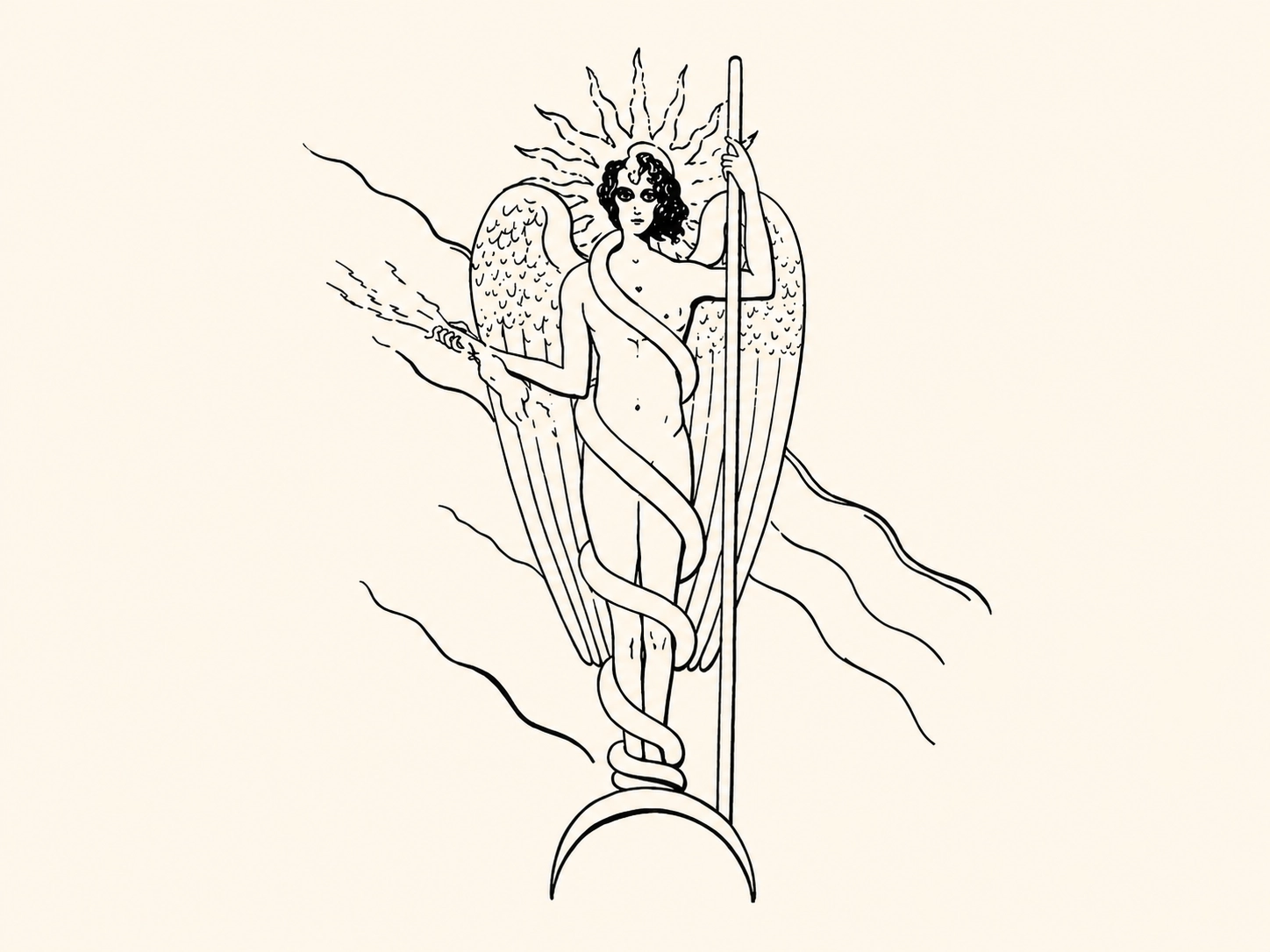
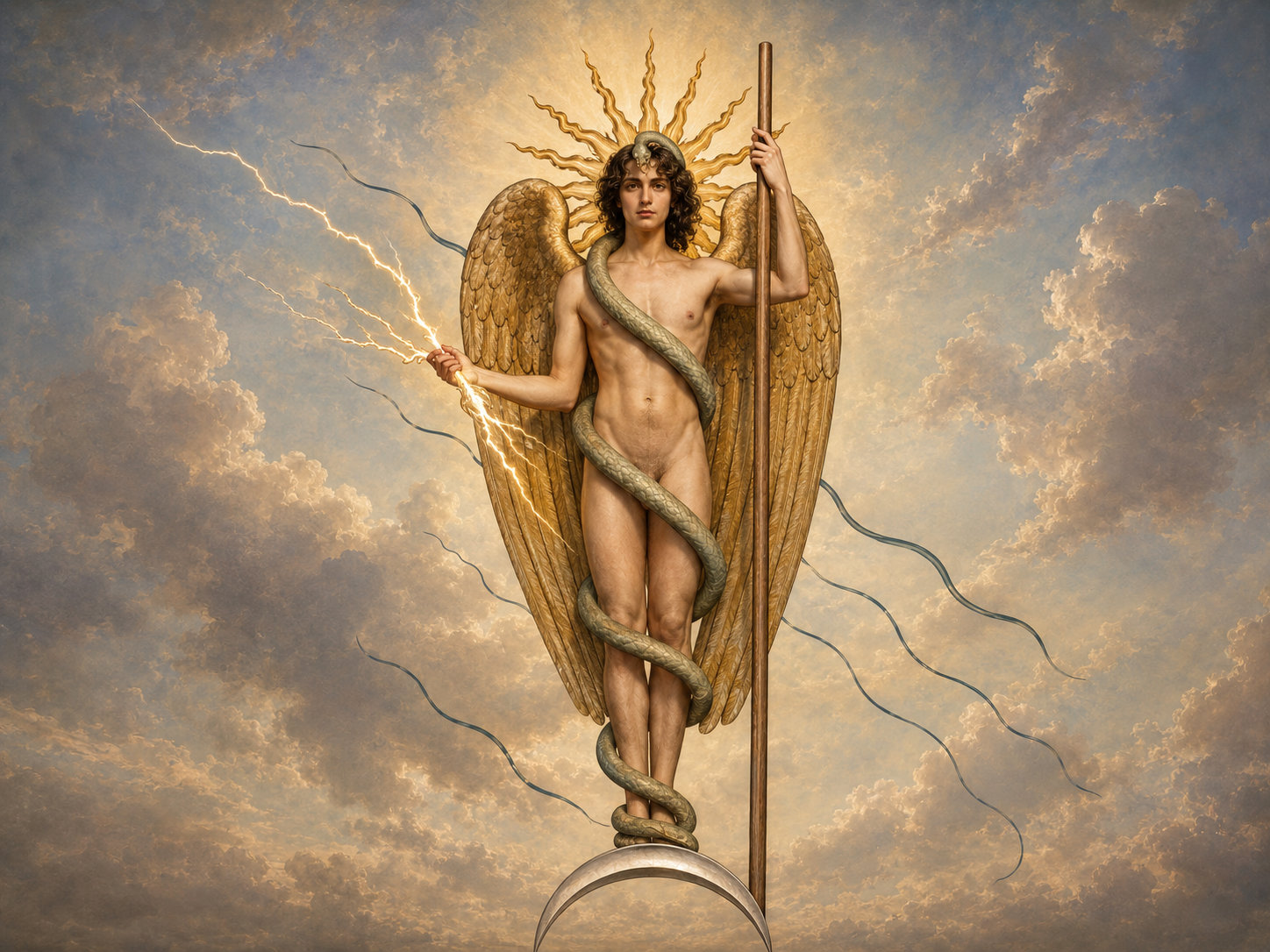
Original drawing accompanying the article in UR, 1927.
Anonymous
Editorial note: This commentary originally accompanied the introduction and text of the Mithraic ritual published under the title IMMORTALISATION in UR in 1927.
I
We may connect the ‘Providence’ and ‘Fortune’ (πρόνοια καὶ τύχη) invoked in the propitiatory formula with the Hvareno — the ‘Radiant Presence’ or ‘Glory’ or ‘Supernatural Fire’ which, according to the most ancient Iranian tradition, would descend from the Empyrean to invest Kings and Adepts, confirming spirituality through royalty and royalty through spirituality, since it bears witness to both through the manifestation of victory. Hence, in the formula itself, its relation, which seems clear to us, with the initiatic force of initiation and consecration which the invoker declares that he has already received, and by virtue of which he may turn towards further fulfilment — and pass from the grade of ‘Son’ to the grade of ‘Eagle’, according to the rite given in the text.
In any case, πρόνοια is one of the epithets of Athena, goddess of Wisdom, who, as a consequence of her infinite knowledge, also possesses the faculty of foreknowledge of future events, and can therefore confer the knowledge required so that nothing may disturb the outcome of the sacred operation. Τύχη is the equivalent of the Roman goddess Fortuna, usually represented with wings, resting upon a ball or wheel, emblems of her swiftness. At times she is also veiled, indicating how she proceeds upon her way with nothing before her at the moment of bestowing her gift. The invocation of the two goddesses suggests that the neophyte, in attempting the conquest of immortality, invokes not only Fortune, that is, the unpredictable and instantaneous force which plays so great a part in magical operations (to which might be related the Christian ‘action of grace’ and the ‘superior and personal vijjā’ of Buddhism), but also the necessary wisdom to know how to recognise the ‘gifts’ and not reject them, and how to gather them at the most opportune moment. (Another reading has εὐτύχη in place of τύχη — the Initiate would invoke not only all the cognitive faculties to assist him, but the soul itself — ψυχή — in its infinite capacities: all the vital force that is within him).
‘Son’ is to be understood as ‘Son of the Art’, and also as ‘born according to power’, through the amphibology, not devoid of meaning, of the term δύναμις, which moreover in Gnostic-Christian literature extends so far as to include the meanings of noetic force, miracle, sacrament (cf. Rom., I, 16; Matt., VII, 22; Mark, VI, 5; II Cor., XII, 12, etc.); as such, it is to be referred to the subject of the Mysterion, in relation to the ‘Father’, who is he who, in the initiatory act, ‘transfuses’ into him the principle, the force of awakening and regeneration, the germ of transcendent consciousness. At the end of the ritual we shall see that this ‘force of initiation’ is actualised in the very nature of Mithras from which it originally proceeds and which it bears within itself; that the initiate takes possession of it and fixes it within himself, becoming in turn, through this act, a centre and a ‘Father’, the highest grade in the hierarchy of these mysteries. And the ‘Father’ is the fulfilment of the ‘Eagle’ — of the ‘animal’ capable not only of detaching itself from the ‘earth’ and soaring in the ‘air’ (as the first instruction will state), but also of gazing fixedly at the Sun — of ‘seeing God without dying from it’, as required by the splendour of the law of him who has conquered the Sun: God-Mithras.
In this regard, we agree with Dieterich and Mead that the expression ‘Sun-Mithras’ is a gloss by an inattentive copyist, since in the tradition in question Mithras is not the Solar God, but he who goes against him, and who assails him and takes him as his ally and herald (as his ‘light’ and his ‘vestment of power’, to express it more esoterically) only after having conquered him. The Sun would thus be equivalent to the alchemical ‘Green Dragon’, to the ‘Matter’ not yet digested, to the universal earth in its free and impure state, not yet subdued by those ‘Saved from the Waters’.
In the Western and pagan tradition, the Eagle is the ‘bird’ sacred to Jupiter, and is represented with a bundle of red thunderbolts between its talons (the white thunderbolts came from Minerva, the black from Vulcan — and the student of Hermetic sciences might find correspondences with the ‘colours’ of the ‘matter’ in the Work). It is the symbol of force and sovereign power; the standard of Imperial Rome, and almost the tutelary goddess of the legions (we have said, correspondingly, that the Hvareno manifested itself in victory), it was also an attribute of other cities, particularly in Egypt, where its hieroglyph indicated Heliopolis — the ‘City of the Sun’. — As regards the iconography of Jupiter, we may briefly note that the Supreme is represented seated, indicating that the supreme power which governs the universe is stable and firm and never alters (cf. this with the symbolism of the ‘Pole’, of which we shall speak below). The naked torso of the God indicates that he manifests himself to the divine intelligences, while the lower parts, covered, signify that which is unknowable to man.
One further reference: in the Hermetic treatise ‘The Virgin of the World’, Isis declares that the sovereignty of Wisdom is in the hands of Harnabeschinis — a name which Pietschmann (Hermes Trismegistos nach ägypt., griech. u. orient. Ueberlieferungen, Leipzig, 1875) reconstructs as ‘Hor neh en Xennu’ (Horus, the Lord of Xennu), whose hieroglyph is precisely a golden eagle flying close to the Sun and gazing at it without blinking.
The expression παράδοτα μυστήρια — in which ‘mysterion’ has the sense of an initiatory act — leads us from Mithraism back to the general doctrine of ‘traditio’ and ‘tradere’ on the basis of a ‘presence’ — which in Kabbalism is the Shekinah, in the Arab traditions the Baraka or ‘blessing’, and here that very πρόνοια καὶ τύχη or Hvareno invoked at the beginning by the theurgist — a doctrine to which we already referred in no. 3 of Ur in connection with the Tantric text published there, and which is common to all the mysteries of antiquity (cf. LOBECK, Aglaophamus, 39 for the literature, and, for its meaning, A. REGHINI, E. C. Agrippa e la sua Magia, Milan, 1926).
Cf. the propitiatory formula given in the text with that given in the magical ritual of PIETRO D’ABANO (Heptameron, § XI): ‘… My heavenly Father … if it is granted to the sinner, make clear within me, on this day, if it is permitted to thy worthy son, the arm of thy power, against these most obstinate spirits: that I, with thy will, may be illuminated with all wisdom, and ever glorify and adore thy Name’.
II
In the first logos, the theurgist evokes from the depths of his own being the sensation of the ‘perfect’ or ‘completed body’ (σῶμα τέλειον), which is as the ‘act’ in which the various ‘elements’ that in their dark and corruptible form compose his animal body burn in purity and immaterial unity. This ‘body’ is formed from the ‘world of Light and Darkness, of Life and Death’ — that is, it is drawn from things which, subject to becoming, ‘are and are not’ — by means of the ‘Power of the Right Hand’, a name for the initiatic power of which we have spoken, which effects the ‘transformation according to substance’, conceived also, in Gnosticism, Hermetism and Stoicism, as an integration, rectification, fixing, straightening. The mode of the ‘elements’ as they are found in man’s animal body is something oblique, curved, weak, dark, fleeting: it is the mode of shadows and corpses. The essentially virile and ‘heroic’ virtue (viryā) of the ‘Right Hand’ — which is the ‘Hand of Power’ (in Hebrew as in Arabic, jod, hand, also means power) and of ‘Justice’ — fixes, awakens and dynamises these elements; it acts upon them, raises them up, transfusing into them its own force and its own incorruptibility.
Then the law of homoeopathy comes into action. It is a teaching common to all occultism that within every organ of the intact human body there is, as it were, enchained a form of cosmic sensibility, a path for communicating ‘according to substance’ with the elements of the higher or inner world; and this ‘sensibility’, when the I is awake, is itself awake.
In the invocatory logos, the theurgist seeks to exalt his own consciousness into this ‘sense’ and towards this cosmic relationship, because only upon its basis can any ritual or magical act produce an effect (cf. the article by ‘Leo’ in no. I of Ur). The doctrine of the ‘Perfect Body’ has correspondences in various other traditions: we need only recall the Pauline ‘spiritual body’, the ‘augoeides’, the ‘radiant body’ spoken of by Plotinus, and the vajra-kāya of the East, where the term vajra (in Tibetan: Dorje) simultaneously contains the idea of the thunderbolt and of adamantine incorruptibility and hardness. This ‘body’ is a ‘body of resurrection’ and a ‘magical body’.
In Agrippa (De occulta philos., III, 44) it is said: ‘In the whole entirety of the world there is no work so admirable, so excellent, so miraculous, that the human soul, having in its constitution the image of divinity, called by the magicians the standing and non-falling soul, cannot accomplish by its own virtue and without any external aid. The form (the actuality) of all magical virtue comes from this soul of man, standing and non-falling’. The technical expression ‘standing and non-falling’, traditional and used since the most ancient times, refers precisely to the aforementioned ‘fortification’ by means of the ‘power of the right hand’ or ‘heroic power’ (Buddhist virya). In the Corpus Hermeticum (crit. ed., Berlin, 1854, p. 121), Tat, the ‘son of the Art’, says to his Master Hermes-Thoth: ‘Fortified by God, O Father, I contemplate not with the eyes, but with the intellectual energy of the powers’. The term used is ἀκλινής, that is, made stable, non-falling — from which we may trace our way back to the term sahu, which in archaic usage designated precisely the body by means of which the deceased confirmed himself in immortality. Indeed, the Egyptian aha means to stand upright, to face, and, with the prefix s, which in that language forms causative verbs, we have saha = to cause to stand upright, to raise up, to straighten. In ancient Egyptian the dead man was also called kherit, that is, he who has fallen; and it was only through the sahu formed by the rite that immortality was made possible. On the other hand, the very name of the Hermetic interlocutor, Tat, means stability, duration in Egyptian, and the hieroglyph corresponding to its pronunciation is the nilometer, that is, the tamarisk trunk upon which, according to tradition, the ‘corpse’, the remains of the slain Osiris, had come to rest before his resurrection.
Thus, in the name of the transcendent reality evoked within his own body, the theurgist asks, in the passage to the ‘birth which is free from death’, for the extinction of ‘necessity’. — The idea of ἀνάγκη is found in the most ancient Hellenic mysteriosophy and, identical to the Indian idea of karma and the Buddhist idea of ‘craving’ (taṇhā), from which comes Schopenhauer’s ‘Wille zum Leben’, is based upon that profound, irrational striving by which being has fallen into an animal life made up of need, upon that striving which leads from the state of ‘being-in-itself’ to the state of ‘ex-sistence’, that is, of ‘being-outside’ — to the state of non-persuasion (Michelstaedter), of ‘injustice’ (Anaximander, Parmenides), of ‘privation’, ‘insufficiency’, ‘ignorance’, ‘obliquity’ and spectrality, which in various cosmogonies is conceived under the hypostasis of a distinct principle with which the ‘Seed of Light’ becomes impregnated.
In a special and more technical aspect, the ‘necessity’ and the ‘harsh, incessant need’ of which the text speaks more than once may refer to a characteristic experience which arises in many people as soon as, through their first exercises and first occult disciplines, they succeed (whether knowingly or not) in touching and setting something in motion in the subterranean region of their being. This experience is like an unspeakable, organic, absolute hunger, generating anguish and dissatisfaction without equal. It searches around itself, tries to extinguish itself by rushing towards this or that object, identifying itself with this or that human tendency or appetite — from physical hunger itself to the agony of a love like that of Tristan and Isolde. A vain attempt, because it is a hunger which nothing earthly or human can any longer satisfy: it desperately drives every kind of sensation to its utmost depths, yet each proves insufficient, so that there remains a striving into emptiness, a suffering, a despair. Then death may appear as a supreme joy and as the sole object (cf. the ‘muero porque non muero’ — I die because I do not die — of St Teresa; in the hymn to darkness and death as the supreme fulfilment of love, in Tristan, the same situation may be found); in the obscure instinct that the beyond of death and of night itself (cf. Novalis’s ‘Hymns to the Night’ and A. Onofri, Guida al Tristano e Isotta, Milan, 1924) conceals the supreme object in which this nameless thirst may be extinguished, of which more will be said below also in connection with Orphism. Thus we could point to more than one person in whom suicide has been precisely the epilogue in which a first approach, even if unrecognised or not directly willed, to the ‘Serpent’ within them has tragically miscarried.
This special interpretation of the ‘need’ and ‘necessity’ of which the theurgist speaks is supported by the fact that we are dealing with a rite of the Greater Mysteries, that is, one following preliminary practices which may have produced precisely the experience in question; an experience which finds its resolution only in a death: either in τελεσθαι, in that death which is life, initiatic resurrection — or in τελευτᾶν, in that death which is death, τέλος here having the value not of fulfilment, of the goal, but of the end, of the tragic extinction of the small light of individual consciousness lent to human animals.
A slave to ‘necessity’, man, as we have said on another occasion, runs from existence to existence according to a law which the initiate wishes to break in order to converge within himself. To this end he must fix the power of his human soul, suspend it and hold it firm beneath himself, by means of the higher power obtained through ‘consecration’, ‘rectification’ and ‘tradition’ — and only then will ‘regeneration’ and ‘resurrection’ take place, that ‘birth in mind’ which is ‘becoming a principle unto oneself’ and self-generation. Thus the ‘constriction’ or ‘bond of the heart’ is loosened within him, and the I breathes — breathes the ‘cosmic air’, which is the ether of freedom and liberation, a being-in-no-place and a freshness made of immaterial activity; it is likewise the ‘ether of life’ or ‘ether of the Living’, which resounds in a spiritual form of hearing, in syllables made of evidence and illumination. In the archaic Egyptian tradition these syllables are the so-called ‘names of power’; and in the Indian tradition, the mantra.
Aristides, with regard to the Mysteries of Eleusis, says that there one experienced the most terrible and the most marvellous, the most horrifying (φρικωδέστατον) and the most serene (φαιδρότατον) things that the divine realities can offer to men (Eus., 256). Likewise, our ritual speaks of the ‘Marvel of Fire’, the ‘Horror of the Waters’ (the ‘Waters that cause shuddering’), the ‘Abysses of the Source’. Let us recall that these experiences refer to the Greater Mysteries, and therefore to one whom previous trials have tempered so that he may face, without breaking, the bewilderment, terror and incomparable rapture which they would produce in the mass of men. In this regard, the infinite disproportion between any description or ritual indication and these or similar experiences, once they have actually been lived in the sphere proper to them, should be noted. For them, the text will therefore indicate a protection: the sudden invocation or evocation of ‘Silence’ — of the ‘state of silence’ with which we have dealt both in the introduction and in previous issues of Ur.
The ‘immortal eye’ is the ‘third eye’, the ‘frontal eye’, ‘Cyclopean’, ‘solar and sidereal’, the ‘eye of the Eagle’ — the eye of spiritual vision. Here too initiatic literature is rich in references. It is not only capable of gazing fixedly upon the Aeon, but there are also revealed to it those things which the ‘fire of purification’ strips of their sensible quality and particularity, of their character as ‘objects of craving’, and actualises as a kind of ‘things that are’, in an ‘absolute place’ free from space and time — eternal.
We have already mentioned the correspondence with the ‘eye of Çiva’, which is the urna, the frontal pearl found in representations of the Buddha. We might also refer to the ‘cup of the Grail’ which, according to legend, was carved by the angels from an emerald that fell from Lucifer’s forehead at the moment of his fall, and which Adam in turn lost when he was expelled from paradise. The quest for the Grail is the very path of Awakening. The ‘lance’, in this regard, is the masculine (active, creative) correlate of the feminine (receptive, cognitive) ‘cup’: in the Tibetan schools wisdom or vision is indeed called feminine, while ‘method’ (rite) and initiatic power are masculine — and their symbolism expressively represents the two in sexual union (cf. comm. on the Shrīcakrasambhāra, ed. A. Avalon, London-Calcutta, 1919, pp. XIV, 23). And the ‘blood’ of the lance corresponds to that which, in the Taoist occult traditions, is said to flow beneath the bite of the ‘dragon’: ‘Through its bite, the God will enter. The voice, without speech; hearing, without sound; sight, without the object; possession, without contact: these are the drops of blood from the bite’ (Phankhocdu, I, 3, in the appendix to LAOTZE, Il Libro della Via e della Virtù, trans. J. Evola).
It may perhaps be possible to connect this ‘immortal eye’ with that ‘Radiance’ in whose golden splendours the I, according to what will be said further on in the same logos, is transported to the Heights; a radiance which would correspond to that which is awakened by the ‘bellowing’, that is, to the ‘taurine’ or ‘serpentine Power’, to the ‘Flame of Kundalini’ and to the Hermetic Basilisk, by which human consciousness is transported among the cosmic natures.
It is interesting to note, still in the same logos, the allusion to the fact that the power of the human soul must be restored beyond the state of necessity; for this confirms the anti-mystical view according to which initiation is directed not towards the cessation of the I and its shipwreck in the universal, but rather towards the affirmation of the I itself in a transcendent state of existence. We shall say more: theurgic and mystery evocations have a value not only for man, but also for the cosmos. In a Rosicrucian tale it is related that God created man so that he might tell the various cosmic entities, which did not know them, their ‘Names’. Man is individuation, and in the theurgic and magical experience he brings a power of individuation into the meta-physical world itself. By expressing, through gesture, rite, signs and ‘names of power’, the profound forces sleeping within him, he individuates, sculpts and gives personality to entities which, before his work, were diffused as mere states within the cosmic substance. The magician is truly the creator of the gods and genii (such is the literal meaning of the word: theurgist) which will appear to him and which he will use. Hence in the Kabbalah the adept is called the ‘Lord of the Names’. — Eliphas Levi’s ‘Great Magical Agent’ is the ‘ain, the rouh of the Arabs, the Mana of savages and the nefs, called ‘numinous’ (from numen) by Rudolf Otto and theoplasm (god-stuff) by Hartland (in Folklore, XII, 27), precisely because it is the substance from which theurgic practice brings forth the god. Thus traditional symbols, rites and formulae, enacted with the right intention, possess a real evocatory power, because the various gods retain a life of their own and are virtually present within the tradition or school which, by creating them, has ‘known’ them.
This invocation is dense with ‘voces mysticae’. Of these, then, we have said: they are inarticulate sounds which, when raised into a special state of fluidic exaltation, possess an arousing, evocatory, projective power — almost like illuminations, ‘absolute expressions’, gestures of power in which culminate the meanings with which the remaining words are charged. For these ‘Names’ or ‘mantra’ to have effect, they must be ‘awakened’. The theurgic ‘enthusiasm’ must ‘kindle’ and ‘open’ them to the point that they burst forth almost spontaneously in the invocations.
In these ‘voices’ one should also note the presence of the seven Greek vowels, in their order perhaps corresponding to the seven planets and to the seven grades of the magical hierarchy, of which more will be said below, and which possess a most extensive symbolism.
III
We have said that the first instruction is directed towards a realisation of the element ‘air’ obtained through the breath. It is needless to say that this has meaning only on the assumption of an initiation into the Science of breath or, more precisely, of prāna, which is the vitalising energy borne by the material breath as the soul is borne by a body. The three inhalations probably refer to three stages or depths of the breath itself, inwardly traversed by an impulse which finally resolves consciousness into the ‘aerial state’.
The first vision of the Gods which follows is a supersensible projection made possible precisely by such a state, in which, as we have said, sense is no longer bound to the yoke of external things, but in the transparency of the solar Eye or Disc can give, in the form of astral images, that which sleeps in the buried interiority of man.
That, in the Gods who ascend and descend, the mind should immediately be led to Jacob’s ladder and to the Telesma which, according to the Tabula smaragdina, rises from ‘earth’ to heaven and again descends to earth, bearing within itself the power of things above and below, scarcely needs to be pointed out. These two currents of force move the cosmic air in conformity with the modulation impressed upon the ‘wind’ by the ‘flute’, and manifest the one Force in different, antagonistic ways according to whether one takes as reference the region of the East (symbol of the world of arising, growth and generation) or that of the West (symbol of the world of decline and passing away). And if this opposition leads us back to the classical one inherent in the ‘Great Magical Agent’, we are also inclined to connect with it the meaning of the two mysterious ‘Dadophoroi’, one with the torch raised and the other with the torch lowered, which recur very frequently in Mithraic monuments without profane scholars having succeeded in understanding precisely what they signify.
As for the ‘Wind’, this is not the first time that we encounter it in Mithraism. It should in any case be remembered that in Hermetism it is said to carry the Telesma, ‘father of all things’, in its womb; likewise, in other Mithraic monuments, for example in the Modena bas-relief (cf. F. CUMONT, Les Mystères de Mithra, 3rd ed., Brussels, 1913, p. 109), it comes from four directions to invest the Aeon, who stands between the two halves of an ‘egg’ — a symbol closely akin to that of the alchemical athanor. The connection of the ‘wind’ with the ‘spirit’ — that is, with that which ‘hovers over the Waters’, and in which whoever wishes to enter the ‘kingdom of Heaven’ must be reborn — through the amphibology of πνεῦμα, is also found in the well-known Johannine passage (III, 3, 5–8), in relation to that ‘wind which blows where it wills, and thou hearest its sound’ (to be compared with the ‘flute’ of the text), ‘but knowest not whence it comes nor whither it goes’.
In F. Cumont’s reconstruction of the myth (ibid., p. 133), the ‘Wind’ appears once again, lashing the ‘nakedness’ of Mithras, once he has emerged from the ‘stone’, at the edge of the ‘waters’. But Mithras then does violence to the ‘tree’, tears leaves from it for a ‘garment’ to protect himself, and feeds on its fruits, after which he turns to measure himself against the lords of the marvellous world into which he has entered and who, from the heights of the ‘mountains’, had witnessed the miracle of his birth from the ‘stone’. All these symbols are sufficiently clear to the student of esoteric sciences. According to the interpretation of J. Evola (La via della realizzazione di sè secondo i Misteri di Mithra, in Ultra, no. 3, 1926), the ‘wind’ would be precisely the first experience of the cosmic force by which one is struck at the moment of release from bodily conditions; and against this force the initiate must therefore reassert himself by means of a projection of positive fire which attracts a descent of the cosmic sulphurous feminine. This will envelop the nucleus of the initiate in a ‘vestment of power’ or of ‘flame’, a vestment which will be his supersensible body, necessary in order to subsist and reassert himself among the various ‘Lords of the Waters’ who bar his passage towards the transcendent world.
In our ritual we have, approximately, the same thing, the initiate in the ‘Mysterion’ reliving precisely what is given to him in the various myths and heroes in symbolic form and, at the same time, as a task. And therefore, after the experience of the ‘wind’, we see that of the Gods about to rush upon the newcomer, inasmuch as they are the enemies of one who, after having separated himself from them by means of projection, wishes to be by himself and to transcend the natural hierarchy through the realisation of the supreme principle.
IV
It is the invocation of this principle, joined to ‘Silence’, which enables the theurgist to overcome the trial and which turns to good the influences of the Gods who are now left behind, in the habitual mode of their operation, in their law which has been surpassed. This ‘silence’ which resolves the tension recalls the παῦε παῦε of a Gnostic Naassene fragment: ‘That is, the same Man is called Papa by the Phrygians; for he calmed all things which, before his manifestation, were in a disordered and discordant state. For the same Papa is the synthetic sound of all things in heaven, on earth and beneath the earth, in saying: “Calm, calm (παῦε παῦε)” to the discord of the cosmos. The Phrygians also call him the “dead one” when buried in the (material) body as in a tomb and, after the transformation, God’ (apud Hippol., V, I, 21–22).
Cf. also PHILALETHES, Introit. ap. ad occlus. Regis pal., V: ‘Let the Son of the Philosophers listen to the Sages, who all recognise without distinction that our Work must be compared to the creation of the world. In the beginning God created Heaven and Earth, but the “Earth” was void and empty and the Spirit of God hovered over the waters. Then God said: Let there be Light! and there was Light’. The Author adds: ‘These words suffice for the Sons of the Art. We must therefore join, for our Work, Heaven and Earth upon the nuptial bed of Friendship and Love’, a clear reference to that which the Symbol of the Caduceus of Hermes signifies.
The gesture of the finger upon the lips recalls the familiar representation of the God Harpocrates (cf. Apul. Met., I), who in the Egyptian tradition expresses a form of the rising Sun, a personification of Horus the Younger, that is, of the original force which rises again and reaffirms itself after Osiris has been dismembered (symbol of the process of individuation). This force, on awakening, emerging from the ‘burial’, imposes silence upon the chaos and tumult of elemental nature not yet subdued.
Philalethes, just quoted, refers to impurities of the ‘air’, to the formation of ‘clouds’ which darken the sky and which must be cleared until they attain the whiteness of the Moon; to abundant rains which must be produced so that they restore serenity to the Air (ibid., VI, XI).
The encounter with guardians of celestial gates and their overcoming by means of magical formulae is found in Gnostic texts, for example in that quoted by Dieterich (p. 35, n.): ‘Retreat, Ialdabaoth and Kuko, you archons of the third aeon, for I invoke ZUZÈZAZ ZAÓZUZ KÓZÓZ. Then the archons of the third aeon will descend, will flee towards the west, towards the left, and you will go upwards’.
Hissing is also found in the Heptameron (cit., § XII) of Pietro d’Albano: it is followed by ‘great movements’ and then by the appearance of entities which had previously been about to hurl themselves upon the operator enclosed within the magic circle, and which now, when he also displays the ‘Seal of Solomon’, assume a peaceful form and obey him.
VI
The declaration by the initiate of his own stellar dignity occurs frequently in Gnostic-Chaldaean and Hellenistic literature. The analogous allusion contained in the Orphic tablets with regard to the guardians of the spring of Mnemosyne is well known: ‘My race is celestial (ἐμοὶ γένος οὐράνιον), and you too know it. Thirst burns and consumes me’. ‘I am a child of Earth and of starry Heaven. Celestial is my race’ (Petelia Tablet). — ‘I am of your blessed race. But Moira and the flash of the thunderbolt struck me down and withered me’ (Thurii Tablet, II). Let us recall, on the other hand, the Paracelsian identification (Arch. mag., l. VI) of the ‘Invisible Man’ (to be compared with the ‘Ineffable Man’ of Alexandrian Gnosticism) with a star: ‘And is the Invisible Man anything other than the star itself, invisibly gathered in the soul and in human thought, which appears and manifests itself through his imagination?’
We believe that in our ritual the declaration has a self-determining meaning, establishing, that is, the homoousia with the celestial natures into whose order one has entered; it is in fact followed by the awakening of the solar vision, indicated by the ‘Disc’. — The ‘hissing’ and the ‘blowing’ are in all probability connected with practices involving prāna; indeed, it is not rash to compare them with the so-called ‘purification of the nadi (nādiśuddha)’, consisting precisely in a syncopated exhalation (hiss) (blowing), performed mentally so as to project out the sluggish and impure elements of the fluidic body and actualise all its ‘currents’. The corresponding prescription in fact follows, in the text, the ‘thunder’ — we have said what this signifies, and here we might also refer to an analogous symbol to which Dante, in his otherworldly journey, connects a ‘fainting away’ (Inf., III, 130 ff.) — and would be intended to confirm a steadfastness amid the disorder and tumult of the inner elements produced by the ‘thunder’ itself.
The solar vision is identificatory and productive: each of its perceptions is a projection, and space, the place of entities, is consciousness itself, in its immaterial simplicity. One might attempt the interpretation that the five-pointed stars indicate that the vision has turned towards human beings, inasmuch as these have precisely 5 as their ‘Number’. Then the immense Wheel would be the very Wheel of rebirths (ὁ κύκλος τῆς γενέσεως), the Wheel of destiny and necessity (ὁ τῆς μοίρας τροχός) which dominates men in the cycle of samsāra. Compare one of the leitmotifs of the Buddhist Majjhimanikāya: ‘Then with the celestial eye, purified, superterrestrial, he sees beings disappear and reappear, low and noble, beautiful and ugly — he recognises how beings always reappear according to their actions’.
The necessity of earthly things is reflected in the closing of the celestial gates; and it is not possible to proceed unless one closes one’s eyes to this tragic knowledge, whose horror permeates the most ancient Greece, in order to overcome the bewilderment of human nature through the invocation of the Lord of Fire.
VII
This invocation is one of the most beautiful and powerful in this kind of literature. There is indeed an occult rhythm which binds the various attributes together with the nomina arcana and drives them onward in a crescendo of exaltation, culminating in the series of divine names, where expression seems to sweep beyond itself, to free itself from articulation and vibrate in forms made of verbal acts, presences, flashes of illumination. The text says that the logos is to be repeated until the seven Gods, the sevenfold body of the higher sidereal divinity, are completed, that is, realised and sculpted in the inner light. Then, after a new ‘Silence’ in which the exaltation of the invocation is released and ‘fixed’, the ‘gates’ actually open. The ‘thunder’ and ‘crash’ once again mark the ‘leap’, the change of state, the neutral point or ‘laya’, the ‘drop in potential’, to use a physical image, and the Gods actually appear, while consciousness is rapt and carried upwards among them.
The ‘Names’, says the text, are to be pronounced ‘in Fire and Spirit’, in the Hermetic conjunction of Solar and Lunar, Mercury and Sulphur, the dry, golden, masculine force and the moist, fluidic, feminine breath, and with the appropriate, right ‘intention’. The various attributes are to be taken as so many pieces of fuel which, cast into the fire, progressively excite an ever higher flame.
VIII
We have already mentioned that the invocation is one and sevenfold. It is addressed to the seven planetary gods and to the One, to the solar Aeon which is their root, which closes their realm and which alone will be able to open it again. Indeed, it is he who is invoked by the new logos and he who appears first, only after the sevenfold hierarchy of Gods and Goddesses.
The One who holds the celestial keys is undoubtedly the Mithraic Chronos. The epithet ‘thou of the double body’ is reflected in the images which represent him with a lion’s head with open jaws, a symbol of devouring Fire, and a human body. He also bears wings, a serpent coils around his body (cf. the ‘kundalini serpent’ which, in Tantric symbolism, coils around the svayambu-linga of Çiva, that is, his self-generating principle), then rests its head in the middle of his forehead, a further reference to the ‘place’ of the Cyclopean eye. In one hand he holds thunderbolts, in the other a key, or, in other images, a sceptre, and this representation corresponds to that proper to certain images of Janus. His feet tread upon the lunar sign, just as in the symbol of the alchemists’ ‘Rebis’, like him a ‘double thing’, hermaphroditic, and of that ‘Virgin’ whom Christians ‘worship’ without knowing what it means; and, like the Phoenix, he rises from the fire.
IX
With the fourth logos, while the mode of centrality is being formed, the rays taking the initiate as their centre of convergence, the messenger of Mithras appears, the Sun, which we have said coincides in a certain way with the Hvarenô, the ‘Glory’ surrounding the Persian Kings and the ‘Slayers of the Bull’.
In the following logos, the fifth, there are points worthy of particular attention. First of all, it confirms that the Sun is not the supreme divinity. It is ‘generated and produced’ by Mithras, it is, let us repeat, his proceeding and dependent light. We have already said that Mithras, instead of submitting to the solar force, as happens in the Semitic myth to the one who likewise strips the ‘World Tree’ and to the other daring ones who, according to the allusion of the Orphic tablets already cited, were struck down and withered by the aeonic thunderbolt, conquers it, and only afterwards grants the Sun investiture and a pact of ‘alliance’.
Secondly, we should note the expression concerning the Life-Juice of the Sperm which, having already created the initiate’s animal body, undergoes a ‘transformation’ in the rite through the action of the solar principle. It seems to us that there is here a sufficiently explicit allusion to the doctrine of the occult regeneration of sexual power, of the ‘conversion of the Waters flowing downwards into Waters flowing upwards’, into ‘eternal Waters’ which establish the ‘generation of the Gods’, the rebirth of the I into ‘Life-that-is-from-itself’. This supremely secret operation would not only be alluded to in the invocation, but the ritual would also speak of its actual execution in the course of the theurgic action itself. We refer to the instructional passage immediately following the fifth logos, where mention is made of the solar God moving to the ‘Pole’, to the ‘Support’, and then proceeding; and where there is also mention of a ‘bellowing’ and of completely expelling the breath.
Let us recall, in fact, that in kundalini-yoga the ‘place’ of kundalini, which in its dormant form is said to be precisely man’s generative power, of kundalini, which is the cosmic Fire, the serpentine Power coiling around the body of the Mithraic Aeon, as also in images of male divinities proper to the Syrian cults of Isis, is called mūlādhāra, which means ‘root-support’, an idea whose close analogy with that of ‘pole’ or ‘pivot’ is evident. From the solar principle actualised within himself, the theurgist is led to the root of his own being, to the mūlādhāra, and thence to the awakening of the cosmic flame, of dormant kundalini. The bellowing (ΜΟ) may be a ‘mantra’ of awakening, and the comparison both with the mantra OM, made by Mead, and with the other, UM, given by Tantric texts precisely for such practices, does not seem to us devoid of significance, especially for one who knows through experience the ‘reversal’ undergone by verbal expressions in their ‘subtle’ assumption. And that expelling of all the breath while articulating the act in the bellowing cannot but remind us of one of the principal teachings of kundalini-yoga, where precisely kumbhaka, the suspension of the breath completely expelled or completely retained, is said to create the ‘fire’ by which dormant kundalini will be awakened.
In any case, there can be no doubt that the bellowing is connected with the ‘taurine power’, with the masculine and Ammonic creative force. Bellowing is mentioned, besides in Mithraism, in Thracian rites to Dionysus, and Dieterich, on the basis of interesting research by A. Lang (Custom and Myth, 43), relates it to the so-called ‘bull-roarer’, an instrument which, in the ceremonies of many primitive peoples in New Mexico, Australia, Africa and New Zealand, produced a kind of roaring or bellowing which evoked the God or announced his arrival. No woman could see this sacred instrument without dying. In an esoteric sense, this is to be connected with the ‘fault’ of one who, having dared to strip the ‘tree’, is unequal to his own act and falls. The taurine power burns and annihilates the ‘woman in the I’, and therefore whoever awakens it without having first confirmed himself in the hard and dry nature of the ‘Steel of the Sages’ is led to catastrophe. Hence women were excluded from the Mithraic Mysteries, as from every uncompromising school of Magic.
For us, the prescription to fix the solar God once he, having taken his place at the ‘Pole’, proceeds along the ‘path’, also alludes to a special technical meaning. This is the same ‘Royal Way’ in which the flame of kundalini will be unleashed, where the ‘Dragon’ will take flight. This ‘fixing’ would express an absolute yet immaterial abiding while being carried along in such a ‘flight’, without which the operation leads to the catastrophic result just mentioned. In Agrippa (De occul. phil., I, 20) mention is made of ‘a certain very small bone, called luz by the Hebrews, which is incorruptible, which is not overcome by fire but remains unharmed, from which, they say, as a plant from a seed, in the resurrection of the “dead” our human body sprouts again, and these virtues are not demonstrated by reasoning, but by experience’. We should note that in Aramaic luz is precisely the name of the bone attached to the lower extremity of the sacrum, at the base of the spinal column. Now this, according to Indian teaching, would be precisely the place of the mūlādhāra, seat of kundalini; and kundalini is said precisely to regenerate the body, to draw from that ‘sepulchre’ in which lies the mystical ‘Papa’, the Dead One of the Naassene fragment cited above, the ‘immortal body’, the ‘perfect body’ of our ritual.
According to the Pentateuch (Gen., XXVIII), Luz was the ancient name of the city of Bethel, ‘House of God’, near which Jacob had the well-known dream; for Jacob himself, ‘awakening’, said: ‘Surely the Lord is in this place, and I knew it not!’ and, seized with fear: ‘How terrible is this place! This is none other than the house of God, and this is the gate of Heaven!’ Now the mūlādhāra, still in the tradition in question, is called precisely the ‘Gate of Brahman’ (brahmadvāra). Nor are references lacking in alchemical Hermetism. Let us again quote Philalethes (ibid., IV): ‘This centre [of the “magnet”] naturally turns towards the Pole, in which the virtue of our Steel is strengthened by degrees. It is in this Pole that the heart of our Mercury is found, which is a true fire in which its Lord rests’ (in Indian symbolism the Lord is Çiva, around whom, in the mūlādhāra, coils the serpent Çakti, which is fire, called precisely by Philalethes the ‘fiery dragon which conquers all and which is our chaos or Spirit’) ‘and, sailing across this great Sea, he will arrive as far as the two Indies’.
It is further related that at the entrance to a ‘cavern’, to be connected with the Hermetic symbols of the ‘mine’ and the ‘cave of Mercury’ and of Trophonius, as also with that which may be reflected in the materialisation of the various ‘cave cults’, near Luz there was an almond tree with a hole in its trunk; through this hole one entered the ‘cavern’ and found the way to the ‘city’, which was entirely hidden and such that the ‘angel of Death’ could neither enter it nor have any power over it (cf. the Jewish Encyclopedia, VIII, 219). Anyone who took the trouble to leaf through a Tantric text (SHIVA-CANDRA, Tantratattva III, 2nd s.) might perhaps be surprised to find an almost identical allegory concerning the secret ritual of yoga. Important symbolic and ritual considerations could therefore be developed concerning the ‘Pole’ to which the solar principle or ‘our Gold’ moves. In Far Eastern traditions it corresponds to the ‘invariable mean’, from which the activity of Heaven manifests itself, that ‘celestial dew’ which will revive the dried bones of the ‘dead’; and in many other traditions the ‘Polar Mountain’ recurs, which is the entrance to the Land of the Living. It is the point of Çiva, motionless in movement, the neutral, fixed point, the beginning of that state of ‘stability’ of which we have already spoken.
X–XI
For all these reasons, in connection with the following phases given by the text, where the seven gods and the seven goddesses are in question, we might also refer to a characteristic episode of Hellenic mythology; for from what we have been saying, even just now concerning the city of Luz, it may be understood that in myths, as also in the mythological cosmogonies of antiquity, we believe that very often what is at issue is neither poetry nor a naïve philosophy in allegorical form, but rather symbols in which the teachings of the Art are concealed.
Here, then, we wish to speak of the myth which represents Hermes and Apollo in the act of exchanging the Caduceus and the seven-stringed lyre. The correspondence of this meaning with that conveyed by the Mithraic ritual is sufficiently evident.
Apollo is the solar god, and therefore the same thing as the apparition which follows the fourth logos and first moves to the ‘pole’ and then proceeds along the path to the point where it will be ‘fixed’ and the bellowing will intervene, heralding the awakening of the primordial force. — As regards the technique of this ‘awakening’, we have mentioned the suspension of the breath, which is said to act in such a way as to combine two currents of subtle force (Solar and Lunar — corresponding to the two Dadophoroi and to the two currents of the ‘flute’) which, in the normal state of sensible consciousness, are distinct and run serpent-like along the two sides of an ideal line which traverses the body from the crown of the head to the sacrum, thus following approximately the line of the spinal column (called merudanda, where meru is precisely the Sanskrit name for the ‘polar mountain’) — just like the two serpents of the Hermetic caduceus (on this and on kundalinì-yoga in general cf. J. EVOLA, L’Uomo come Potenza, Rome, 1926; and A. AVALON, The Serpent Power, Madras, 1924). The caduceus of the myth expresses precisely this combination, from which proceeds the actualisation of a third, central, synthetic direction (the staff of the caduceus), which will be precisely traversed by kundalinì; and along this inner direction the so-called cakra, or centres of force, are kindled and awakened, corresponding both in their number and in their meaning to the sevenfold hierarchy — to the seven planets, the seven gods, the seven strings of the lyre, the seven spheres, the seven dragons, the seven coils of the serpent of the Phrygian divinity and of the Mithraic Aeon, etc. Thus, from the Hermetic combination of the Caduceus (of which that indicated is only one of the methods — and to others perhaps Ur will soon refer, also in relation to sexual magic), the initiate obtains from the solar principle (Apollo) access to that ‘Royal Way’, where, borne by the taurine igneous power which opens the ‘gates’ to him, he realises the experience of transcendent states constituting the immaterial hierarchy of the hebdomad and the ‘Land of the Living’.
This realisation has two phases: first seven virgins appear, and then seven gods. Referring again to Indian teaching, a god (deva) and a goddess (devi) ‘sleep’ in each of the seven cakra, to be understood as the masculine and feminine aspects of the special metaphysical essence corresponding to it. We have already mentioned that the ‘feminine’ aspect is the manifested aspect, hence dynamic, active, immanent, demiurgic; it is the çakti aspect, that is, the power aspect, the substratum of existing things insofar as they exist. The ‘virginity’ of the goddesses expresses the condition of this power in a pure and free state (not yet subject to the law of duality, of I and non-I, proper to the physical world); and their ‘sinuous’ and mutable nature, that is, aqueous, lunar, passive (since every power or ‘word’ stands in the relation of an ‘instrument’ to the higher principle which acts through it according to the ‘action without acting’ — wei-wu-wei — proper to the unmoved movers), is expressed in the familiar correspondence of the ‘serpent’ which marks the faces of the virgins; their demiurgic character is confirmed by the epithet ‘guardians of the four Foundations’ and ‘Goddesses of Destiny’.
The masculine aspect, on the other hand, is the transcendent aspect, the immobile aspect of the ‘active immobility’ of the unmoved movers; an aspect to which, according to a symbolism found in the Kabbalah, in the cult of Kâli, in the image of ‘Vulcan’, in the ‘wood’ of the Egyptian Hermes, which is ebony, etc., the colour black is appropriate (from ‘black’ there also comes a connection with the terrible power of the ‘Left Hand’, whereas the initiate, when turning towards the goddesses, turned towards the right), as opposed to ‘light’, which begins where manifestation, expression, πρόοδος begins, without being able to contain the primordial creative power which sustains and commands it, and which is expressed in the taurine faces of the seven gods. These, then, are the ‘supports’, the centres of the seven centres, their solarity and their consistency; and from them proceeds, as the text says, the whirling movement of the celestial wheels referred to the order no longer of the ‘quaternary’, but of the ‘ternary’. In passing, with regard to the meaning of ‘black’, we may note, with Guénon (Le Roi du Monde, Paris, 1927, ch. VII), the rapprochement of coelum with caelum, which closely recalls the word caelare (to conceal), analogously to the derivation of the Sanskrit varuna from the root kal, having the same meaning and found both in the Latin celare and in the Greek synonym καλύπτειν: further allusions towards understanding what various traditions have meant in speaking of ‘underground’ or ‘hidden’ or ‘cavernous’ places — as far as the subterranean Agartha, ‘seat’ of the ‘King of the World’.
The ritual therefore alludes to a realisation, on the plane of projection, of the hebdomad, first in its immanent aspect, then in its transcendent aspect, first in its aspect of ‘passive perfection’ (the yin of Chinese tradition) and then in its aspect of ‘active perfection’ (the yang) and of ‘foundation’.
And at this point we might recall the well-known passage of Apuleius (Metam., XI, 23): ‘I reached the limits of death, I trod the threshold of Proserpina and, borne through all the elements, I returned to the “earth”; in the middle of the night I saw the sun shining with pure light: I approached the lower gods and the upper gods and worshipped them face to face’. The correspondence of these phases with the itinerary already given in our ritual is particularly evident. But one must pass beyond these experiences as well in order to attain true fulfilment. The initiate passes through the various gods or planets, freeing himself successively from their orbits and proceeding beyond. This celestial journey is a well-known point of Mithraic doctrine, moreover common to various other Hellenistic mystery schools: it is an ascent which is simultaneously a simplification, a ἅπλωσις, to use the Plotinian term: in each of the spheres the soul frees itself from those various elements of passion through which, in its mortal life, it was subject to the Lords of those very spheres, until it becomes entirely naked, ‘clothed only in its own power’ — as is said in a well-known passage of the Corpus Hermeticum.
In our text, therefore, the various transcendings are given in the form of a salutation to each of the gods, combined with mystical sounds or mantra which may have the value either of chrism or of conjuration. We should note that here the ‘mysterion’ unfolds on a plane that is more theurgic-contemplative than magical in the strict sense (active, dominative), so that the text says nothing of the dramatic and terrifying character which such experiences may assume when the initiate’s task is to transcend the various cosmic hierarchies only by conquering them, that is, by identifying himself with them without failing, but instead resisting and preserving himself, and creating in their very direction or ‘ascending’ line a force stronger than that which each possesses, by means of which force the passage into the immediately higher hierarchy is effected.
In any case, it remains certain that the ritual leads us to the ‘state beyond the seven’ (or ‘beyond the three’, according to another, equivalent symbolism), where, amid a trembling of the earth which has the same meaning already indicated for the ‘thunder’ (let us recall the thunderous voice of the ‘Gigantic Man’ seen from a ‘high mountain’ spoken of in the Gospel of Eve — ap. EPIPH., Haeres., XXVI, 3), the initiate’s encounter with Mithras, the great God, takes place.
The taurine force (calf), through the symbol of the ‘Bear’, is once again indicated as the central cosmic force around which the movement of things and of the heavens revolves (cf. the passage from the SEPHER JETSIRAH, VI: ‘The Dragon in the Universe like the King upon his throne’, and the astronomical interpretation attempted by S. SAVINI — introd. trans. op. cit., ed. Carabba, p. 42 — for the correspondence with the meaning of the ‘Bear’). Mithras is its ruler. In various monuments he is depicted carrying a calf’s shoulder, precisely to indicate his quality as ‘slayer of the bull’. And the taurobolium, in this tradition, has the value of a rebirth into eternity (cf. N. TURCHI, Le relig. misteriosofiche del mondo antico, Rome, 1923, p. 192). In Mithraic doctrine there is precisely a taurobolium after the spirit has passed beyond the seven spheres, a taurobolium performed by Mithras Saoshyant, to whom is attributed the power to resurrect the ‘just’ on the day of the ‘supreme battle’. — We do not wish to omit the observation that the constellation of the Bear, referred to in the text as the ‘calf’, as a whole gives precisely the figure of a cart with yoked oxen; and the ‘north’ which it indicates may be rendered precisely as septem-triones, that is, according to the Virgilian use of the term, seven oxen. From this we would be led back precisely to that which supports the seven gods already encountered, represented with taurine and black faces — that is, ‘occult’, concealed — celestial.
As regards the instruction given at the end of the seventh logos, we have said that it refers to the celebration of the initiate in the very nature of Mithras, to the immanent realisation of the very quality of Mithras, to be accomplished through a supreme assumption of the taurine power which has already opened the celestial gates or those of the ‘city of the Lord’, upon which power the same transformation figured in the symbol of the taurobolium must now be effected.
XII
In the penultimate logos, the theurgist fixes this realisation within his own soul. It is the ‘digestion’ of the power and splendour of Mithras, which is possible only through an act of violence — through a command, through a new testimony of the aquiline nature in the initiate, who intensely fixes the projection of the Great God while in the ‘bellowing’ there resounds the threat of that force now wrested from him and brought under his domination.
A similar invocation, of Egyptian origin, is given in another Greek magical papyrus (A. DIETERICH, Abraxas, Leipzig, 1891, 195, 4 ff.): ‘Mayest thou be in my mind and in my heart for the duration of all the days of my life, and bring to fulfilment all that my soul desires! For thou art me and I am thee. Whatever I say, may it be done for ever, for I have thy Name (in the Egyptian sense — that is, thy “presence”) as a guardian in my heart’.
XIII
The completed work is crowned by the final formula of ‘Hail’ to the god of the Rite, who has accomplished the Mystery of Transformation. The epithet ‘Ruler of Water’ is transparent with a meaning which should by now be familiar to the readers of Ur. That of ‘Lord of Spirit’ finds a counterpart in the identical expression found in the Corpus Hermeticum and which characterises the initiatic and magical traditions; for these, the highest value is not to be spirit (as in Christian beliefs — in the Johannine Gospel itself — is affirmed of God), but precisely to be the Lord of spirit.
The ‘regeneration’ of the initiate is his integration, his fulfilment, his perfection and confirmation. It is his awakening to true life, to that life with respect to which the obscure, thirsty wandering of mortals is nothing but death; to that life which is ‘life in itself’ and ‘from itself’ (αὐτόζωον), life which is lord of itself and therefore immortal and incorruptible life. Liberated into this Life, the adept proceeds upon the ‘Way’, upon the unpronounceable Tao of Far Eastern tradition — indeed he is this Way itself, since, according to a saying of the Sufis, ‘on the celestial Way, he who goes, the going, and the Way upon which he goes are one’: immense flow of eternity ‘where God continually flows into God, a being that burns and flames’ (Meister Eckhart).
Drawn from the ‘mass’ of the dead by ‘sacred consecrations’, by the ‘Strong Force of the forces’ and by the ‘incorruptible Right Hand’, and made worthy of initiation, the initiate, the ‘Son’ of ‘Tradition’ and of the Art, in the rite of the Greater Mysteries rises to the power of the ‘Eagle’ ascending beyond every height and greatness, to the summit where the formula of the Book of the Dead resounds:
‘I AM YESTERDAY, TODAY AND TOMORROW AND THE POWER OF REBIRTH. I KNOW THE ABYSSES — IT IS MY NAME’.