THE PATH OF ENLIGHTENMENT ACCORDING TO THE MYSTERIES OF MITHRAS
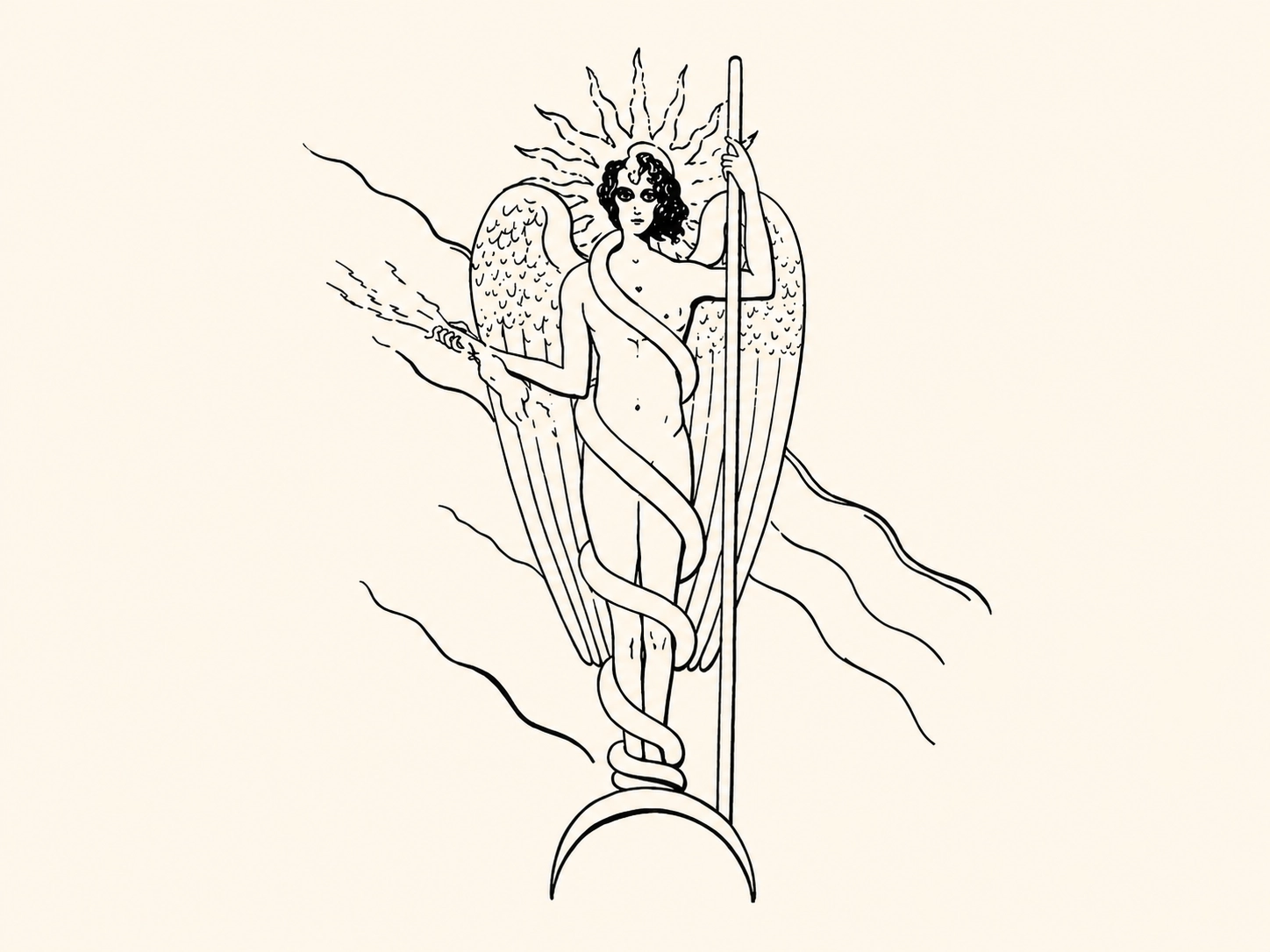
![Senza titolo [Composizione] 1918–1920 (detail)](/album/notitia/770c543285c730e0.jpg)
Senza titolo [Composizione] 1918–1920 (detail)
Julius Evola
At a particular level of spiritual development it is immediately evident that the myths of the Mystery religions are essentially an allegory of the states of consciousness which are experienced by the initiate on the path toward self-realization. The various deeds and adventures of mythical heroes are not poetical, but real events; they are the specific actions of one’s inner being and shine forth from within the one who attempts to follow the path of initiation which leads beyond the fulfillment of the merely human mode of existence. These adventures are not allegorical concepts, but experiences. The philosophico-allegorical interpretation of myths is still mere allegory and no less superficial than the naturalistic and anthropomorphic interpretation of myths. This implies that people can learn a valuable lesson from this subject only if they already know something; otherwise the “door” remains inexorably shut. This also applies to what I am going to say about the inner meaning of the Mithras myth.1
The Mithraic mysteries lead to the very heart of the magical Western tradition—a world characterized by self-affirmation, light, greatness, regal spirituality and spiritual regality. In this path there is no room for escapism; or asceticism; or mortification of the self through humility and devotion; or renunciation and contemplative abstraction. Mithras’ path is one of action, of solar power and of spirituality, which is opposed to both the dull and dreamy oriental universalism2 and to Christian sentimentalism and moralism.
It is said that only a “man” could proceed along this path; any “woman” would be consumed and broken by the “taurine strength.” The brightness of the hvareno, of the glorious and radiant Mithraic halo, arises only out of a frightful tension, and it only crowns the “eagle,” which was capable of “staring” at the Sun.
Mithras is the symbol of those who proceed along this path. In the myth he is thought to be the primordial heavenly light which manifests itself as a “god generated from a rock” (theos ek petras, or petroghenos Mithra). While standing on the bank of a river, he frees himself, escaping the obscure mineral by wielding the sword and torch which helped him while he was in the “mother’s” womb.
This is a miraculous birth, noticed only by “shepherds” hidden on the “mountaintops.”
What I have mentioned so far is a body of symbols related to what may be called the initiation phase in the strict sense of the word. The heavenly “light,” which was the light of the Word, but men could not comprehend (Jn 1:9-10), is rekindled in he who experiences his first spiritual birth. This birth occurs when one breaks away from the “god of this earth” and is able to withstand the onslaught of the waters. This light is rejected by the principle which informs ordinary people’s lives and the stuff on which their ephemeral being, their lights and certainties are based. This principle is characterized by a frenzied, shallow and confused activity; by a blind race toward the “abyss”; by a deep-seated greed which perpetuates, through the chain of rebirths, (that is, through different lives sharing the same inconsistency and transience), an hetero-centric life-style, characterized by an insatiable craving for various things.
This wild and unrestrained vital force, which first generates and then devours its own energies in a context of radical contingency,3 corresponds to the symbol of the “waters” at the edge of which Mithras is generated. An initiate is one who is “rescued from the waters” (notice the connection with the Moses legend as recounted in Exodus), and who “walks on water” (hence the esoteric meaning of Christ’s miracle). The initiate is a being who has learned how to take control of the totality of the cravings and the deficiencies which urge him internally. He has learned how to resist them, and has the power to say NO, and how to break their law and how to develop a new life without them. On the contrary, the beings of the "sub-lunar world"4 continue to experience death, annihilation, or reabsorption.
Thus, to be initiated is like leaving behind a bank of a river, on which people’s lives unfold with all their miseries and greatness. At that point one has to face the current which becomes increasingly furious until he reaches the middle of the “river”;5 then he has to move beyond this limitation and to struggle toward the opposite bank. Once the opposite bank has been attained, a new, spiritual being is born: Mithras, the Divine Child.
The “rock” which acts as the womb of Mithras, is a symbol of the body. The body is the substratum of cosmic yearning, and the element which is subjected to the “wet principle.” Thus the waters also dominate all those human states and faculties, whether “spiritual” or not, which exist in a physical substratum. In order to become initiated one has to become free from the “rock” and to achieve a state of consciousness which is no longer limited by the connection with the bodily vehicle. Likewise, the following episodes which I am going to refer to, are out-of-body experiences which take place in a special state induced by specific practices, which I am not going to describe in detail.
The expression “theos ek petras” carries yet another meaning in the magical tradition. On the one hand, the precipitation of what constitutes the “heavenly light” into the dungeon represented by the dark “earth,” is a negative and degenerative process; but, on the other hand, it also represents an opportunity for the spiritual element to become individuated and actualized. The body’s sophisticated organism witnesses the presence of a nucleus of qualified energy. Magical initiation does not consist in dissolving such a nucleus into the indistinct fluctuation of cosmic life. On the contrary, it consists in strengthening and integrating it. Thus, an initiation consists in carrying this nucleus forward, not backwards. According to initiatory thought, the spirit is not “something else,” but rather something immanent, which needs to be elevated from the pits of concrete human reality (the “rock”). This reality is divine, not by grace, but according to its own nature; hence the expression “generative rock” (the equivalent concept in the Hermetic-Alchemical tradition is that of the “material required in the Opus Magnum”) and the attribute of petrogenos (generated from the rock) which is bestowed on the Man-god, Mithras, who does not descend from Heaven, but who is derived from the Earth.
The “nakedness” of the divine child finds its complementary symbols in the notions of “being rescued from the waters”; of “being extracted from the rock”; of “throwing away the clothes” and of “being washed.” These symbols are found in many esoteric traditions. To be “naked” is the equivalent of being pure, which in this context refers to autarchy, self-sufficiency, detachment from anything and anybody.
With particular reference to the will, esoteric traditions call a will impure when it is pre-occupied and determined by various factors, such as objects, purposes, reasons, or passions. It is also called impure because a will such as this is unable to proceed by itself, to want and to assert itself, or to resolve itself in a pure form. In the West, this pure form (which the Hindu call nishakama-karma as opposed to sakama-karma, which is an action willed for the sake of the results it will yield), is symbolized by the “Virgin.” This “Virgin” tramples under her feet the “Snake” and the “Moon” (two symbols for the waters), and through a “virginal conception,” she gives birth to the divine child. The so-called autozoon, which is a self-generated life subsisting beyond the contingency, of human nature, springs from a “virginal” and purified will which is free of all bonds, consisting only of pure act. In the Mithraic ritual, mention is made of “the existence of the soul’s power in a state of uncontaminated purity”; this existence generates a new nucleus beyond the waters. This nucleus, in turn, once it develops into a new being, goes on to populate a world which is beyond the human dimension, beyond space and time.
Such a miraculous birth is perceived only by “shepherds hidden in the Mountain.” The symbol of the Mountain refers to those superior spiritual beings who command and who direct in an invisible way the great currents of the waters. The waters symbolize the historical and social forces, the traditions, the beliefs and the collective psychic system which dominate the passive beings who, living like a flock, inhabit the sublunar world. The Mountain itself is symbolic of a particular state of metaphysical consciousness, which is echoed in the “Sermons on the Mount” which are found in various traditions.
But in order to attain virility, the new being must undergo new and more difficult trials, in which he can experience either victory or catastrophe. Since Mithras is superior to the world inhabited by inferior natures, he must also achieve superiority over the world of those spiritual natures which his out-of-body condition progressively discloses to him.
The myth goes on to say that once Mithras is beyond the waters, a “furious wind invests and scourges his naked body, as he feels the presence of terrible powers arising all around him.” Without hesitation, Mithras approaches a tree, and proceeds to pluck and to eat of its fruit. From the leaves he fashions a “garment.” Now he is ready to contend with the lords of the wonderful world in which he has entered.
This refers to a series of particular states of consciousness, which are attracted to “nakedness,” or to the element of the will in its purest and most free state. The “wind” alludes to an experience which is very characteristic and yet difficult to communicate. I will try to explain it with an example. To say “I love,” or “I hate,” is to presume an imaginary property. Feelings, in their essence, are universal, cosmic realities which become actualized in various beings, in the same way fire is produced whenever the mechanisms leading up to combustion are present. One should not say: “I love,” but rather: “Love loves in me.” What is commonly called “personality,” is actually nothing more than the result of the dynamic interaction of such impersonal forces; thus “personality” lacks a true existence in itself, and it cannot attribute such forces to itself.
When this aggregate is dissolved6 by the ignis essentiae (the fire of initiation as well as the blaze of death7), something continues to exist, such as an identity of consciousness, which in the Alchemical tradition is called “golden, incorruptible grain.” The above mentioned forces, once freed from the phenomenal, particular and psychological world in which they are experienced by mankind, manifest themselves to this something in their true nature, as cosmic forces. But vis a vis these forces one is as impotent as a physical being confronted by the fury of the elements of nature, such as oceans, thunderbolts and cataclysms. In his nakedness the initiate is animated by these forces. When the “waves” created by these forces push him to the deepest dimensions of his inner being, the initiate cannot do anything but remain still and non-reacting, lest he be swept away. According to the hermetic work Tabula smaragdina, or The Emerald Tablet, these waves constitute the “wind” which carries the Thelesma, which is the principle destined to draw to itself the power of all things, whether they be of a higher or of a lower nature.
This trial, which some esoteric Christian traditions hide behind the symbol of “flagellation,” bestows on Mithras a firmness and an unbreakable nature, without which he would lose his life in the trial which follows.
This trial requires nothing short of a complete turnabout, this time in the affirmative sense of the word, opposite to what the Biblical myth refers to as original sin. The Self dares to do violence to the “Tree of Life,” to defoliate it and to eat its fruits. The Self is strong enough to snatch away from the Universal Principle a certain amount of cosmic power and to dominate it, meaning that it has the capability to stand up against the “water” and the “wind.” This is performing a radical deed, an absolute action and going beyond oneself. This action creates a vacuum, immediately filled by a force which envelops, in the form of a flame, the naked nature responsible for such a daring feat. In many traditions, this deed is referred to as the “projection of fire,” an eminently positive act which attracts a negative element; it has also been called a “feminine descent,”8 which becomes the nucleus’ garment of power. Dressed with this garment, the newly constituted nucleus acquires the means to manifest and to project itself, which is as necessary for life in the super-sensory dimension, as the physical vehicle is necessary in the sensory life.
Thus, the power which becomes precipitated is in need of a center and those who, after having evoked this power, do not know how to provide it with a center, are swept away by it. The “Fall” refers precisely to this. The “fall” consists in failing in the course of this action, or in “the Kingdom of Heaven, or Fate, suffering violence”; or in one assuming Life in its entirety; or in being overwhelmed by a terror which immediately sweeps away and destroys an individual.9 The latter is a possible catastrophic outcome. Others, on the contrary, prove to be sufficient to their own act. They can break the curse, take upon themselves the power, retain it and dominate it. Far from “falling,” they are “reborn in power,” in the “mighty strength of all strengths,” in the “incorruptible Right Hand.” Mithras is one of these people; not only does he not submit to the law, but he draws from his action the strength necessary to turn against the One who upholds the law and, in turn, to subject him to his own law.
Here the peculiar character of magical initiations is apparent. Actually, there is a tendency, in a number of schools of thought which should be regarded as mystical rather than esoteric, to dissolve the individual in an impersonal reality,10 whether it is described as the undifferentiated infinite (e.g., the nirguna-brahman of the Vedantic tradition) or as a transcendent order or harmony. To dissolve the Self’s nucleus in this impersonal reality, “as a grain of salt is dissolved in an ocean of water,” is the declared goal of these schools of thought, which view any notion of affirmation, struggle and spiritual subordination as utterly meaningless. Conversely, the Magical Tradition understands the spiritual world in very different terms, inasmuch as it firmly upholds the notion of individual, or that of an affirmative center existing beyond any “dissolution,” although in other terms than merely physical and personal ones. The Magical Tradition does not view the spiritual world as characterized by an idyllic order or by an undifferentiated universality, but rather as an ensemble of unrestrained, abyssal forces existing in a state which is free, terrible and blissful at the same time. These forces are thought to be caught in an interplay of tensions, compared to which, anything which human beings call “struggle” is only a pale and cadaverous reflex. Each one of these entities continues to exist and to retain its individuality in the same proportion in which it has the ability to withstand and resist other entities which, in turn, are trying to attract and to assimilate it. This is a world existing in a free state, not governed by any providential plan, nor subject to any teleological and aprioristic ordering law to which the various forces are simply supposed to conform. The only real a priori are these very forces. All the laws and systems are nothing more than the by-products of the organization of these forces, and nothing more than the signs of a wider power which has succeeded in sweeping away, assuming and unifying other powers underneath it, thus decreasing the primordial chaos of the various struggling forces.
In this context, the struggle is very different from the struggle which usually takes place in the material world. Destructive violence, hatred, will power, strength in the physical sense of the word, are not found in this world. What takes place is more a confrontation of “presences,” an encounter between different degrees of being and between diverse quantities of spiritual intensity. No power wants, strictly speaking, to overcome and to dominate others. However, this takes place naturally, as a consequence of a higher degree of being. This higher degree of being acts upon lower powers as a deep vortex, which swallows and dominates them whenever they come in contact with it. In this context, in order to come out victorious, namely to retain one’s autonomy, the secret is to endure. Any force which invests a being without succeeding in sweeping it away, is in turn swept away and subjugated by that being. There is no gap, no safe area in this world of tensions where not to subordinate means to become subordinated.
Hence the saying, which is a law to those who are called masters: “Do not reveal yourself to others.” This concept gave J. G. Frazer the subject matter for his main work, about the priest of the mysteries (the “King of the Woods”) and his dignity, which was confirmed only by triumphing over a challenger. Hence, the strange saying according to which a student who succeeds, kills his teacher; and, finally, hence the puzzling Eastern notion according to which the “gods” are enemies of the yogin. In the “lunar” path, or the path of Isis, what matters is to turn oneself into an obedient instrument of higher entities. In the magic, “solar” path, or path of Ammon, the most important action is to retain one’s being vis a vis these entities; this, however, is not possible other than by overcoming them. One must wrestle away from them the “quantity” of fate which they carry, in order to take upon oneself their weight and responsibility.
When Mithras reaches this point, “doors” are thrown open and around him shines the light of “those who are”—terrible powers who stare at the newcomer. Beyond them all is the Sun, the flaming Æon. In this terrible instant, which creates a barren silence, the desert, the terror of great catastrophes and of great sacrileges, Mithras endures and stares at the great god. He ceases his prayers and commands. And lo, the god yields and asks Mithras to confer the initiation on him and to sign a pact of mutual respect and friendship.
This climax marks the end of the first great phase of initiation: a being has come into existence, stronger than nature, stronger than the gods—a being who is beyond birth and death.
I have previously mentioned that the experiences Mithras underwent correspond to a series of spiritual realizations taking place immediately and directly outside the body. In the case of the initiate, this is supposed to happen through the induction of particular states of consciousness. He who induces these states is a qualified person (the hierophant, in the Mysteries); these states constitute both a problem and a trial which the initiate must resolve through a determinate act of his spiritual being. But in the Mithraic mysteries, there is a further realization, which corresponds to the myth of the “slaying of the bull.”
The task consists in this: to reaffirm the solar and royal apex, which is realized outside the physical realm, in the body itself, in the dark “rock” which had been left behind during this entire phase. Mithras now has to grapple with and eventually subjugate the wild and untamed power of life, symbolized by the “bull.” This deed involves disciplines which affect the body itself, and which tend to alter in a radical way the relationship which the body has with the Self. This is not the place to discuss the methods employed for this purpose; it suffices to say that these methods range from the exclusive assumption of the “fire” of mental concentration, to the adequate employment of psychic traumas such as those encountered in suffering or during sexual excitement. The Hindu schools focus mainly on disciplines which are related to breathing. Since the ritual described by Dieterich shows how they are also employed in Mithraic theurgy, I will briefly mention them. A word of caution is due, since these practices are either useless or extremely dangerous to those who have not yet made the experiences I have described so far.
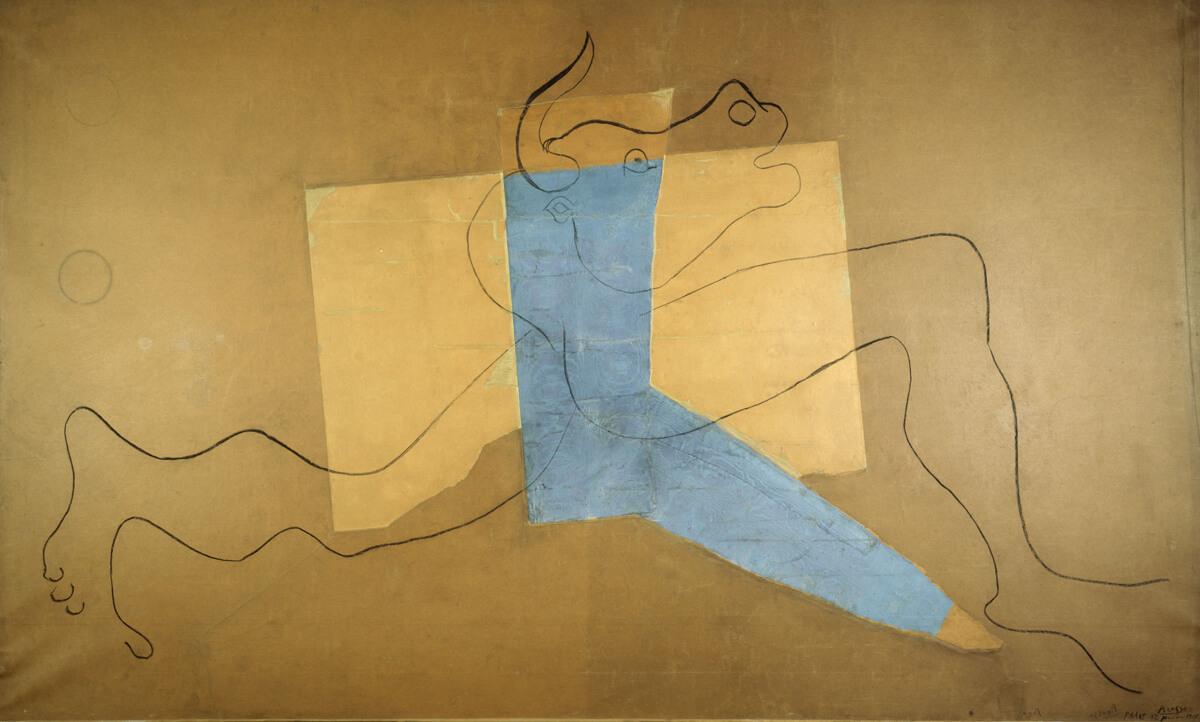
Mithras grasps the “bull,” holding onto his horns. He jumps on its back and rides it. The beast breaks into a gallop and takes its rider for a wild and dangerous ride. Mithras holds firm, and lets himself “be carried,” hanging from the horns. The bull soon becomes exhausted and returns to the “cave” whence it came out. Mithras holds him “still,” and then finishes the beast off with a dagger, in the name of the Sun.
I have already mentioned that the “bull” symbolizes the elementary life-force. It is to be identified with the Green Dragonof Alchemy, with tantric kundalini or with the Taoist “Dragon.” The disciplines which focus on breathing call this force prana—a breathing considered in its “luminous” and “subtle” dimension. Prana is related to material breathing as the soul is to the body. This life-force is naturally evasive and resists coercion; it is the restless “mercury,” the “volatile,” the “bird” (the hamsah bird of the Hindu tradition, ham and sah being respectively the sound of inhaling and exhaling), which the initiate has to “ride” and to “immobilize.” The practice consists in focused breathing and in becoming lost in it; then, boldly, in letting go, in sinking. This is what the expression “the Dragon flies away” is supposed to mean.
According to the initiatory disciplines found in Hinduism, breath has four dimensions: a material dimension (sthula), related to the state of wakefulness and to the cerebral-psychological faculties; a subtle, luminous dimension (sukshma), related to the dream state and to the nervous system; a causative, igneous dimension (karana), related to the state of deep sleep and to the blood system; and finally a dimension which the Hindu texts call turiya (the fourth), which is related to the special state observed in catalepsy: a state of apparent death, related to the skeleton and the reproductive function.
Mithras, who after taking hold of the bull “lets himself be carried” in a wild ride without ever letting go, symbolizes the Self which, as it sinks, goes through these four stages and through the neutral areas separating them. By contrast, ordinary people simply lose consciousness and fall asleep at the very first stage. The bull gives up only when Mithras shows enough boldness and a subtle enduring strength, or until the process of “sinking” reaches the fourth stage.11 At this point, the basic mechanisms of the primitive life-force are seized and brought to a halt; the mercury is fixed and congealed; the “bull” is slain.
The life-force, finally deprived of all support, is suspended, broken, burnt to the roots.
Once this climactic point is reached a miraculous transformation occurs. A blazing, whirling, divine life arises from the deep, quick as lightning. This new life-force permeates the whole body with a gleaming which transfigures it. It re-creates the body ab imo, as an entity of pure activity, as a glorious body of immortal splendor; this is the “radiating body,” the augoeides, the Hvareno, the vajra, the Dorje. These are all different names recurring in various Eastern and Western traditions, describing the same force. This new life-force, which has the nature of diamond and of irresistible thunderbolt, transforms the mortal and deprived condition into one of immortality.
What oozes from the bull’s wound is not blood, but wheat, the Bread of Life, as a perennial source created by the surrounding desert and as the miracle of a new kind of vegetation. However one obstacle still needs to be overcome: swarms of impure animals crowd around the dying bull to drink its blood and to bite its genitals, thus poisoning the source of life. This is the last episode in this saga; the meaning of this is that the prodigious and superhuman power, called kundalini in Hindu tradition, is awakened once the bull is slain. This power immediately floods all the principles and the functions which support the physical being. If during this process all these elements have not been purified, organized and unified, they become unleashed, absorbing and transforming to their advantage the higher power which was supposed to transform them into a spiritual body. What ensues, therefore, is a terrible setback, an emanation, a gushing forward of those forces which belong to the animal and emotive nature, and which are now extraordinarily excited. This phenomenon has been variously called the “clouding of the sky,” “the storm,” or the “deluge.”
In the alchemical and Taoist traditions, this “storm” is said to occur after somebody has drunk the “Virgin’s milk,” which is the “Dragon’s blood.” In the myth of Mithras this phenomenon corresponds to the swarming of the impure animals.
It is unlikely that this experience could be entirely avoided, since it is the very last trial. But lo, after it has taken place, the sky opens up and the miracle continues. The last obscure obstacles are swept away by the rising flood of light and sound, illuminating what is latent, obscure, buried, contracted in the form of bodily organs, in gestures, in a powerful and cosmic enlightenment. This constitutes the ascent of the man-god to the heavenly spheres, to the hierarchy of the “seven planets.” Here the external dimension of things fades away, becomes inwardly bright, and then burns up. Everything becomes alive, awakens and is reborn from within; everything becomes symbolic, meaningful, radiant—the spirit of an unlimited and eternal body.
Beyond the seventh sphere lies the ULTIMATE, where there no longer is a “here” or a “there,” but calmness, enlightenment and solitude as an infinite ocean. It is the dimension of the “Father,” beyond which lies the dimension of the “Eagle,” the apex, the substratum of the flaming, whirling world of powers.
This is the path and the challenge open to man, according to Mithraic wisdom, which competed with Christianity to inherit the legacy of the Roman empire. Once it was pushed back and relegated to the external, exoteric plane, the efficiency of the mystery wisdom was preserved in the occult tradition, but it continued to operate on Western historical events, exercising a subtle, invisible influence. Today, once again, it surfaces again beyond that world which science has “liberated” and which philosophy has “internalized.” It re-emerges in attempts still very confused; in beings who have been broken under the weight of a truth too heavy for them, which however others will know how to take up and to affirm. It re-emerges in Nietzsche, in Weininger, in Braun, in the most radical trajectories of the most recent Idealism. It re-emerges in myself, in my yearning for the infinite, in the only value that I cherish: a regal and solar life, a life of light, freedom and power.
References
- I have made a rigorous use of F. Cumont's Mysteries of Mithras and Texts and Bas-Reliefs Relative to Mithras' Mysteries, as far as the Mithras myth is concerned. When dealing with Mithraic ritual, I have relied upon A. Dieterich's A Mithraic Liturgy (Leipzig, 1903) and G.R.S. Mead's A Mithraic Ritual (London: TPS 1907 & Holmes Publishing Group, 1994.). ↑
- See J. Evola, L'arco e la clava (the chapter: “Il mito di Oriente e Occidente”). ↑
- In the East this vital force goes by the name of tana (Buddhism); samsara (Hinduism); maya-shakti (Tantra). In the West it is known as Jaldabaot, taking the name of the “lunar” or “serpentine” principle, the “earthly Venus,” the “astral Soul,” or the “sidereal Light.” ↑
- A symbolic expression designating those beings who are still under the “water,” and are dominated by it. ↑
- All this corresponds to the preparation phase, which, by and large, is left up to the initiative of the person to be initiated. ↑
- This is the phase which in Alchemy is called putrefaction, calcination, and mortification. In this phase the “rock” is dissolved. ↑
- It has been rightly observed that initiation is nothing other than the active assumption of that process which produces the death of ordinary people. Initiation is the power to induce death, to go through it, in order to re-assert oneself beyond it. Apuleius said that: “Initiation used to be celebrated as a voluntary death.” (Metamorphosis, II, 21). ↑
- It must be noted that in various initiatory traditions, power, in the strict sense of the word (shakti in Hinduism), is conceived of as instrumental passivity, namely as the negative and the feminine element. In relation to the latter, the positive and the masculine element acts as an “unmoved mover,” or as one who commands without issuing orders, in virtue of an immaterial initiative and of spiritual determination. ↑
- Concerning the development of the myth of the fall in relationship to Dyonisius, see J. Evola, L'uomo e il divenire del mondo (Roma, 1926). ↑
- I have discussed this topic in my books: La maschera e il volto dello spiritualismo contemporaneo (at the beginning of the chapter: “Il neo-misticismo.”); in The Doctrine of the Awakening (the chapter called: “Determination of the Vocations,” when denying any relationship between pantheism and Buddha's doctrine); and finally in L'arco e la clava (in the chapter “Il mito di Oriente e Occidente.”). Concerning the achievement of the supreme and unconditioned state in the Vedantic doctrine, see R. Guenon, Man and His Becoming in the Doctrine of Vedanta. ↑
- The cave in which the “bull” seeks refuge at the end of its run, corresponds to the alchemical “cave of mercury,” which is often associated with the subtle center of the body located at the base of the spine, which the Hindu call muladhara; the Hindus relate it to the tattva of the earth. ↑