THE LANCES OF DAWN
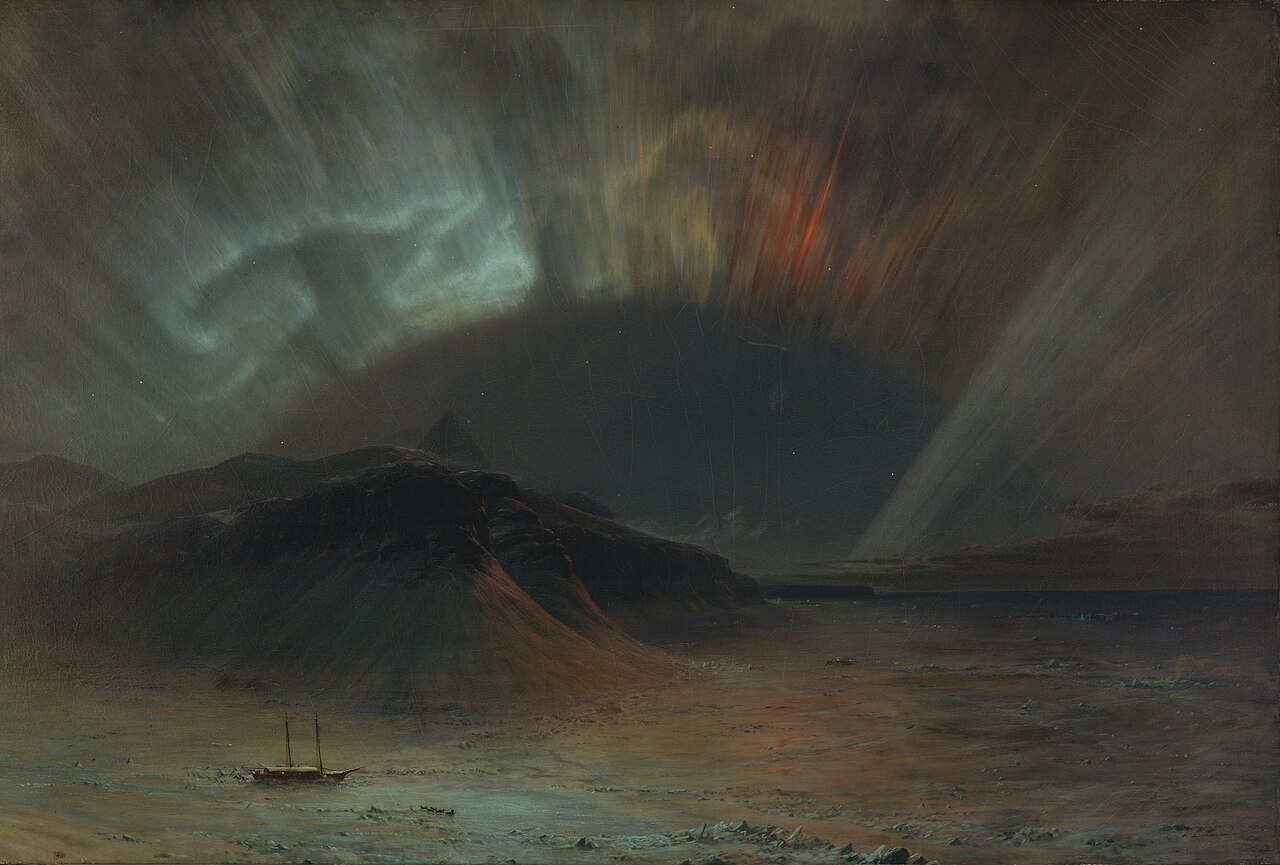
Aurora Borealis by Frederic Edwin Church (1865).
Public domain
Notes on the Earlier Gods and the Secret Realms of Time
‘The tradition of the Mysteries, defeated on the most outward plane, withdrew into a subtler sphere, passing from flame to flame, from initiate to initiate, through an unbroken though secret chain.’
Julius Evola
The shimmering shores: the disappearance and appearance of the Gods
For a long time — and it is not entirely certain that we have abandoned the habit — an interest in the ancient world was associated with a ‘republican’ commitment of which our modern societies were supposedly the heirs. The devotee of the ancient Gods thus found himself, rather paradoxically, on the side of modernity, secular ideology and even a form of progressivism. Yet one could scarcely imagine a mode of thought more foreign to the Ancients than progressivism. Their entire thought was oriented, on the contrary, by the recognition of degradation, decline and a gradual distancing from the Golden Age. How did this pessimistic thought give rise to the boldest creations in philosophy and to the greatest artistic plenitude? This is a decisive question, and one that it is all the more important to answer because we see that ‘optimistic’ belief, by contrast, plunges us into spinelessness and formlessness. If we make of our fidelity to the philosophy of the Earlier Gods an ardent prayer, it goes without saying that we shall become increasingly alien to this modern world, which worships Technology and the Commodity and moreover claims to represent the ultimate culmination of Ethics!
For an intelligence attuned to the Presocratics, the world of Romanesque symbolism will certainly remain infinitely closer than the ‘society of the spectacle’ belonging to the world of slaves without masters. Faithful to the logic of the included middle, we shall not enter into those polemics that turn Paganism into a kind of anti-Christianity scarcely less crude than the anti-paganism of the early Christians, as described by Celsus and the Emperor Julian. If the struggle of the Poet against the Cleric is of some importance in our eyes, how could we fail to enlist the powerful poetic and metaphysical vision of Meister Eckhart and Johannes Tauler against the modern clerical establishments of ‘single thought’? Increasingly vulgar, utilitarian and enamoured of mediocrity, the dominant ideology has never ceased to destroy the divine splendour dear to the Archaiothrèskoi, the faithful of the ancient Gods, even when it appears, from time to time, to claim them as its own. Yet this distancing is only quantitative. The quality of being, and the vision proper to it, remain subtly present. The world of the ancient Gods is not dead, for it was never born. That this luminous permanence has for the time being become inaccessible to most of us in no way alters its meaning or the possibility it ceaselessly offers. Eternal, the divine forces and virtues interweave within the fabric of the world and leave us the choice between remaining mere spectators chained within a schematic representation of the world, or entering into the real presence of beings and things through the recognition of the Soul of the World. Separated from everything, enclosed within a ‘psyche’ that he believes to be the ‘other’ of the world, modern man enslaves himself to the narcissistic representation he forms of himself.
For modern man, the Gods, Ideas and Forms originate in his mind, but he does not see far enough to understand that this mind itself originates elsewhere than within himself. This inability to imagine beyond the narrow circle of his own contingency is what the Platonists called ‘being prisoners of the shadows in the Cave’. Modern man idolises his own contingency and makes it the measure of all things, reversing the Greek principle which teaches that man must rediscover the measure of all things. To believe that the Gods are purely ‘inward’ leads to an idolatry of inwardness that is doubtless the cause of the most conspicuous external disasters of the modern world. Did not the murderous utopias of the twentieth century, the homogenising and planning fanaticism of the various fundamentalisms that arose, originate in this unbridled subjectivism, which seeks to make man’s ‘inwardness’ and his immeasurable claim to ‘be moral’ the measure of the world? For ancient man, the Gods are within us because they are reflected within us. Our understanding receives the external forces to which it will fall, by virtue of a principle of poetic creation, to give Forms; and these Forms, in turn, will pay homage to the Gods whom they name and enclose for other ages.
This vision of the world is humble and generous, attentive and giving. Far from thinking of man as the Other, or as standing opposite the Other, it recognises within the self the same reality beneath the forms of divine appearance. The God is the one who appears. Now the man who goes forth to meet the divine world and knows neither birth nor death appears before eternity, and the God who appears to him is, in the admirable phrase of Angelus Silesius, ‘a flash within a flash’; for it is in the briefest and most intense radiance that eternity is given to us. Apollo’s lightning manifestation endures for ever in the instant of appearance that reveals us to ourselves, in the pure presence of being.
Beings of light, the Gods; not beings of shadow, beings of presence and not of representation. Appearance is the act of sovereign apprehension in which vision frees itself from representation in order to reconquer presence. Such is the promise, the only promise, made to us by the Earlier Gods. They promise us only that we shall be present to the world, for the moment we are present to the world, we hear their voices. To be present to the world, is this not already, to a large extent, to be freed of the burden of oneself? Is it not to become infinite to oneself? What am I that is not in the image of the vast configurations of the world’s forces named by the Gods?
To believe in the Gods is to believe that the inner world and the outer world are one. The luminous Apollonian force manifests itself both in the physical sun, which brings nature into bloom, and in the metaphysical sun, the Logos, which brings Intelligence into bloom. The genius of ancient wisdom lay in giving the same name to these inward and outward, visible and invisible forces, for from their separation is born the estrangement that reduces us to interchangeable units, that is, leaves us at the mercy of the homogenisers under the guise of individualism. How are we to overcome the erosion of time, the progressive transformation of life into an object, the reification peculiar to commercial society, without recourse to older demands and older forms of beauty? The diversity, freedom and complexity of the ancient wisdoms, and the pre-eminence accorded to Poets, Bards, Singers and Aoidoi — who create the truth they proclaim, unlike the cleric who administers a truth already formulated once and for all — remain a permanent injunction not to submit. The modern world appears triumphant in its vast schemes of planning, but it is well known that there are triumphs from which one perishes.
The determinism in which moderns take pride when asserting the inevitability of their so-called ‘civilisations’ is probably no more than a particularly inept construction of the mind, one that a little pragmatism is enough to correct. Where the modern sees a necessary chain of events — what he calls ‘progress’ or ‘evolution’ — a free spirit will see only an a posteriori interpretation. The sequence of events leading to a disaster or a fortunate circumstance, according to the interpretation placed upon it, appears as a sequence precisely only after the event. This sequence, which nineteenth-century science calls determinism, appears to an intelligence set free and endowed with some imagination as a delusion.
Within the vast human and divine polyphony, things might have occurred otherwise, and indeed they never cease to occur otherwise, in ways that the crude schemata of the human sciences cannot foresee, for the configurations they obey involve not only line and plane, but also heights and depths entirely unknown to the deterministic sciences of the moderns.
The dancing earth
Apollo and Dionysus, for example, manifest themselves according to logics wholly different from those of planning and linearity. Apollo flashes forth from the Heights and unfolds in the inward sunlight of Forms brought to perfect equilibrium. Dionysus, for his part, in the words of Euripides, makes the earth dance. ‘When Dionysus leads, the earth will dance,’ sings the chorus of The Bacchae. The phrase deserves contemplation. Such contemplation is a gathering into lightness. The Dionysian earth is no longer the heavy, immobile earth of those who are ‘down to earth’; it is the vibrant earth, the mysterious earth, the earth won over by the aerial symbol of excellence: dance, victory over gravity.
In profane time and in the profane world, gravity is what binds us to the earth and closes to us the realm of heaven, the abodes of the Gods. In sacred space and sacred time, beneath the sign of Dionysus, the telluric forces themselves deliver us from gravity: the earth dances. Our dance upon this earth, won over by the carrying powers of the sacred, is the dance of the earth itself; intoxication brings us into harmony with the world.
This harmony, of course, does not preclude later disharmonies. The accord with the world aroused by intoxication is not a final blessedness, nor is it an unlimited approval. The dark face of the Dionysian myth, like that of the Orphic myth, shows that such accord is the achievement of a surpassing of the ordinary human condition, with all the boldness, dangers and also enchantments implied by such a surpassing. The dangerous part of intoxication is dangerous not only to individualism; it is also dangerous to the social order whenever that order fails to grant it its rightful place.
The genius of the Greeks lay in giving the mysterious and disturbing Dionysus a central place in mythology. Whereas modern fundamentalisms appear above all to be human expressions of fear before the Dionysian forces of soul and body, the ancient mythologies knew how to reserve a royal share for pure expenditure and festive exuberance. In Greek mythology, Dionysus is often called, like Zeus, ‘the master of the Gods’. This is because the infinite prodigality of intoxication reflects the inexhaustible richness of the world of the Gods. Such prodigality will always be the enemy of planners, puritans and fundamentalists, for it subverts the administration and management of goods and persons.
Against the values of utility and hoarding, it sets the Gift restored to its native innocence. Yet the subversion goes further still, for when Dionysus leads, identities themselves are overturned. What, in profane temporality, ordinarily confines us within a space-time that defines our identity is here brought back into play under the influence of the forces of becoming. In bourgeois ages, which are in reality decadent, human beings who no longer know how to conquer new virtues become increasingly attached to their identity; yet this attachment is deadly, for identity is only a dead husk, and only Tradition matters, irrigating, traversing and overturning appearances like a violent river.
During the Dionysia, profane identities are put to the test, and a force of renewal seizes being, frees it from its dead husks and once again exposes it to adventure. For men enamoured of their status, for men imbued with their bourgeois and modern certainties, the Dionysia are the worst of threats. For the poet, by contrast, or even for the man who wishes to make his life an homage to the Beautiful and the True, the Dionysia are not a threat but a promise, for the certainties they destroy in their onrush, and the identities whose groundlessness they reveal, are merely delusions that obstruct the experience of the truth of being.
The radiance of being, of which the Gods are the messengers in this world, is ceaselessly veiled, under the profane conditions of existence, and covered over with dross in the form of mental habits. It is by freeing us from these mental habits through the contribution of the giving vigour of intoxication that we recover a vision of reality that is no longer instrumental but ontological.
Intoxication reveals the world to us no longer as we use or plan it, but as it is in the hurricane of being revealing itself to itself. Leaving behind the illusory self-evidence of identity, we find ourselves at the centre of a play of dancing forces that bear witness to the being we had failed to recognise.
Intoxication, when Dionysus himself leads the dance rather than one of his simulacra, is knowledge. The world past which we ordinarily pass, as though before a spectacle that does not concern us, imposes itself upon us, resounds within us, exalts and frightens us by turns. The man seized by intoxication, or rather by an intoxication — for there are as many intoxications as there are colours and even shades in the rainbow — is inclined to see mysteries in things. Trees become arcana. Skies and seas offer themselves to him as haunting questions. Forests murmur with presences, and cities themselves become Brocéliandes. Above all, however, words acquire a new power and resonance.
The Dionysian dithyramb celebrates man’s reunion with the sources of speech. For the source of speech lies not in the use of reality but in its celebration. These words which, in profane language, are themselves dead husks, vain identities, are restored by Dionysian power to their invocatory magic.
Where the world is restored to the presence of being, the word resounds infinitely within the human soul. The word is not foreign to the reality it names; it is the magical site of the encounter between man and the world. Dionysian intoxication clears the stones from the spring of speech. In every age, verbal genius has been bound up with intoxication. The poverty of speech, the miserliness of expression — which certain modern critics praise under the name of ‘economy of means’ — what else is it but a tightening of the mind around the obvious, a refusal to be won over by the vast exactitudes of intoxication?
Fine eloquence is the work of consent to intoxication, of the sovereign harmony of soul and body. For speech, when it becomes rhythm and music and carries thought with it into new adventures, is born of the accord between soul and body. When soul and body fall out of tune, speech freezes and withers.
The laughter of the Gods and the Science of the Soul
The culture of resentment, anti-Dionysian par excellence, recoils from these magnificent proofs of the concord between height and depth. It wants speech to become ‘writing’ and to be ‘minimalist’, that is, as little intoxicated as possible, as though intoxication, which overturns identities, were Evil itself. The works of André Suarès, Saint-John Perse and John Cowper Powys are magnificent challenges to this culture of resentment, whose only irrefutable ‘values’ are pettiness and calculation. The ‘laughter of the Gods’ of which Nietzsche speaks is intended precisely to alarm the ‘right-thinking’, to reveal the fundamental comedy of ‘values’ and their futility in the face of the Principles and the power composing the polyphony of the world.
Modern man, subject to the principle of identity, is fundamentally attached to ‘values’, whereas the Archaiothrèskos remains faithful to the Principles, which, within the headlong gesture of ecstasy, become principles of metamorphosis. Protean intoxication invents forms, whereas bourgeois and modern identity merely reproduces them. Intoxication changes and transfigures, whereas the profane principle of identity confines itself to quantitative duplication. Intoxication creates qualities. It inaugurates the age of the qualitative, endlessly postponed yet endlessly on the verge of arriving. Every perception of a quality is the prelude to intoxication. Quality belongs to the order of the indisputable. He who does not perceive it cannot speak of it. Once perceived, quality gives rise to infinite interpretation. The hermeneutics of quality is limitless, whereas quantity, however considerable, is defined from the outset by its limit. Quantity is limited; quality is infinite. Dionysian intoxication is a principle of poetry because it opens onto the qualitative harmonics of the world: breath then accords with idea, and the poem is born from that nothing which is the thing itself restored to the sovereignty of being. The Orphic or Dionysian Mysteries have no other meaning. The moment of mystery is the moment when being appears beneath the forms of reality. It is mystery because the site from which the song unfolds is that of irreducible being, which no logical or grammatical explanation can seize. This Mystery is not the mystery of ‘other worlds’, nor does it belong to the kind of occultism favoured by the moderns. It is the Mystery of the thing restored to its own silence.
Yet we can speak things only if we receive within ourselves, as a promise, the silence from which they emanate. For a long time, the human sciences pretended to believe that the Gods were merely clumsy explanations of natural phenomena, explanations that could now be dispensed with. The God, in reality, is elsewhere: he does not explain, he names, and he names with such precision that we have not yet found anything better than the names of the Gods and the accounts of their adventures to describe the vicissitudes of soul and world. To say that belief in the Gods died with Christianity is to hold a very impoverished idea of that belief, and indeed of belief in general. Exuberance, prodigality and intoxication do not die by decree, even one clothed in theological pretension. The ‘Paganism’ of nineteenth-century writers was far less ornamental than doctrinal considerations have led us to suppose. Through his taste for prosodic plenitude, for vast and profound spaces, and for august symbols, Leconte de Lisle naturally recovers part of the ancient genius; and fidelity to the Earlier Gods, far from being an artificial construction, reconnects with a tradition that was never truly interrupted. The remoteness of the ancient wisdoms, and their supposed incomprehensibility to us ‘moderns’, increasingly appear as wishful thinking, ardently contradicted by most modern works of art, literature and poetry.
The Virgilian Gods tremble through Giono’s Provence with an immediacy that Christian morality, however praiseworthy it may be in certain respects, cannot take from them. He who wishes to know being as a presence rather than as a concept sees the Gods appear, naming and recounting those aspects and forces of the real world that escape every possible use.
Once freed from the progressive arrogance that relegates the Gods to the status of superstition, we can recognise the hermeneutic relevance of mythical narrative, its aptitude for saying what happens in this world in obedience to laws that we do not fully understand. The Gods describe a knowledge and at the same time express the limits of knowledge. The Gods, certainly, govern, but man accepts the limits of his science by saying that he does not know exactly how the Gods govern. One could scarcely expect a more balanced judgement from a present-day physicist. The God does not state the cause of a mechanism; he names the mechanism and everything in its antecedents or consequences that reveals nothing measurable.
If we agree to reconsider this divine terminology from the perspective of our own hermeneutic concerns, we shall encounter fortunate surprises. Who has not observed that the weakness of many modern systems of interpretation lay first of all in the division between inside and outside, object and subject? In modern epistemology, the science of the inner world and the science of the outer world appear separated by impassable barriers. Yet everyone knows that the inner world conditions our knowledge of the outer world, and vice versa. Nevertheless, the sciences of the Soul and the sciences of physis too often develop separately and display an immense indifference towards one another.
The genius of Paganism and of mythological narratives lay in formulating knowledge of the world in a terminology that simultaneously concerned the world of physis and the world of the Soul. Far from lying beyond science, this search for a coincidence between inner and outer now appears attuned to contemporary research. Why should that which orders the world and that which orders the mind be confined within radically separate categories? Is not this dualistic obstinacy the cause of our present disarray? Is not the triumph of external technology, together with the complete absence of self-mastery and inward discipline among our contemporaries, proof of the inefficacy of this dualistic thought? The ancient God speaks to us because he speaks from a site that knows no separation between outside and inside.
In Hindu, Greek and Celtic mythologies, inner and outer principles are not judged to be different in nature. They are different in degree, not in nature. Elsewhere we have discussed the very common error of interpretation that sees in Plato’s work a ‘radical separation’ between the Idea and the sensible world, where Plato speaks instead of an ‘infinite gradation’. Likewise, the Gods are not radically separated from the world; they are themselves infinite gradation, messengers and principles of infinite variation, linked to other principles according to the law of analogy that governs the world and teaches us that, within the presence of being, nothing is created and nothing is lost. The Gods bear witness to the eternity of our souls and our thoughts, just as they bear witness to the eternity of the world.
An illuminated temporality
Master of intoxications, Dionysus invites us to experience time freed from all linear servitude. Dionysian intoxication is the first and most immediate approach to altered time. Through intoxication, temporality becomes shimmering, complex and variable according to metaphorical and poetic data over which imagination becomes the sovereign mistress. The acceleration and intensification of ideas, the ardour of feelings and imagination, in a word, the multiplying powers of intoxication, subvert the illusion of mechanical and quantifiable time. When Dionysus leads the dance, the soul leaps from quality to quality, from intensity to intensity, so that time becomes like a space resonant with echoes and shimmering with appearances, each less predictable than the last. The entire universe then becomes the theatre of this dithyrambic festival. Filled with intersigns, sudden manifestations and illuminations in the Rimbaldian sense, Dionysian temporality is an illuminated temporality.
Yet the luminous Apollonian construction is no less freed from linear time than Dionysian ardour; in certain respects it is even more so, for Dionysus still struggles with linear time as with an enemy, whereas Apollo dominates every temporality through his sculptural self-evidence. The most common interpretative error seeks to take advantage of the timelessness of the Gods in order to conclude that they do not exist, because, according to profane historiography, only things and creatures subject to time truly exist. Certainly, everything that falls beneath our gaze appears subject to time, but is it not because we ourselves are subject to time that we believe we see the mark of this subjection in things themselves? Do we not arbitrarily infer the nature of things from our knowledge of our own infirmities? We pass through appearances towards a more or less certain extinction, and from this conclude that all things are fleeting. Is this not to leap directly from the a priori to the conclusion and fail the elementary demands of philosophical exactitude? Drunk with love, glory and beauty, we declare our love, glory and beauty eternal, because this intoxication, by projecting us temporarily beyond ourselves, allows us to glimpse the nature of the world as it is in itself: eternal!
By delivering us from our all-too-human affairs, our petty preoccupations and the conditions that bind us, intoxication at last leaves us face to face with the real world, which we no longer feel obliged to subject to the circumstances that witness our limitations and defeats. The ancient Neoplatonic and Orphic theurgies prescribed departure from oneself through ecstasy in order to attain vision, for only when temporarily freed from the limiting conditions of human nature can we see that which by nature lies beyond those conditions. Visionary ecstasy was thus long regarded as an instrument of knowledge.
To know through ecstasy, to see through ecstasy, far from drawing man back towards subjectivity or inwardness, was then a means of seeing the world beyond the ordinary limits of human understanding. That this vision was ‘abnormal’, outside profane norms and the mental habits acquired through ordinary activities, is far from invalidating its relevance. The measure of man becomes the measure of the world, of the Cosmos, only if man agrees to attempt the adventure, the Odyssey of thought and of the Soul. In this respect, the epic demand is no different from the philosophical demand. Empedocles joins Homer in celebrating aretē, the fundamental virtue, that excellence which frees man from commonplace submission to phenomena, appearances and determinism. Heroic ethics is an ethics of disengagement that may go so far as to appear nonchalant. Vision will be all the more accurate and all the richer in instruction the more unusual it is, the more freed from the ordinary conditions of existence. Through instruments that explore the infinitely large and the infinitely small, and through bold mathematical hypotheses, modern chemists and physicists use methods that invite the gaze to see reality in a light radically different from that in which it presents itself in everyday life.
What physics has taught us about the nature of Time since Newton contradicts our experience of it in the succession of our labours and our days. The Theurgist of the Platonic or Orphic Mysteries acted no differently in making visionary experience, which breaks with the logic of profane perception, a source of knowledge. Only the unusual point of view can inform us about the nature of the usual. The supra-temporality of the divine world revealed in the Theurgist’s vision frees us from the prison of subjectivity, which sees in everything only its own insignificant and perishable image. In mass civilisations subject to the law of the greatest number and the reign of Quantity, it is customary to explain the higher by the lower. Thus disinterestedness and human conduct partaking in the virtue of giving are subjected to the suspicion of the lower, which seeks interested motives where festive and prodigal genius freely operates. Likewise, divine inspiration, visionary ecstasy and the higher operations of the understanding to which theurgy summons us are reduced by criticism to ‘subjectivity’ or made answerable to a more or less naturalistic psychology. The misunderstanding, in this respect, is fatal, for nothing can compensate for a lack of imagination. In a more recent and restricted order, the literary work and its Author, whenever they do not benefit from the fruits of their labour in hard cash, are invariably accused of vanity, because it is becoming increasingly difficult for most people to imagine an activity devoted solely to vision. The modern’s inability to see beyond the narrow circle of his most immediate interests deprives him from the outset of any competence to judge poetry and metaphysics. This is less a question of culture than of inward orientation. The world struck by Dionysian intoxication gives way to subtler constructions in which the multiplicity of states of consciousness unveils the multiplicity of states of being. The late Greek cults and Hermetic philosophies, far from being merely decadent elements of a civilisation destined to yield to Christianity, appear extraordinarily rich to anyone who approaches them with a certain deference. The Orphic Hymns, for which Jacques Lacarrière has recently provided a new and musical translation, bear witness to an ancient fervour and carry within them the testimony of the most distant Greek meditations.
Likewise, the Emperor Julian’s Hymn to King Helios, Iamblichus’s On the Mysteries of Egypt and the Pythagorean fragments, far from bearing witness to a corruption of the ancient wisdoms, reveal certain aspects of them that had probably remained concealed until then, the discipline of the arcane being exceptionally lifted in these periods sensed to be final. The haste with which these last testimonies of a paganism not yet confronted with prohibition and persecution are relegated to obscurity is, at the very least, suspiciously partisan.
If these testimonies of paganism in the ancient world are merely fancies or mediocre compilations, then Christianity indeed proves its necessity, and its inevitable advent is guided by Providence. If, on the other hand, the last free forms of paganism are variegated with meaning and beauty, if we can hear that meaning and beauty and allow them to shimmer within us, then nothing has been decided. The traditional perspective, embraced by some of the most eminent Catholic authors, inclines us to believe that Wisdom cannot be dated, that ‘it is born with the days’, in Joseph de Maistre’s phrase, and that the most ancient religious forms are also the most luminous ambassadors of the golden light of the origins. These conceptions, hostile to every form of religious exclusivity, were shared by those faithful to the Earlier Gods. If the centre of time is the origin of the world, then all our formulations are points upon the circumference, an horizon of eternity altered by nothing and fundamentally threatened by no obsolescence.
Sacred texts and the golden spark of secrecy
The genius of late Paganism lay in transposing the vast certainties of the Gods into the order of secrecy, with a view to their transmission from master to disciple, so as to ensure their survival through the approaching times of distress and deprivation. Orphism and Pythagoreanism are not forms of ‘pre-Christian’ Paganism, but Paganism rendered subtle in preparation for a historical passage fraught with hazards. Our thesis is that this passage did indeed take place, and that, far from disappearing with the beginning of the Christian era, Paganism endured in a minority and more or less clandestine form through the major works of European culture. This essay will attempt to describe several links in this unbroken catena aurea, extending to the present day.
If polemics against Christianity, especially in the vulgar form favoured by the moderns, seem futile to us — a Romanesque cloister remaining closer, in both form and substance, to the temple of Epidaurus than to any modern construction, even one styled ‘neoclassical’, born of modernist hybris — we nevertheless remain determined to surrender nothing of the ancient fervours to the illusion of any supposed ‘progress’. If the Greek genius persists in Romanesque architecture, it persists elsewhere too, both before and after, and the vehemence of modernist arrogance will alter nothing. The resemblance between the end of the Empire and the present decline of the West is too obvious not to be deceptive in some respect.
The West is certainly sinking, and Western arrogance is being humbled, but it has long been the case that this West, devoted to the dogma of the commodity, has been nothing more than the subversion of the founding principles of the Cities and Empires whose arts and philosophies we have inherited. For a very long time — a long time on the human scale, let us be clear — the genius of Europe and the historical destinies of the West have ceased to coincide in any way, and often appear antagonistic to the most perceptive observers. The genius of Europe did not disappear with the historical triumph of the West, but became secret, the preserve of those audacious individuals who knew how to resist planning and homogenisation.
The century’s three totalitarianisms — Nazi, communist and capitalist — were partially successful attempts to uproot man definitively from his self-sufficiency, his pagus and his ancient beliefs, in order to turn him into the docile object of technology and mass society, in which the West marks precisely its disastrous triumph. The twentieth century will remain in future history — unless it abolishes outright every possibility of history! — as the century of the planned destruction of all traditional cultures. The West destroyed the magnificent chivalric and visionary culture of the Native Americans because it had already renounced the European genius within itself. Why should we feel solidarity with that which kills us? Poets, artists and lovers of great hours, of Dionysian intoxications and Apollonian dreams, why should our destiny be confused with the titanism of a power founded, in Heidegger’s excellent phrase, upon ‘the oblivion of being’? The genius of Europe is fidelity to the Gods; the destiny of the West is submission to the Titans. When, in Drieu la Rochelle’s phrase, ‘the titans on their knees stiffen their torsos’, it is not the Gods who dream their defeat, but the reign of a mechanical force, as uncanny as it is destructive and transient. Thousands of human destinies may yet be shattered against it, but Athena’s mere gaze resting upon our tumults, if only we become aware of it, already consigns all that causes us suffering to the limbo of past errors. Whatever may happen, the Gods precede us. The Gods do not belong to our past; it is we who inhabit the past of the Gods and strive to rejoin them.
Memory and the benevolence of the Gods
With every sentence we write that wrests the meaning of speech from stupefaction and muteness, we recognise that we live within the benevolence of the Gods. The Gods watch over us because our existence is an ardent vigil. At the limits of the decline of what was once an illusion of power, we discern the ‘golden spark’. Poets preserve meaning, that is, the infinite possibility of expressing the genius of a tradition, even when that tradition appears temporarily defeated or forgotten: in truth, there is no other struggle than the struggle of memory. Through etymology, and through the experience of the most essential thought, truth and recollection are one and the same thing; and one misunderstands the profound meaning of memory if one does not discern within it the source of truth, just as one misunderstands the essence of truth if one fails to recognise within it the movement of recollection. A world peopled by Gods is no more subject to irrationality than any other world.
A world filled with Gods is not a world in which people believe more, but one in which they see better, a world in which men are more concerned with the world and the forces governing it than with themselves, a world in which their gaze dwells more readily upon the sky, the seas and the forests. The Gods come where reverent attention to the world becomes inventive. Poets are the singers of the Gods because, from the attention they give to the world, they receive messages to which their poems will bear witness. The ancients believed that the poem was a means of knowing the world, and not merely a means of knowing the poet. What is called sacred literature is nothing other than literature rightly acknowledged to possess the power to serve as a means of knowing the world, and not merely as a ‘vehicle of knowledge’. Sacred is every literature whose purpose is to speak the world and, through the Saying, to unite with that world the one who hears it and who, through understanding, will relive the adventure told.
When the sacred text is not read with a profane gaze, the person who deciphers its sentences becomes its Author. The chief reproach that may be addressed to certain monotheistic sectarians is that they sought to desacralise all the world’s poetry, from the beginning of time, for the benefit of the Bible and the Qur’an alone. Modern criticism, whether formalist, narratological or psychoanalytic, is heir to this desacralisation. For poets, however, and for the hermeneutic traditions descending from Homer and Virgil, such desacralisation is scarcely more than wishful thinking! Anyone who reads Novalis, Hölderlin, Mallarmé, Rimbaud or Saint-John Perse can plainly see that this is literature offering us far more than knowledge about its authors. What is brought back into play within these works touches us precisely because through them we gain access to Knowledge, of which the authors and ourselves are merely mirrors. Sacred literature, however, remains sacred only through hermeneutics. In the absence of hermeneutics, of an art of interpretation, the sacredness of the text becomes a pure secret.
The augur declares the meaning of the birds’ flight; he deciphers these celestial configurations. In the absence of the interpreter, the birds certainly do not cease their flight, but their flight no longer says anything. Likewise, when hermeneutics is stifled beneath the weight of Dogmas, convictions and slogans, sacred texts cease to say anything, or say nothing beyond accepted and catalogued banalities. To reduce sacred texts to insignificance has always been the strategy of the homogenisers, whether their intention was to establish the exclusive authority of one symbolic discourse at the expense of all others, or whether they plotted the disappearance of every form of the sacred and of mythical language, and sought to extinguish the Logos itself beneath an accumulation of dross and insignificance.
What is a sacred text? Sacred science being that which qualifies reality, as opposed to profane science, which quantifies it, one might say that a sacred text is a piece of writing possessing the power to bring its reader or listener into the world of qualities. To know the world qualitatively: such is the creative purpose of the sacred text. This qualitative knowledge, this Gnosis, differs from quantitative knowledge as decipherment differs from enumeration. The sacred text deciphers reality and offers this decipherment, through the poetic Gift, to the one worthy of making its demands his own. The interpreter of the sacred text, the hermeneut, extends the resonances of the initial creation. His purpose merges with the purpose of the work. Homeric and Virgilian hermeneutics was not merely a commentary upon the works of the masters, but a response to the decipherment undertaken by the works themselves. The hermeneut does not stand outside the work, neutrally enumerating its characteristics; he resumes the act of decipherment where the Author left it, in order to lead human understanding as far as possible into the world of qualities, that is, the sacred world.
The light and infinite fabric of the world
In a world ruled by the Gods, the primacy of Quality over Quantity is affirmed by the rites that condition the very order of the City. When Quality prevails over Quantity — just as the light prevails over the heavy — existence itself becomes enriched with qualities, which are virtues and powers. Contrary to what certain hasty exegetes claim, the sacred world is far less teleological than the profane world, which ultimately subjects every act and every thing to quantitative, utilitarian and commercial evaluation. If the world of qualities into which sacred hermeneutics invites us disregards the general ends of linear logics, it nevertheless disposes us to understand the interdependence of qualities, powers and virtues. Gods and men interweave their destinies, and from this interweaving epic is born.
Men and Gods weave the fabric of the world, and even their hostilities are fruitful. Neither Gods nor men possess meaning in isolation; they acquire meaning through their exchanges, within complex configurations that bear witness to the eternity of being. A certain philosophical intelligence is required to understand that the non-teleological character of the ancient theurgies coincides with a vision of eternity and being. Being and eternity are not ends; they are the principles of decipherment and at the same time its end. For the contemporaries of Empedocles, and also for those of Plato and Iamblichus, there is no evolution of intelligence, but rather recognition of the true, summed up by the Greek word Alētheia, which signifies both truth and recollection. This non-evolutionary vision of the growth of knowledge presupposes that plenitude is always a recovery.
‘Become what you are.’ The Delphic formula admirably sums up this vision of the world, which locates the plenitude of knowledge in the recovery of the origin. Becoming is the celebration of being, not, as one sometimes ventures to think, its refusal or negation. Nietzsche’s dithyrambs to Dionysus seize this vision of the depths from the surface — depths and surface becoming one in the vision crystallised by the instant! The teleology of dogmatic exoteric theology and the evolutionism of scientism are equally foreign to ‘become what you are’, for in both cases everything is decided, if not in completion itself, then at least in the subsequent stage that renders the preceding one obsolete. For the teleologist and the evolutionist, what we are in the presence of things is devoid of meaning. Plenitude lies beyond reach.
For the most ancient intuitions, by contrast, eternity is consubstantial with the world in every instant we live, for each instant bears witness to a constellation of forces unlike any other. The uniqueness of the Instant is the sign of its eternity.
What is unique and irreplaceable never passes away. Fidelity to the Earlier Gods is not nostalgia, nor merely recourse to the past in order to populate a present deserted by presences. This fidelity is awakening. The faith bestowed upon us by the magnificence of the world is awakening. We awaken to greatness as soon as we forget ourselves a little. A world without Gods is a world without greatness. Consider the pettiness of these existences reduced to themselves, vain, despotic, deaf to every summons of the world, to every music!
The Gods awaken us to consciousness of the world. By naming the forces that govern us even as they govern the world, we attempt to enter into their intimacy. The rites that invoke the Gods seek to approach it, in the Jüngerian sense of the mystery from which our finest hours emanate. The absurdity of certain late or decadent religious forms lies in their attempt to compel man towards the sacred, whereas the sacred is the fundamental nature of the world perceived qualitatively. One may compel people towards Quantity — as productivity, the religion of performance and democracy do — but it is impossible to compel them towards Quality, for Quality is, by definition, that which escapes all determination. Quality conditions; it is never conditioned.
The inexhaustible ‘first time’ and hermeneutic exactitude
To invoke a God is already to deny determinism. So long as Gods, whatever names they may bear, live in our memories, homogenisation remains only partially achieved and totalitarianism has failed. The distance separating certain men from the great pagan theurgies is less considerable than it appears. Cendrars is an Eubage. What separates Saint-John Perse from the great Aoidoi of Antiquity is certainly far less significant than what separates today’s soldier from the warrior of old. Poets invent the new because their speech comes from the site of eternal newness. Their Logos is the source of the inexhaustible ‘first time’. Eliade showed masterfully that the rite does not commemorate but reactualises. Through the rite that invokes the Gods, we recover the first time — where the first Faith has its source — and the universal possibility of all Forms. This is why the deepest fidelities are also the least foreseeable principles of creation. What is born from the first time is without precedent and rigorously unpredictable.
Tradition, in its inexhaustible primordiality, ought, on the basis of such premises, to be somewhat less exposed to misinterpretation and abuse. The hermeneutic act, so close to the poetic act, should likewise recover a meaning more precise and altogether different from gloss, analysis or exegesis. Fidelity to the most distant sources of our culture cannot, under any circumstances, without falling into the worst counterfeits, dispense with hermeneutic exactitude.
But what, precisely, is hermeneutic exactitude? It certainly does not mean becoming bogged down in specialist terminology or imitating the rigour of legal prose. Hermeneutic exactitude lies much more in a sense of nuance, in a certain plasticity of intelligence that favours sympathy between the work and its interpreter. The moderns, who know exactitude only in the domain of Technology, approach essential questions with such negligence that one might take it for pure contempt. Yet nothing demands greater exactitude and rigour than a hermeneutic approach. Convinced that everything not pertaining to the mechanical world is purely subjective, the moderns permit themselves to approach the metaphysical world in the greatest confusion, as though it were entirely indifferent to say anything whatsoever about questions whose answers gave rise to the styles of the different civilisations we have inherited!
For the hermeneut, style expresses the depth of meaning and, so to speak, its ultimate reality. From the perspective of a creative hermeneutics, there is nothing deeper than style. Contrary to the most widespread opinion, the general idea, opinion, conviction, knowledge, immediately recognisable meanings, everything belonging to the play of arguments for and against, is merely appearance, merely surface. What is deep is style, which manifests what animates ideas. Through style, whatever our arguments or positions — which may themselves be the origin and cause of misunderstandings — we bear essential witness to the provenance of our thoughts. Our style bears witness to the original site of our thought. Every true reader knows that the first and deepest sympathy established between an author and a reader is musical in nature. What do an author’s convictions matter when the ‘consanguinity of spirits’, to borrow Marcel Proust’s phrase, possesses the privilege of attuning intelligences through musical sympathy? ‘We understand one another’ — the familiar expression says everything. The hermeneut excels at finding the key. From that moment, his interpretation will be infinite, just as the musician’s variation is infinite even when enclosed within an immanent duration. Owing to certain rather gloomy and ponderous translations, but above all through lack of ear — and understanding in its fullness is always divinatory! — we underestimate the musical virtue of the Epic.
The Odyssey is not only the paradigm of almost all our tales of adventure and all our hermeneutic audacities; it is also the source of our great music. Variation, music, interpretation: these are the modes of operation of the ‘odysseys’ of our soul. From this perspective, the expression ‘to lose one’s soul’ recovers its fateful meaning. When we have lost our soul in oblivion, everything within and around us becomes immobile and schematic. The luminous and overwhelming powers of the Gods no longer irrigate appearances, and we slowly wither within borrowed identities. The soul, if we recall the etymology, is that which animates. Corresponding to the musical interpretation of variation is, within the Epic, the metaphysical hermeneutics of the peripeteia. The Odyssey lends itself with such varied felicity to the art of interpretation because it is itself an art of interpretation. Odysseus is not only the exemplary hero; he is also the gaze that discovers and releases within things themselves the meaning and qualities that would otherwise have remained unnoticed.
Metaphysical Greenland
The exemplary character of the hero is strengthened by the primordiality of a gaze whose breadth conquers both heights and depths. The ample gaze — what Ernst Jünger would later call panoramic vision — is the conquest of the Epic. In reading Homer, we see with other eyes, and as though for the first time, a world rich in wonder and dread, a world of forces and presences that carries us with it into the most beautiful and irresistible metaphor of human existence: a sea voyage.
Those writers who experienced maritime adventure, such as Herman Melville, are distinguished precisely by a vision that surpasses immediate appearance, a symbolic vision. The symbolic vision of reality is not born from a refusal or distancing of reality, but from the most intense experience of reality possible. When reality is brought to an extreme degree of incandescence and intensity, it becomes symbolic. He who lives amid the banality and boredom of everyday life has very little chance of attaining a symbolic vision of reality. Navigators, poets and men who place their existence at stake within the adventure of a reality not subjected to planning or reduced to harmlessness often rise to a lyrical and symbolic vision of reality. No one better than Herman Melville knows how to express the fundamental metaphysical experience:
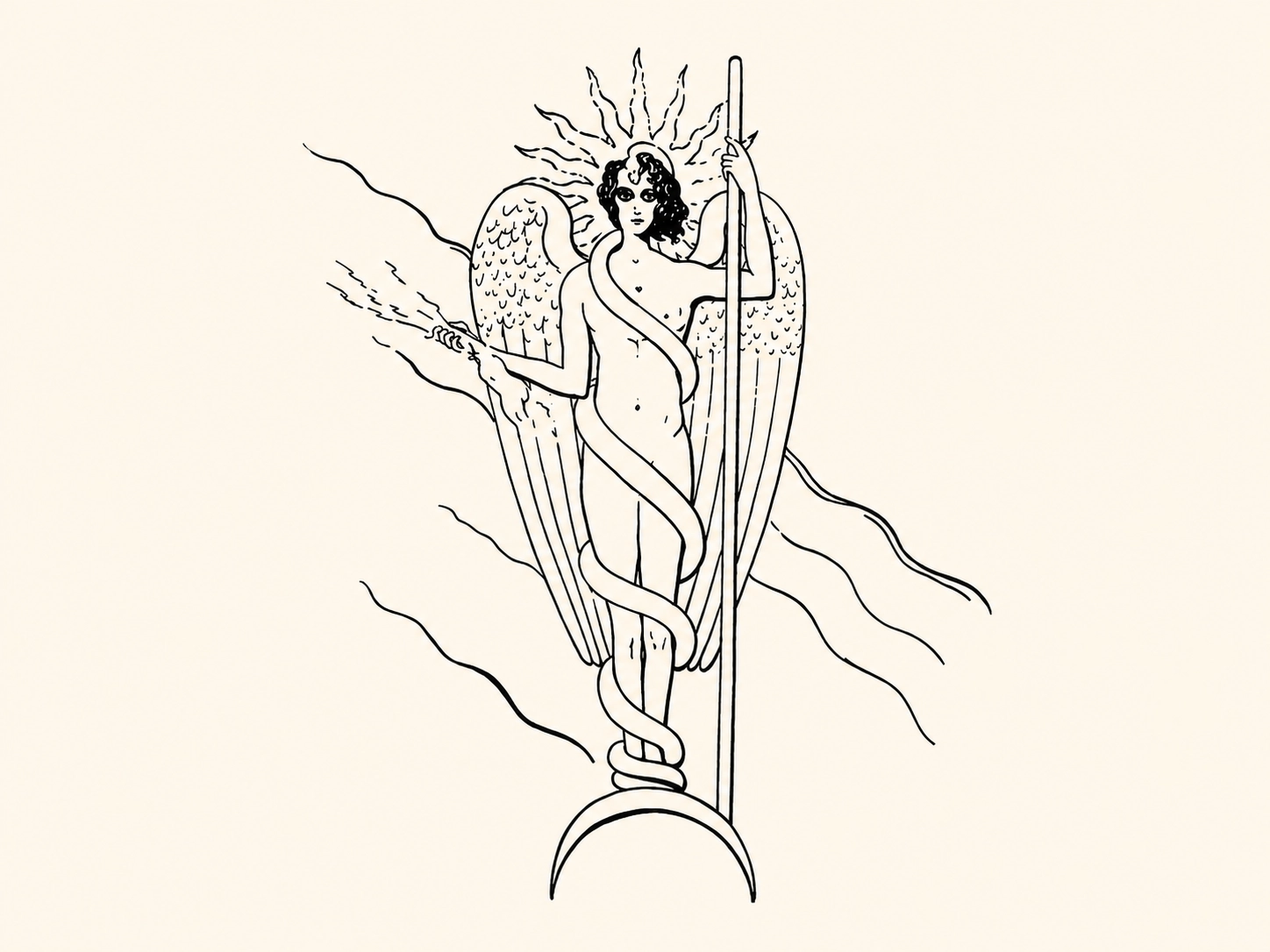
‘We serve as sheaths for our souls. When a man of genius draws his soul from its sheath, it shines more brightly than Aladdin’s scimitar. Alas, how many allow the steel to sleep until it has eaten through the sheath itself and both fall into rust-coloured dust! Have you ever seen the fragments of old Spanish anchors, the anchors of ancient galleons at the bottom of Callao Bay? The world is full of martial bric-a-brac, ruined Venetian arsenals and old rusted rapiers. But the true warrior polishes his good blade in the brilliant rays of morning, girds it about his intrepid loins and watches for specks of rust as though they were enemies; with many a cut and thrust he keeps its steel keen and bright, like the lances of the Northern Lights assaulting Greenland.’
Every adventure, when it is not reduced to a mere representation within the society of the spectacle, is always an adventure of the soul. The boldness that launches itself against the elements and against unusual or extreme circumstances is itself an act of decipherment. The navigator must decipher the signs of sky and sea. Meteorology, so decisive in every physical adventure, is nothing other than the language of the heights, whose correspondence in the language of the depths the hermeneut must strive to discern. Adventure is decipherment, and every decipherment is adventurous. There can be neither Epic nor hermeneutics without a direct confrontation with the Unknown.
The Unknown, The Odyssey teaches us, must be sought and confronted heroically. The hermeneutic hero does not seek to reduce the unknown to the known, but on the contrary to confront the unknown intensely and lovingly. The hero does not reduce the unknown to the known; he raises the known to the magnificence of the unknown. The hermeneut and the hero not only refuse to content themselves with the known; they regard this known as a miserable delusion, a lie. The attraction of the unknown guides both the man who ventures upon the seas and the interpreter who ventures into the undeciphered regions of the mind. The Odyssey masterfully unites these two fundamental demands of the human being. In the heroic and hermeneutic vision of the world, the unknown is not reduced to the known; rather, the known is augmented by a plenitude of the unknown. The human being, far from reducing the world to himself, to his own use and instruments, exposes himself to being metamorphosed by the world. The unknown into which I venture makes me an unknowable being, and this unknowability is the power of my sovereignty.
Within the portion of secrecy resides my freedom, that which within me cannot become the object of use or quantitative evaluation. Confronted with the unknown of the hermeneutic adventure, I become what I conquer. Hermeneutic light transfigures what it touches and reaches. The unknowability with which it clothes me illuminates me to the very depths of the heart.
Luc-Olivier d’Algange
Born in Göttingen in 1955, Luc-Olivier d’Algange founded the journals Cée and Style, the latter with the poet André Murcie, editor of Alexandre, and has contributed to Questions de, Dossiers H, L’Œil de Bœuf, Phréatiques and La Place royale. He has already published several works of poetry and metaphysics: Manifeste baroque, Orphiques, Le Secret d’Or and L’Œuvre de R. Guénon. He is preparing a political essay, Le Songe de Pallas. In Antaios, he has published texts on Jünger and Pessoa.



Comments