MITHRAS INVICTUS
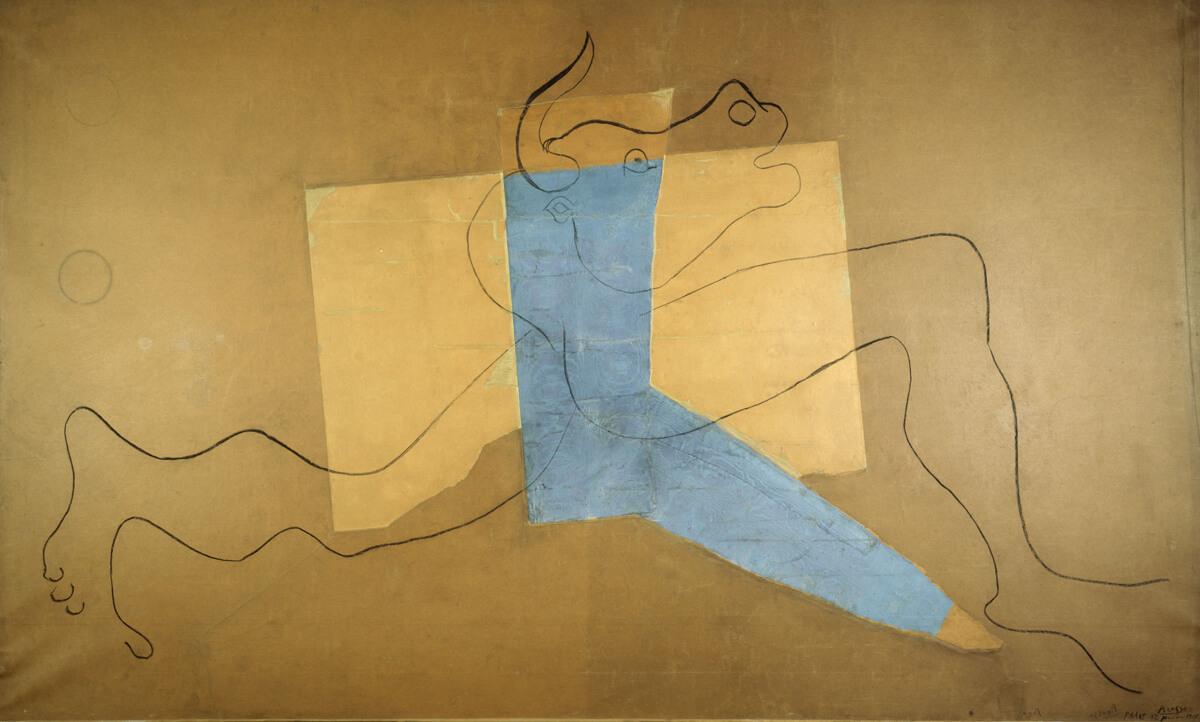
Pablo Picasso, Minotaure courant, 1928
Unknown
Deo Soli Invicto Mithrae
At the Summer Solstice of 1994, I completed the fourth issue of Antaios, devoted to Mithras. At the time, I dedicated my reflections, “Mysteria Mithrae”, to the memory of Alain Daniélou, a devotee of Mithras and one of my intellectual awakeners, whose home I was able to visit, together with the mithraeum adjoining it. Far from disowning this text, still rather academic in character, I now submit it once again, unchanged, to the indulgence of our readers 1. I have added these few reflections as avenues for further exploration. Far from being an affectation of aesthetes or a whim for eccentrics, this sustained interest in the Rock-born God is justified on many grounds. For my part, I see in him a fascinating figure capable of bringing together Eurasian elites, much like the myth of the Wild Hunt that I discussed in “Feralis exercitus” 2.
Mithras, between Freud and Jung
Above all, the solar Mithras has never disappeared from our imagination. This is demonstrated by his remarkable resurgence during the twentieth century in the thought of two of its greatest minds: Sigmund Freud and Carl Gustav Jung. A recent study of Jung’s spiritual life suggests that the rupture between these two observers of the human soul, both outstanding connoisseurs of the ancient world, was in all probability caused by Mithras 3. Both men had turned their attention to the central image of the Mithraic cult, the tauroctony, but drew very different conclusions from it. In 1910, Jung, having read and assimilated an extensive body of scholarship on the subject, including Franz Cumont’s monumental Textes et Monuments figurés relatifs aux Mystères de Mithra (Brussels, 1896–1899), and having taken a close interest in the astrological dimension of Mithraism, proposed during a public lecture a subtle interpretation according to which Mithras, the slayer of the bull, was, like his victim, also a sexual symbol. The tauroctony should therefore be understood as a double sacrifice, both voluntary and involuntary, somewhat akin to the death of Christ. A month after this lecture, his mentor wrote to refute his thesis: the killing of the bull, he argued, should be understood as the mythological projection of the ego’s repression of erotic impulses.
The author of this study, R. Noll, points out that Jung knew Freud’s astrological sign: Taurus. Accustomed as he was to interpreting the most deeply concealed symbols, Freud may well have perceived in Jung’s theory an unconscious wish to kill his master, expressed through theoretical argument, of course. Jung himself was unlikely to have been indifferent to such symbolism, especially since, and Noll does not appear to have noticed this, the young psychiatrist was born under the sign of Leo. What a powerful symbol: the young disciple, Mithras the Lion, metaphorically slaughtering his elder, the Bull. Both men must, more or less consciously, have had these striking images in mind during the early stages of their estrangement.
Moreover, Jung was thoroughly familiar with the lion-headed figure of Mithras, of which a magnificent relief survives in the Palazzo Colonna 4, as well as with the numerous illustrations reproduced in Cumont’s work. In his Musée imaginaire de C. G. Jung, C. Gaillard, translator and specialist in Jung’s writings, reproduces the pages devoted to the analysis of one of Jung’s patients and places alongside the text an image of the lion-headed Mithras 5. It was precisely while examining the case of an illiterate patient who, in his delirium, saw the Sun equipped with a membrum erectum from which a beneficent wind emerged that Jung made the connection between this inexplicable vision and Mithraic liturgy, after reading Dieterich’s Eine Mithrasliturgie in 1910, and perhaps also through the conscious or unconscious recollection of his earlier reading of Cumont.
Thus Mithras, far from being an inert figure belonging to a vanished past, inspired Jung, one of the two men who, together with Freud, most profoundly shaped our understanding of the human psyche during the twentieth century. Mithras precipitated the rupture between them through an extraordinarily violent symbolism, the tauroctony as the slaying of the father, and thus a kind of metanoia, a “conversion”, by which Jung emancipated himself from Freud’s intellectual tutelage. More than that, by reading the text of a Mithraic “liturgy”, Jung was able to elucidate an otherwise incomprehensible case, one that ultimately led him towards one of the most important discoveries of his career, namely the existence of a “functional disposition to produce similar or analogous representations”: the archetype. Who, then, has claimed that Mithras was insignificant?
Jung and Mithras
A man as attentive as Jung to signs, dreams and symbols could hardly have been unaware of the considerable debt he owed to the Rock-born God, who, like Krishna and Christos, was born of a virgin and appeared at the Winter Solstice. Mithras, along with many other pagan deities, is omnipresent in a work as fundamental as Symbols of Transformation, which Jung began in 1911, immediately after his break with Freud, the Bull, and subsequently revised in 1924, 1937 and 1950 6. This book therefore accompanied him throughout the most creative period of his life. Indeed, the shadow of Mithras hovers over almost every page of this substantial work, far more than that of Wotan. Should this be dismissed as mere coincidence?
For Jung, once liberated from Freudian dogmas concerning the libido, Mithraism and Christianity alike represent an attempt to sublimate mankind’s animal instincts through sacrifice. Still influenced by a Christian outlook, his father was a Protestant pastor, Jung nevertheless regarded Christianity as the superior path:
“Whereas the Mithraic sacrifice is still symbolised by an archaic animal sacrifice and seeks only to tame and discipline instinctive man, the Christian idea of sacrifice, made manifest through the death of a man, demands the renunciation of the whole man. It therefore requires not merely the taming of his animal instincts, but their complete abandonment, together with the disciplining of specifically human, that is, spiritual, functions, in order to direct them towards a supraterrestrial spiritual goal.” 7
This is, to my mind, a fundamental passage, illustrating one of the essential differences between two antagonistic worldviews, the pagan and the Christian. The latter demands that we renounce our animal nature through an act of will. Such an effort is superhuman, indeed inhuman and impossible, hence the taboos and repressions, and the ignorance of one’s own nature. The Christian attitude towards sexuality provides a perfect example, combining hypocrisy with intolerance. This denial of one aspect of reality, this blind submission to dogma, characterises dualistic and monotheistic modes of thought. They are invariably concerned with eradicating “error”, correcting nature through absurd disciplines, and taming and neutralising life under “sublime” pretexts. Hence the morbid character of Christianity, its unbearable pathos, more pronounced in its Catholic and Protestant forms than in Orthodoxy, which remains more sensual. Why this fanatical refusal of the shimmering complexity of humanity and the world? Why this simplification, this obsession with exclusion, excluding the animal within us, the pagan, the heretic, matter itself, an endless catalogue of what Nietzsche, the great awakener, called the “instinctive hatred of reality” in The Antichrist (1888)?
In Mithraism, by contrast, an optimistic religion and an ethic of action, the task is to master instincts and passions, as in all the great traditional cultures from India to Japan. Such an approach stands at the very opposite pole from Christian repression. By killing the bull, overtaken only after a relentless pursuit and struggle, Mithras likewise sacrifices part of himself, hence the anguished gaze he directs towards the Sun, who commands the deed. Mithras appears as a tragic hero, sacrificing a part of himself in the tauroctony. He knows that mastery over instincts and passions can never be more than temporary, perhaps even illusory. Yet such mastery remains indispensable. A return to Paganism cannot amount to a regression into some imagined barbarism, as various splinter groups seem to believe, groups that are pagan in name alone and descend into a grim parody utterly devoid of anything solar, a perfect by-product of Western nihilism 8.
The Mithraic sacrifice exemplifies the fundamentally inclusive pagan attitude. What distinguishes us, as Pagans, from Christians is, among other things, our acceptance of our own animal nature, which we never deny. It is also our clear awareness that every quest is necessarily incomplete, together with our rejection of all comforting impostures. Following Nietzsche, we know that “all those who say yes to life are pagans, those for whom God is the word expressing the great Yes to all things.” 9 Acceptance of the divine alternation, rejection of every mutilating renunciation, a holistic vision of a polymorphous reality, and a passion for singularity: these are the reasons why Mithras invites us to reflect upon why we are not Christians.
Initiates and Believers
Julius Evola, whose work is receiving increasing scholarly attention, see our interview with J. P. Lippi, had taken an interest in Mithras as early as 1926, when he published his first article on “the path to self-realisation according to the Mysteries of Mithras” 10. In 1934, in his major work Revolt Against the Modern World, this eminent representative of Traditionalist thought once again turned his attention to the Rock-born God, emphasising the contrast between the heroic nature of Mithraism and the process of decline affecting the Empire:
“For a certain period, it (the cult of Mithras) represented the symbol of a different path that the Romanised West might have followed, as opposed to the one championed by Christianity. Yet Christianity prevailed, crystallising around itself a number of disintegrative and anti-traditional influences.” 11
From his youth onwards, see the work of the Ur Group, Evola had studied the principle of initiation as “a kind of transcendent, non-human influence grafted onto the individual” 12. For him, the initiate belongs to the Olympian plane and stands in contrast to the mystic, who is more passive and emotional. To these entirely valid distinctions, I would add that the initiate, whether Mithraic or Shaivite, for example, differs fundamentally from the believer of the Abrahamic religions, who abdicates, renounces and submits. The Emperor Julian, almost certainly initiated into the Mysteries of Mithras, was already reproaching the Galileans for this: “Yours are irrationality and rusticity: all your wisdom amounts to saying, ‘Believe.’” 13
The initiatory path, associated in Mithraism with the profession of arms, since it speaks of a “militia”, is a demanding path, existing on an altogether different plane from the docile acceptance of a creed, which is conceived more as an instrument of social control than as a path towards awakening. The heroic character of the cult of Mithras deserves particular emphasis, for it is capable of bringing together all rebellious hearts. Amid general decline and increasing standardisation, Jünger speaks somewhere of the multiplication of “cheap” faces. To venerate Mithras, that is, to follow the path of the Gods, is an act of resistance and the surest way of escaping the fatal slumber.
Zarathustra or Mithras?
A further line of enquiry is suggested by the Europa sacra association, which brings together the friends and disciples of Paul du Breuil (1932–1991), a historian of religions who espoused a form of “interreligious Christianity”, in reality a kind of Neo-Zoroastrianism. Drawing upon the little-known work of Charles Autran on the Iranian prehistory of Christianity 14, Paul du Breuil sought to move beyond the confines of pure scholarship, an intellectual pastime and often a refuge, in order to reflect upon possible ways of contributing to the renewal of our continent. Like Jünger and Eliade, who launched the Antaios project in 1959, he was convinced that a free world could only be a spiritual one. To overcome Western nihilism, du Breuil looked to the Zoroastrian Good Mind (Vohu Manah), which he believed capable of regenerating Christianity. Under the leadership of the Orthodox thinker D. Théraios, his friends founded Europa sacra and organised two conferences of a very high standard 15.
In their collection entitled Zarathustra and the Christian Renewal of Europe, they pay eloquent tribute to their master while defending the somewhat neglected thesis of the Indo-Iranian foundations of European civilisation. Iranian influences, for example, are clearly discernible in Judaism, Christianity and Paganism, from Plato to Nietzsche. A return to Zarathustra is therefore proposed as a way out of the present impasse:
“The new united Europe, exposed on the one hand to the imperial globalism of North American commercial interests, which uproots the European peoples from their ancestral lands, and on the other to the globalism of a lumpenproletariat pouring in from the Third World, means the end of Europe.” 16
These thinkers’ fascination with the Indo-European heritage is unmistakable. They seek to bridge the divide between revealed monotheistic religions and pagan polytheistic traditions. In their view, the rebirth of our continent can be built upon the rediscovery of Zoroastrianism, which is called upon to strengthen a Christianity that has indeed grown weary. Yet they clearly intend to remain Christians, which is of course their unquestionable right. Do they not affirm that “no one can become, or become once again, a Christian unless he already is one in the depths of his heart”?
For us Pagans, however, conversion to a form of Christianity, however distant from that of the Bishop of Rome, is entirely out of the question. The position remains too ambiguous. Let us therefore propose our own alternative, that of Antaios and the Society for Polytheistic Studies. Rather than returning to Zarathustra, whom we revere, following the example of the profoundly pagan George Gemistos Plethon, and whose followers we count among our friends, let us return to the Vedic Mitra, to the Mithra of the Younger Avesta, to the Mithras of the Roman legionaries. Let us attempt a bold synthesis, both post-Christian and post-rationalist: the deified Contract within the framework of a Religion of Truth 17. Like the Mazdeans after Zarathustra, let us break with dualism, with belief in a single personal Creator God, and with the infantilising vision of an individual post mortem “salvation”. Let us honour Mithras Invictus, the sovereign God of daylight, the God of law and friendship, guardian of treaties and regenerator of a world that we still regard as beautiful, while never forgetting the nocturnal Gods, who remind us each day of the circumpolar origins of our ancestors.
A New Chivalry?
In his writings, Paul du Breuil emphasises the transmission of the chivalric ideal from the Zoroastrian East to the Latin West, undoubtedly one of the finest expressions of the genius of our continent. The role of Hindu India, the true India, was fundamental in this process, since it was there that the Kshatriya castes, the Bellatores of our Middle Ages, had survived 18. From India and pre-Islamic Iran came values that, in ancient Europe, found expression in the Greek hero and the Germanic warrior. Through the intermediary of the Arabs, the Crusades provided the occasion for scattered elements of a common ancestral heritage to meet once again and give rise to a new synthesis: European chivalry. Paul du Breuil believed that “beneath the outward covering of the Islamic religion, it was in reality the Vandals, who had settled in North Africa several centuries earlier, who were transmitting Germanic values to their blood brothers, the Visigoths of Spain” 19.
This remarkable journey, stretching from Vedic India to royal France, witnessed the enduring re-emergence of an archetype: that of the loyal and gallant paladin, who found “honour in punishing injustice and defending the weak” (Montesquieu). What nobler figure could be offered to those who refuse to resign themselves to decline? At the risk of appearing an incurable Boy Scout or a latter-day Don Quixote, I am among those who believe that Europe has greater need of a chivalry than of elites. Our schools are full of elites of greater or lesser competence. Yet they are amnesiac elites, technicians devoid of any centre, and therefore incapable of radiating influence. I am certainly not referring to the remnants of a nobility decimated by civil wars and often degenerate, nor to the grotesque jet set. Rather, I envisage a non-hereditary aristocracy, perpetuating itself through co-option, much like the clergy of the Galileans: men and women devoted to the Mysteries, trained in dance and fencing, in the service of the Gods and of the greater Eurasia, Eurasia sacra, under the aegis of Mithras Invictus.
Christopher Gérard
Spring Equinox 1999
References
- Christopher Gérard (ed.) (1994) Antaios 4: Mysteria Mithrae ↑
- Christopher Gérard (1997) Antaios VI : Chasseurs et Chamanes ↑
- Richard Noll (1997) The Aryan Christ: The Secret Life of C. G. Jung ↑
- C. Gaillard (1998) Le Musée imaginaire de C. G. Jung ↑
- See, for example, R. Merkelbach, Mithras. Ein persisch-römischer Mysterienkult, Beltz Athenäum, Frankfurt, 1994 (first published in 1984), p. 305. Armed with two burning torches, the lion-headed God, identified with Saturn-Chronos, Time, which devours all things, blows upon a blazing altar. This image of the divine breath would assume great importance in Jung’s work: he would draw upon it in the treatment of one of his patients, whose visions he succeeded in deciphering, visions that would have remained inexplicable without reference to Mithraic iconography and liturgy. ↑
- Carl Gustav Jung (1950) Métamorphoses de l'âme et ses symboles ↑
- C. G. Jung, op. cit., p. 708. ↑
- I explain in Parcours païen (Antaios, 1998) my views on industrial music, which I regard as a mixture of Satanism and a mindless cult of brute force. ↑
- Friedrich Wilhelm Nietzsche (1974) L’Antéchrist ↑
- J. Evola, Symboles et « mythes » de la Tradition occidentale, Archè, Milan, 1980, qui contient aussi « Quelques notes sur les mystères de Mithra » (1950). ↑
- Julius Evola (1991) Révolte contre le monde moderne ↑
- Cité dans J. P. Lippi, « Julius Evola et la pensée traditionnelle », in Dossier H Julius Evola, Lausanne, L’Âge d’Homme, 1998, p. 61. ↑
- Grégoire de Nazianze, Discours IV contre Julien, 102. Trad. Bernardi, Sources chrétiennes 309. ↑
- Charles Autran (1935) Mithra, Zoroastre et la préhistoire aryenne du christianisme ↑
- D. Théraios (ed.), Quelle religion pour l’Europe?, Georg, Geneva, 1990, including a contribution by Alain de Benoist on the sacred among the Indo-Europeans. More recently, Zarathoustra et le renouveau chrétien de l’Europe. Hommage à Paul du Breuil, Trédaniel, Paris, 1996. ↑
- D. Théraios, Zarathoustra, op. cit., p. 59. ↑
- For further discussion, see Jean Haudry’s illuminating synthesis on Mithra in the work cited in note 15. ↑
- See the interview with B. Marillier in this issue of Antaios. Professor P. Vial has also just published an excellent study on the subject: La Chevalerie européenne, Éd. Défi, 1 Place Verlaine, F-92100 Boulogne-Billancourt. Both works argue for the exclusively Germanic origin of chivalry, a thesis that should probably be qualified. ↑
- Zarathoustra, op. cit., p. 82. ↑
