Biography
of Sextus Egnatius Primitivus
- Sextus Egnatius Primitivus, a freedman, is attested as a member of a Mithraic community (syndexios), holding the office of Sacerdos at the Mitreo di Carsulae.
- Attested at Carsulae, Umbria, Italia in 1st half of 3rd century (TNMM 484).
TNMP 104
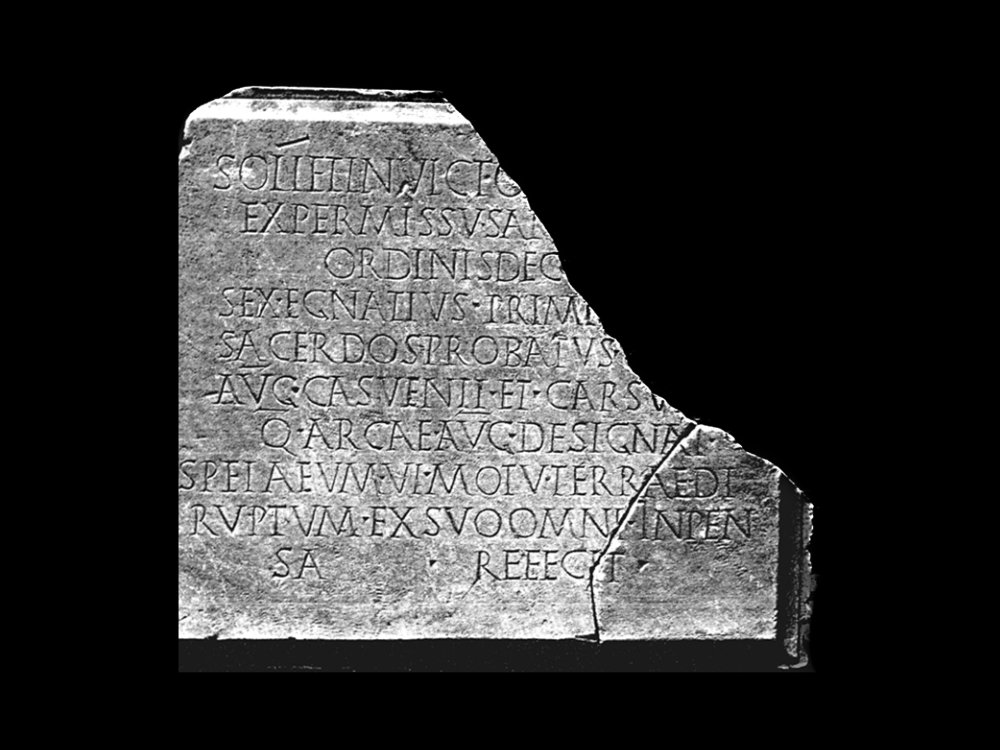
Sextus Egnatius Primitivus was a Mithraic priest and sevir Augustalis active in Umbria during the 3rd century CE. He is known from an inscription recording his reconstruction, entirely at his own expense, of a spelaeum that had been destroyed by an earthquake (TNMM 484).
The inscription styles him sacerdos probatus, VIvir Augustalis Casuenti et Carsulis and quaestor arcae Augustalium designatus. He therefore combined a priestly role within a Mithraic community with prominent responsibilities connected with the Augustales. The latter title indicates that he had been designated quaestor of their treasury. His description as sacerdos probatus, “approved” or “recognised priest”, is unusual in Mithraic epigraphy and can be compared with the sacerdos legitimus Egnatius Reparatus attested in the nearby inscription from San Gemini (TNMM 483).
Primitivus restored the sanctuary ex suo omni impensa, bearing the entire cost himself, after it had been vi motu terrae diruptum, destroyed by the force of an earthquake. As at Carsulae, the intervention required the explicit permission of the municipal authorities, ex permissu sanctissimi ordinis decurionum. The inscription therefore provides unusually explicit evidence for interaction between a Mithraic community and local civic institutions.
The location of the sanctuary is uncertain. The inscribed marble slab was recovered in fragments from the basement of the castle at Montoro, near Narni, together with archaeological material of uncertain provenance. Ciotti (1978) and later Bastianelli (2018) considered both Casuentum and Carsulae possible locations for the spelaeum. Casuentum itself has never been securely located, while Carsulae lies in an area affected by considerable seismic activity. The monument should therefore not be assigned unequivocally to the Mithraeum of Carsulae.
Bastianelli suggested that the earthquake mentioned in the inscription might have been one of those recorded in the region in 217 or 223 CE, which would place Primitivus in the first part of the 3rd century. She nevertheless stressed that the earthquake cannot provide a secure date, and a broader 3rd-century chronology remains possible.
The shared nomen gentile Egnatius and the unusual parallel between Primitivus as sacerdos probatus and Egnatius Reparatus as sacerdos legitimus have prompted suggestions that the two priests may have been related. Vilogorac Brčić (2024) goes further, proposing that they were probably blood relatives and that Mithraic priestly functions may even have been hereditary within the Egnatii of Carsulae. This remains a hypothesis, since the inscriptions themselves establish neither a family relationship nor hereditary succession.
Bastianelli also suggested that the cognomen Primitivus, like Reparatus and Profuturus elsewhere in the region, might have functioned as a cultic supernomen expressing initiatory renewal. This interpretation is possible but cannot be demonstrated from the inscription itself.
References
- Giovanna Bastianelli (2018) Mithras in regio VI, Umbria. Fragments of a shipwreck.
- Inga Vilogorac Brčić (2024) Mithras and the imperial cult.
- Philippe Roy & Laurent Bricault (2021) Les cultes de Mithra dans l’Empire romain.
- Vittoria Canciani (2022) Archaeological Evidence of the Cult of Mithras in Ancient Italy.
Attestations
Inscription on restauration of the Mitreo de Carsulae
TNMM 484
Marble plaque with inscription of a sacerdos probatus to Sol and the god Invictus Mithras.

Mitreo di Carsulae
TNMM 485
Epigraphic monuments reveal the presence of a Mithraeum in the ancient municiple of Carsulae, in Umbria.