
Biography
of Titus Lepidius Honorinus
- Titus Lepidius Honorinus, a free citizen, is attested as a Leo at the Mitreo di Carsulae.
- Attested at Carsulae, Umbria, Italia in 1st half of 3rd century (TNMM 483).
TNMP 105
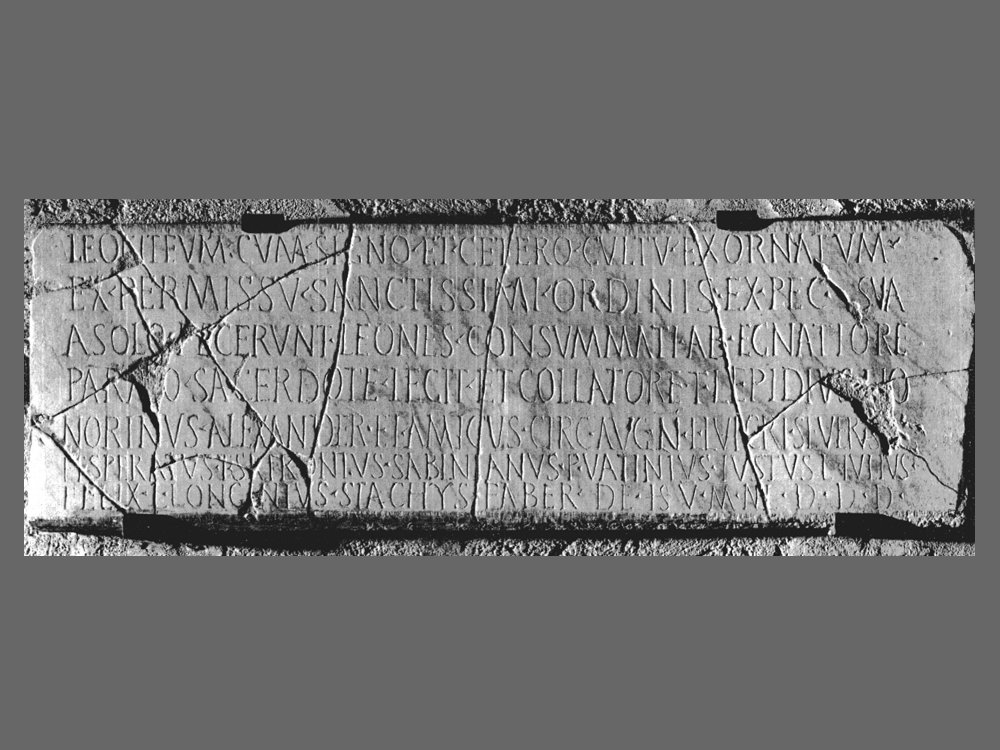
Titus Lepidius Honorinus was a Leo associated with the Mithraic community probably located at Carsulae, in Umbria, during the 3rd century CE. He is named among the nine Lions who financed the construction and furnishing of a leonteum, recorded on a marble inscription found at nearby San Gemini (TNMM 483).
The inscription states that Honorinus and his fellow leones had been consummati ab Egnatio Reparato, the sacerdos legitimus Egnatius Reparatus. Ciotti (1978) interpreted consummati here as referring to their consecration or elevation to the grade of Leo, an interpretation followed by Aloe Spada (1979). The text therefore provides unusually direct evidence connecting a named initiate with the attainment of a Mithraic grade and with the priest responsible for the rite.
Together with the other Lions, Honorinus contributed to the construction of the leonteum from the ground and to its furnishing with a cult image and other equipment. The group spent a stated 5,000 sesterces on the undertaking. The building site was granted by decree of the municipal decurions and the work was carried out ex permissu sanctissimi ordinis, with the explicit permission of the local authorities.
The punctuation of the list of Lions has caused some uncertainty. Ciotti considered the possibility that Alexander was an agnomen of Titus Lepidius Honorinus, rather than the name of another initiate. Later scholarship has generally treated them as separate individuals: Clauss (1992) lists Honorinus independently as a Leo and identifies Alexander and Amicus separately as imperial slaves and circitores, a reading also adopted by Chalupa (2023). No occupation, public office or other social status is securely attested for Honorinus.
The prominence of the Lions in the inscription, and particularly their collective financing of a space called a leonteum, has made the Carsulae evidence important for discussions of the role of the Leo within Mithraic communities.
References
- Aleš Chalupa (2023) Římský kult boha Mithry. Atlas lokalit a katalog nálezů I.
- Concetta Aloe Spada (1979) ‘Il leo nella gearchia dei gradi mitriaci’. Mysteria Mithrae.
- Epigraphik-Datenbank Clauss / Slaby. Inscription on the leonteum of Umbria in EDCS.
- Giovanna Bastianelli (2018) Mithras in regio VI, Umbria. Fragments of a shipwreck.
- Jaime Alvar Ezquerra (2008) Romanising Oriental Gods Myth Salvation and Ethics in the Cults of Cybele Isis and Mithras.
- Manfred Clauss (1992) Cultores Mithrae. Die Anhängerschaft des Mithras-Kultes..
- Philippe Roy & Laurent Bricault (2021) Les cultes de Mithra dans l’Empire romain.
Attestations
Inscription on the leonteum of Umbria
TNMM 483
This plaque from Carsulae, in Umbria, refers to the creation of a leonteum erected by the lions at their own expense.

Mitreo di Carsulae
TNMM 485
Epigraphic monuments reveal the presence of a Mithraeum in the ancient municiple of Carsulae, in Umbria.
