Biography
of Prudens
- Prudens, a slave, is attested as a member of a Mithraic community (syndexios) at the Mithraeum I of Ptuj.
- Also recorded as vicarius.
- Attested at Poetovio, Pannonia superior, Pannonia in 2nd half of 2nd century (TNMM 186).
TNMP 118
Prudens appears at Mithraeum I of Poetovio as a vicarius of Primus, himself a vilicus in the service of the customs contractor Caius Antonius Rufus. As a vicarius, Prudens occupied a subordinate position within the hierarchy of the publicum portorii Illyrici. Van Haeperen (2024) identifies Prudens, together with Festus, Felix and Optimus, among the enslaved customs personnel represented in the earliest Mithraic community at Poetovio.
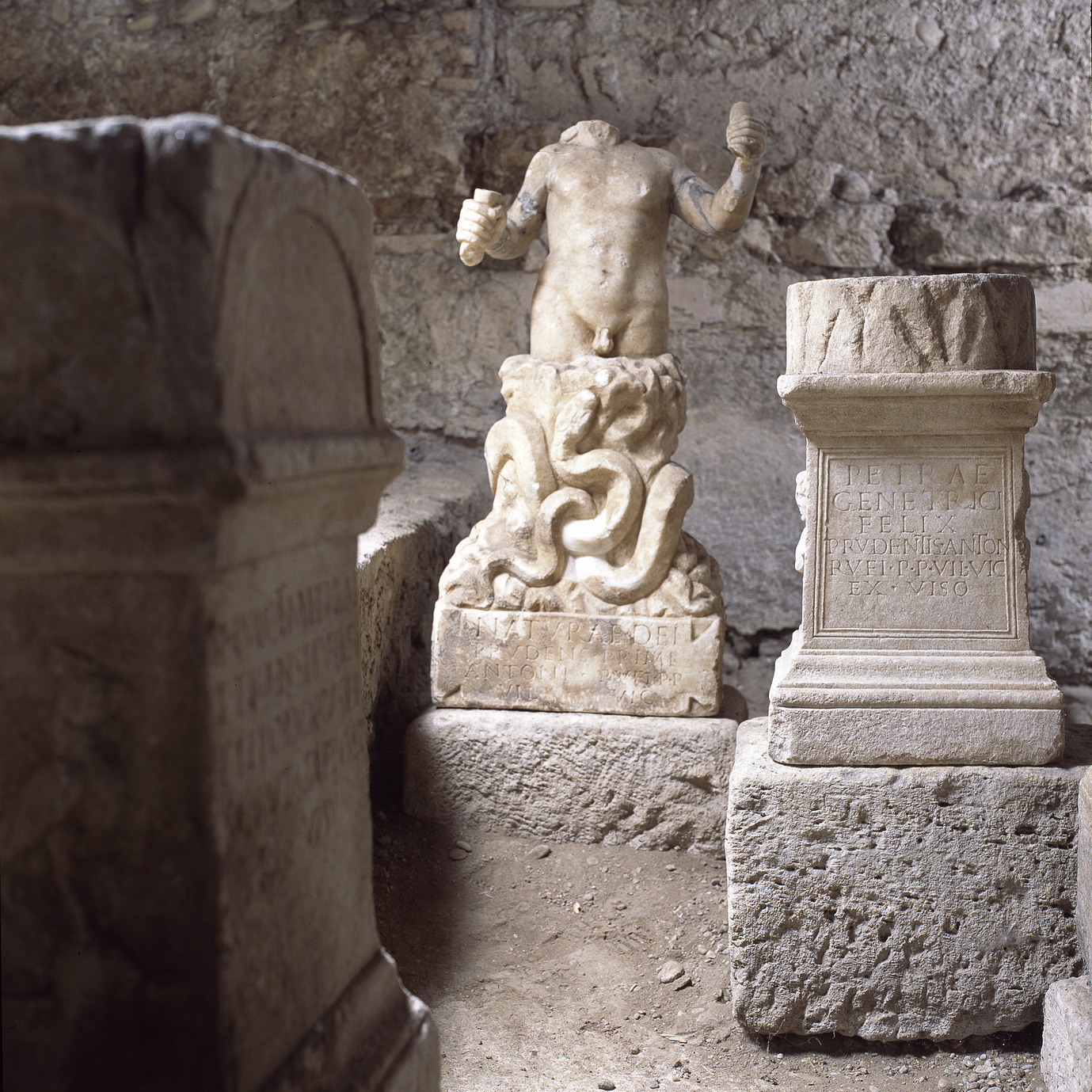
His dedication was considerably more substantial than a simple altar. Prudens offered a marble statue of the rock-born Mithras, preserved to a height of 97 cm, rising from a rock encircled by a serpent and originally holding a dagger and torch. The inscription on its base reads Naturae dei / Prudens Primi / Antoni Rufi p(ublici) p(ortorii) / vil(ici) vic(arius) (TNMM 186; CIMRM 1492–1493; CIL III 14354²⁹; ILS 4245). Naturae dei refers here to the birth of the god represented by the sculpture (Vermaseren 1960).
Prudens may subsequently have risen within the customs administration. Another dedication from the same Mithraeum names Felix as Prudentis Antoni Rufi p(ublici) p(ortorii) vil(ici) vicarius: Felix was therefore the vicarius of a Prudens who had become vilicus under Antonius Rufus. Selem (1980) identified him with the earlier dedicant, an interpretation followed cautiously by Van Haeperen (2024). If the identification is correct, Prudens progressed from vicarius under Primus to vilicus with a subordinate of his own.
Melinda Szabó (2021) regards this change explicitly as a rise in rank, using Prudens as evidence that experienced customs slaves could remain at a station long enough to advance within its internal hierarchy. She dates both the rock-birth dedication and the later monument erected by Felix to 151-170 CE, placing Prudens’ career during the period when Antonius Rufus still operated as conductor of the Illyrian customs district.
References
- Mithras Shrine I Mithras shrine III – Regional Museum of Ptuj.
- Françoise Van Haeperen (2024) Mithra en contexte. Les débuts du culte à Poetovio au IIe siècle de notre ère.
- Melinda Szabó (2021) ‘Szervezeti váltás a poetoviói vámhivatalban’. Acta Numismatica Hungarica, Supplementum 3: Numismatica Pannonica III, pp. 37–45.
- Visit Ptuj (2020) Mithras shrines. Mithraeum I and III.
Attestations
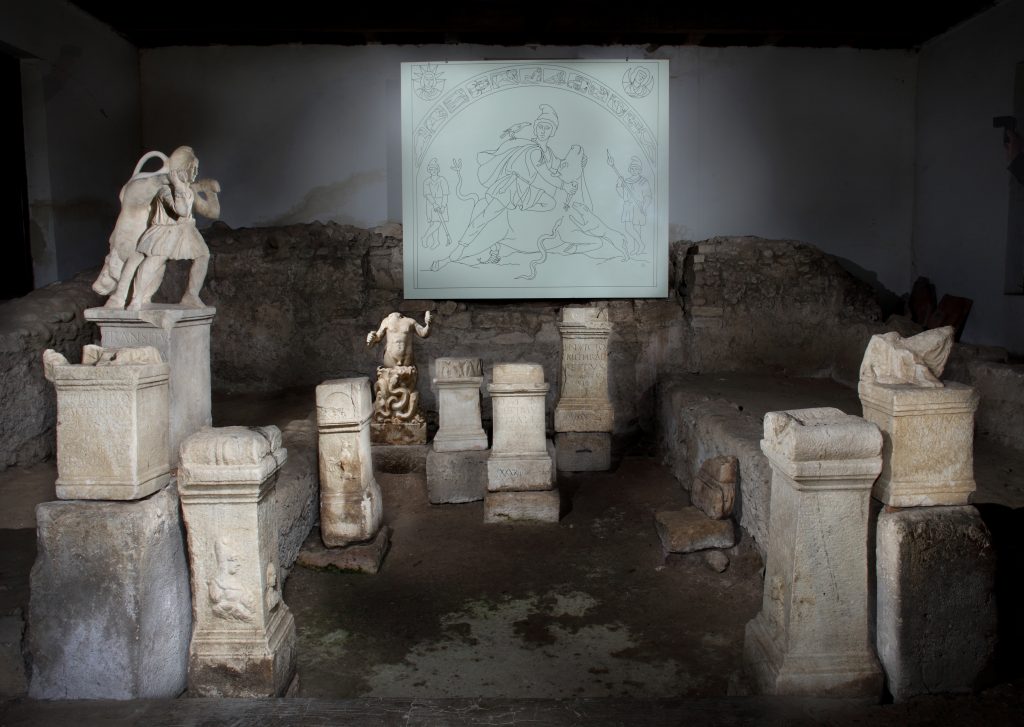
Mithraeum I of Ptuj
TNMM 185
The Mithraeum I of Ptuj contains the foundation, altars, reliefs and cult imagery found in it.
Mithras rock-born from Ptuj
TNMM 186
The sculpture includes a serpent climbing the rock from which Mithras is born.