Biography
of Hyacinthus
- Hyacinthus, probably a slave, was probably a Pater at the Mithraeum I of Ptuj.
- Attested in the 2nd century.
- Attested at Poetovio, Pannonia superior, Pannonia (TNMM 1594 and TNMM 1593 and TNMM 1595).
TNMP 188
Hyacinthus was an early member of the Mithraic community at Poetovio and may have played a significant role in the foundation of Mithraeum I. He is known from two virtually identical inscriptions set up in his memory by Primitivos on the paired statue bases of Cautes and Cautopates (TNMM 1593; CIMRM 1500–1501; TNMM 1595; CIMRM 1502–1503).
Both dedications conclude in memoriam Hyacinthi, indicating that Hyacinthus was probably already dead when Primitivos erected the monuments. Primitivos was a contrascriptor attached to Caius Antonius Rufus, imperial procurator of the publicum portorii. The paired character of the monuments and the unusual commemoration of Hyacinthus suggest that he occupied a position of particular importance within the community.
Vermaseren (1956) considered Hyacinthus probably the founder of the sanctuary. Clauss (1992) accepted this as a possibility and suggested more specifically that Hyacinthus may have been a deceased former Pater of Mithraeum I. He nevertheless stressed that neither this grade nor Hyacinthus’ legal status is recorded. Although Clauss tentatively lists him as a possible slave, the fact that he is identified by his cognomen alone does not establish servile status, since Mithraic Patres could likewise be named simply by their cognomina.
Hyacinthus belonged to the social environment of the publicum portorii Illyrici that characterised the earliest community of Mithraeum I. Most of its early dedications were made by slaves and subordinate personnel associated with the customs administration, particularly with the households and staffs of Caius Antonius Rufus and Quintus Sabinius Veranus. Clauss (1992) consequently regarded the community in its initial phase as relatively homogeneous and predominantly servile.
Tóth (1977; 1995) attributed a still greater role to Hyacinthus, interpreting him as one of the founding “prophets” or early missionaries of Mithraism at Poetovio. This interpretation was subsequently followed by Szabó (2013), but no surviving inscription describes Hyacinthus as a prophet, missionary, founder or Pater. These designations remain scholarly reconstructions based principally on the exceptional commemoration of his memory.
Vágási (2018) likewise regarded Hyacinthus as the founder of the sanctuary and compared the Poetovio inscriptions with the rare Mithraic memorial dedication from Sublavio for the deceased Pater Valentinus Secundionus. She suggested that the commemoration of a Pater represented by the Sublavio inscription may ultimately reflect a practice already attested at Poetovio.
Van Haeperen (2024) has recently proposed a further possibility. A Hyacinthus associated with personnel of the portorium is independently attested at Aquileia. Given the relative rarity of the name and the connection of both men with the customs administration, she suggests that the Hyacinthus of Aquileia and the man commemorated at Poetovio could have been the same person. If so, Hyacinthus may have encountered the cult of Mithras at Aquileia before participating in its introduction to Poetovio. On this hypothesis, agents of the portorium, including Hyacinthus, may have brought the cult from Aquileia to Poetovio during the first half of the second century.
The identification with the Aquileian Hyacinthus cannot be demonstrated, just as his status as founder or Pater remains uncertain. The inscriptions themselves establish only that Hyacinthus was commemorated after his death by Primitivos within Mithraeum I. Their prominent and deliberately paired form nevertheless points to a figure of particular significance for the sanctuary’s early community.
References
- Csaba Szabó (2013) Microregional manifestation of a private cult. The Mithraic Community of Apulum.
- Françoise Van Haeperen (2024) Mithra en contexte. Les débuts du culte à Poetovio au IIe siècle de notre ère.
- Visit Ptuj (2020) Mithras shrines. Mithraeum I and III.
Attestations

Cautes statue base from Mithraeum I, Ptuj
TNMM 1593
White marble base from Mithraeum I at Ptuj, ancient Poetovio, with an inscription and the preserved foot and lower garment of a Cautes statue.
Cautopates statue base from Mithraeum I, Ptuj
TNMM 1595
White marble base from Mithraeum I at Ptuj, ancient Poetovio, with an inscription and the preserved legs, garment, and torch of a Cautopates statue.
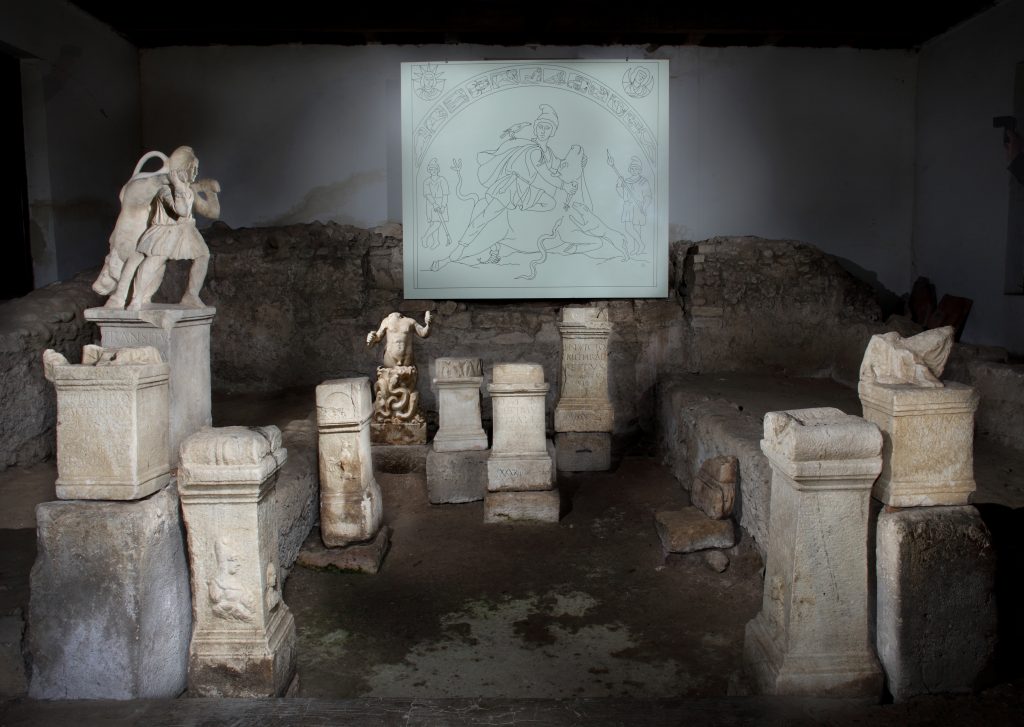
Mithraeum I of Ptuj
TNMM 185
The Mithraeum I of Ptuj contains the foundation, altars, reliefs and cult imagery found in it.