

Biography
of Protas
- Protas, a slave, is attested as a member of a Mithraic community (syndexios) at the Mithraeum of Sarmizegetusa.
- Also recorded as Vicarius.
- Attested at Sarmizegetusa, Dacia superior, Dacia in late 2nd – early 3rd century (TNMM 631).
TNMP 208
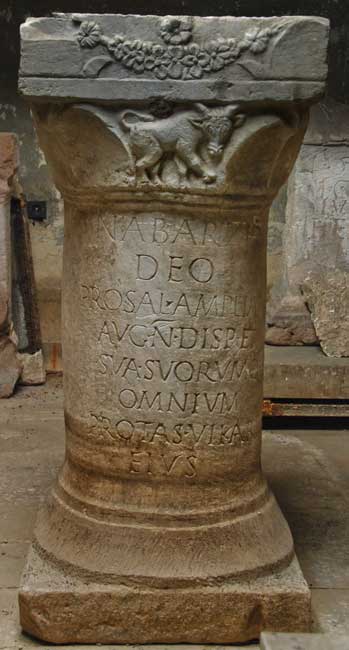
Protas was a slave (servus) and vicarius of Ampliatus, an imperial slave serving as dispensator, or financial administrator, at Sarmizegetusa. He is known from a dedication found in the city’s Mithraeum (TNMM 631; CIMRM 2028–2029; CIL III 7938; IDR III/2, 307), where he addressed the god as Nabarze Deus and made the offering for the welfare of Ampliatus, himself and all those belonging to their household or circle.
The inscription identifies Protas simply as Protas vikarius eius, “Protas, his vicarius”. In the Roman slave hierarchy, a vicarius was a slave belonging to or placed under another slave. Protas therefore occupied a subordinate position beneath Ampliatus, who himself belonged to the imperial administration as Augusti nostri dispensator. Clauss (1992) accordingly lists Protas among the slaves associated with the Mithraic community of Sarmizegetusa and draws attention to the presence there of imperial slaves and freedmen employed in administrative functions.
The dedication is particularly significant because Mithras is not named directly. Instead, the monument is addressed Nabarze Deo. Băluță (1978) identifies this as one of two Dacian attestations of Nabarze, the other being the formula S(oli) I(nvicto) N(abarze) M(ithrae) on an altar from Caransebeș.
Szabó (2026) places Protas and Ampliatus within the wider social environment of the Sarmizegetusa Mithraeum. Many of the individuals attested in the sanctuary were connected with financial activities, the staff of the procurator Augusti and the local urban elite. He argues that these financial officials and their staff point to a network linking the Mithraic community with the procuratorial establishment. The dedication of Protas belongs to this administrative milieu, alongside that of Carpion, an imperial freedman and tabularius.
The precise date of Protas’ dedication remains uncertain. Szabó notes that the epigraphic and palaeographic characteristics of the altars of Protas and Carpion differ, suggesting that they may belong to different periods. He also observes that the palaeography of Protas’ inscription resembles that of the votive column dedicated by Marcus Ulpius Victorinus and Marcus Ulpius Maius (TNMM 1887; CIMRM 2031), which could indicate a 3rd-century phase or rebuilding of the sanctuary. In the absence of supporting archaeological evidence, however, this remains uncertain.
References
- Csaba Szabó (2026) Mithras in Roman Dacia.
- Csaba Szabó (2024) ‘The mithraeum from Colonia Sarmizegetusa: on the limits of materiality of religion’. Contextualizing ’Oriental’ Cults, 281-308.
- Csaba Szabó (2014) Notes on the Mithraic small finds from Sarmizegetusa.
- Epigraphic Database Heidelberg. Column to Nabarze of Protas in EDH.
- Alfred Shenington Geden. Column to Nabarze of Protas in EDCS.
- Lupa.at (2022) 15152 Altar für Nabarzes.
- Manfred Clauss (1992) Cultores Mithrae.
- Philippe Roy & Laurent Bricault (2021) Les cultes de Mithra dans l’Empire romain.
Attestations
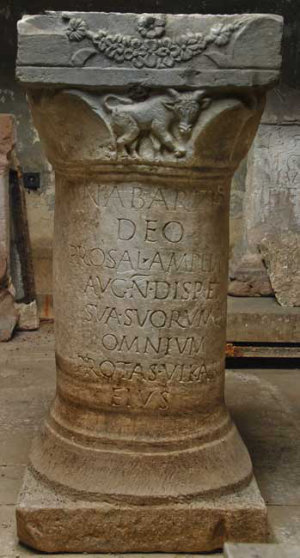
Column to Nabarze of Protas
TNMM 631
This column found in the Mithraeum of Sarmizegetusa bears an inscription to Nabarze instead of Mithras.
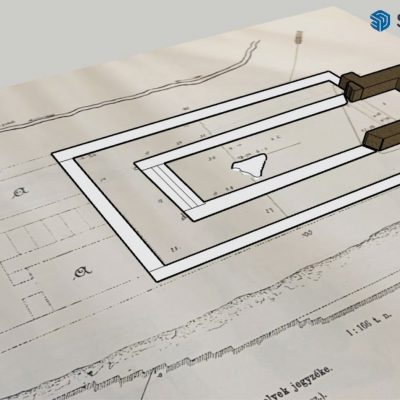
Mithraeum of Sarmizegetusa
TNMM 57
The large number of monuments found at the Mithraeum of Sarmizegetusa and the sheer size of the temple are unusual.




Comments