Your search Franz-Valéry-Marie Cumont gave 236 results.

Marble relief formerly in the Palazzo Giustiniani showing Mithras slaying the bull while grasping one of its horns, with the dog, serpent, scorpion and torchbearers, and a krater before the feet of Cautes.
Two marble busts of youthful figures with Phrygian caps, probably representing the torchbearers Cautes and Cautopates, from the Villa Borghese collection, found at Formiae.
Possible Mithras sanctuary at a grotto entrance in the Kavag-Dağ, Lycia; the identification remains purely hypothetical according to Cumont.
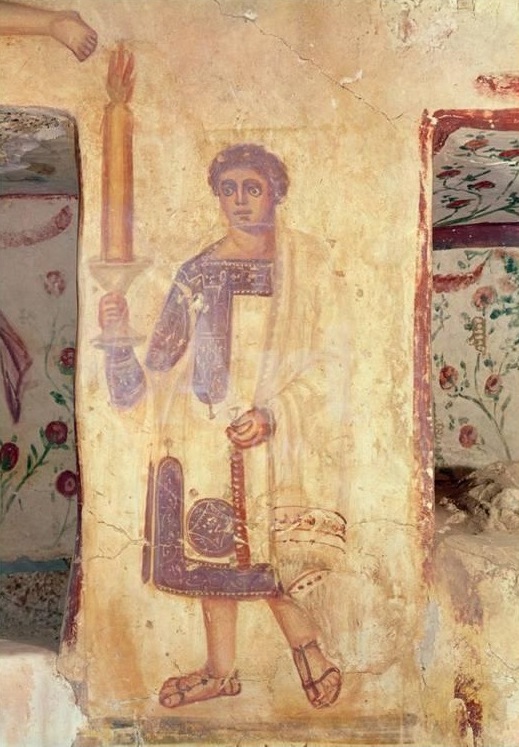
The Mithraic nature of the frescoes of Oea, according to the scholars Cumont and Vermaseren, is now questioned.

In this relief of Mithras as bull slayer, recorded in 1562 in the collection of A. Magarozzi, Cautes and Cautopates have been replaced by trees still bearing the torches.
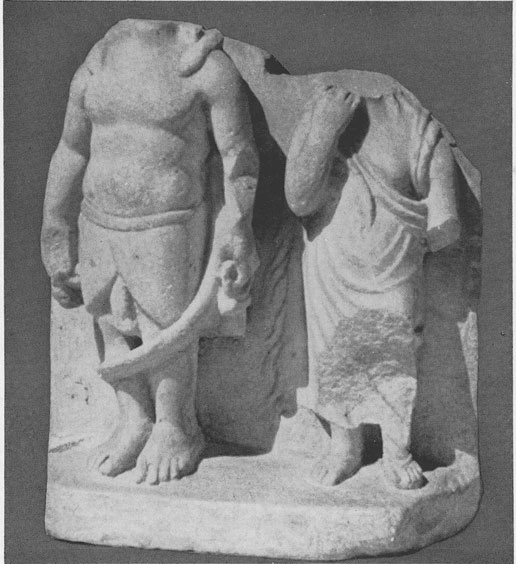
Marble relief, probably found in Rome during the construction of the Palazzo Primoli along the Via Zanardelli.

Roman stone low-relief depicting Mithras as a bull-slayer, with the upper part of his head missing.

A critical edition of the Mithras Liturgy (PGM IV.475–834), providing the Greek text, English translation, commentary, and an updated discussion of its interpretation since Albrecht Dieterich’s 1903 edition.

Collection of early passages on the cult of Mithras, curated and translated by A. S. Geden.

L'école mithriaque représente, à nos yeux, une source riche et féconde d'enseignements relatifs à la conduite de la vie. Il nous a semblé aussi que la psychothérapie actuelle se trouverait enrichie par l'étude des données des "psychodrames"…

Der römische Gott Mithras aus der Perspektive der vergleichenden Religionsgeschichte.

The Mithraeum under and behind S. Prisca on the Aventine is without doubt the most important sanctuary of the Persian god in Rome.

Roger Beck describes Mithraism from the point of view of the initiate engaging with the religion and its rich symbolic system in thought, word, ritual action, and cult life.
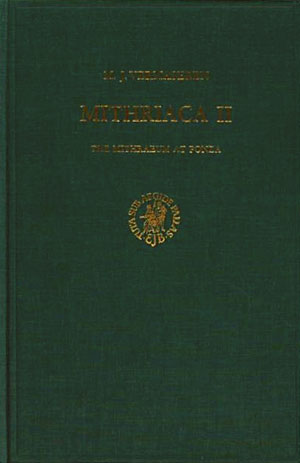
Second volume of Vermaseren's series Études préliminaires aux religions orientales dans l'Empire romain, Mithriaca, dedicated to a small Mithraic sanctuary on the island of Ponza in the Tyrrhenian Sea.

Corpus Inscriptionum et Monumentorum Religionis Mithriacae (or CIMRM) is a two volume collection of inscriptions and monuments relating primarily to the Mithraic Mysteries.

Thrasyllus was an Egyptian of Greek descent grammarian, astrologer and a friend of the Roman emperor Tiberius.

Ernest Renan suggested that without the rise of Christianity, we might all have embraced the cult of Mithras. Nevertheless, it has had a lasting influence on secret societies, religious movements and popular culture.


