Your search Monteu da Po gave 2934 results.
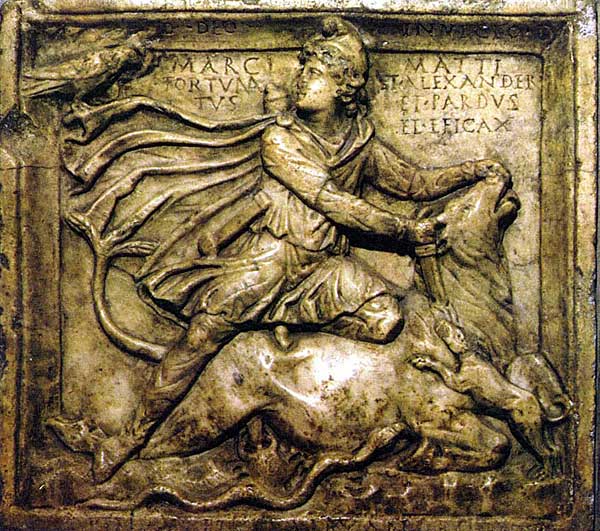
The relief marble of Mithras sacrifying the bull, exposed on the Hermitage Museum comes from Rome.

Preliminary readings of the painted Mithraic texts later revised after additional research and restoration.
Inscription from Lopata, Moesia Superior, recording that Apollonides, imperial slave and scrutator of the statio Lamud, restored a Mithraic temple that had collapsed through age at his own expense; dated to the consulship of Gentianus and Bassus, AD 211.
Limestone tauroctony relief found in a quarry at Békásmegyer, ancient Vicus Vindonianus in Pannonia Inferior, together with the upper portion of a sacrificial altar; the standard bull-slaying scene with torchbearers.
Pottery assemblage from the cult room of the Mithraeum at Linz, ancient Lentia, including glazed dishes, three-handled serpent-vases, and related fragments; a vessel type closely associated with Mithraic ritual in the Danubian provinces.
Underground oblong room at Nyon, ancient Colonia Iulia Equestris, situated on the edge of a second Forum dating to the second half of the first century AD, with a series of pillars along the side walls consistent with Mithraic architecture; its interpretation as a Mithraeum remains tentative…
A skull and two human femora, the lower jaw missing, recovered from a small circular pit within the Mithraeum at Königshoffen; interpreted by Cumont as a parallel to ritual deposits of human remains in other Oriental sanctuaries on the Janiculum.
Assemblage of cult objects from the Mithraeum at Königshoffen including painted lamps, glass and terra-sigillata fragments with potters' stamps and graffiti (including Deo invicto Mithrae), two iron bells, an iron shield-knob, and stone fragments.
Dark red sandstone altar fragment from the Mithraeum at Königshoffen whose upper section, reconstructed from additional fragments, is shown to have supported a shell-shaped basin; dedicated to Soli invicto.
Fragment of a grey marble slab formerly in the Palazzo Caponii and now in the Vatican Musea, Galleria Lapidaria, with an inscription on two arched borders and a leaping ox in the blank space.
Fragments of a marble relief preserving only the lower part, with Mithras slaying the bull, dog and serpent licking blood, a large scorpion, and Cautopates behind the bull pointing his torch downwards, from the Mithraeum of S. Lorenzo in Damaso.
Damaged statue of Mithras as bull-killer on a rectangular base, found in the piazza of the Fountain of Apollo at Cyrene.
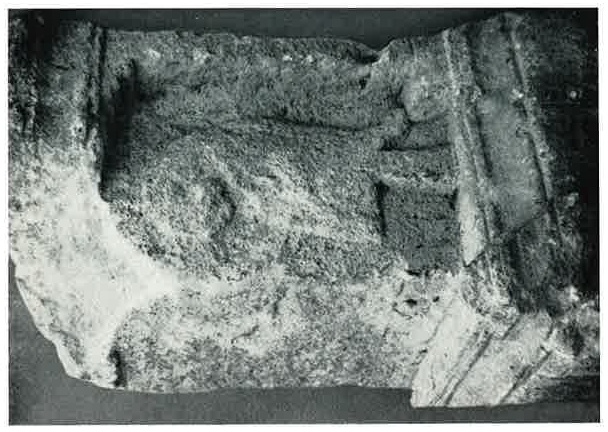
Sandstone altar from Mithraeum I at Carnuntum, Pannonia Superior, decorated on each lateral face with a Phrygian cap upon a dagger — a distinctive Mithraic iconographic pairing — and bearing an inscription on the front.
Ritual coin deposits beneath sanctuary bases helping date the Mithraeum to the late second century A.D.
Elongated cult building near the Saalburg fort traditionally interpreted as a Mithraeum but later reconsidered as a possible funerary enclosure.
Complex military inscription invoking Apollo, Sol and Luna under Severus Alexander.

The Pontiae islands, including modern Ponza, formed part of the Roman maritime landscape of Latium and preserve one of the most remarkable Mithraic sanctuaries of Roman Italy, renowned for its rare stucco zodiac and astral symbolism.
Founded on the site of ancient Byzantium and refounded in 330 CE, Constantinopolis became an imperial residence in the eastern Roman Empire. In the 4th century, it was a key setting for interaction between traditional cults and Christian authority.
Potaissa was a castra in the Roman province of Dacia, located in today's Turda, Romania.
Pons Aelius, or Newcastle Roman Fort, was an auxiliary castra and small Roman settlement on Hadrian's Wall in the Roman province of Britannia Inferior, situated on the north bank of the River Tyne close to the centre of present-day Newcastle upon Tyn
