Your search Sidi Ali Belkacem (سيدي علي بلقاسم) gave 1194 results.

The Sacello delle Tre Navate near the Therms of the Sette Sapienti at Ostia, whose identification as a Mithraeum remains uncertain, with a decorated cult-niche but lacking typical Mithraic iconography.
Marble relief fragments from the cult niche of the Mitreo della Planta Pedis at Ostia, preserving the bust of Sol in radiate crown, the raven's tail, the bust of Luna in crescent, and parts of the rocky border.
The dedicator of this marble basin could be the same person who offered the sculpture of Mithras slaying the bull in the Mitreo delle Terme di Mitra.
This inscription, found in the Mitreo della Planta Pedis, among some other monuments in Ostia, suggests a link between Mithras and Silvanus.
Mosaic-paved floor of the central aisle of the Mitreo delle Sette Porte at Ostia, with a krater flanked by serpent and eagle, standing Jupiter and Saturn, torchbearers at the podia, and planetary gods Mars, Luna, Venus, and Mercury.
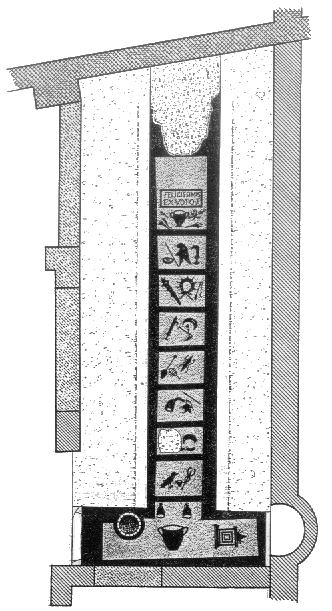
The Mithraeum Felicissimus has a floor mosaic depicting the seven mithraic grades.
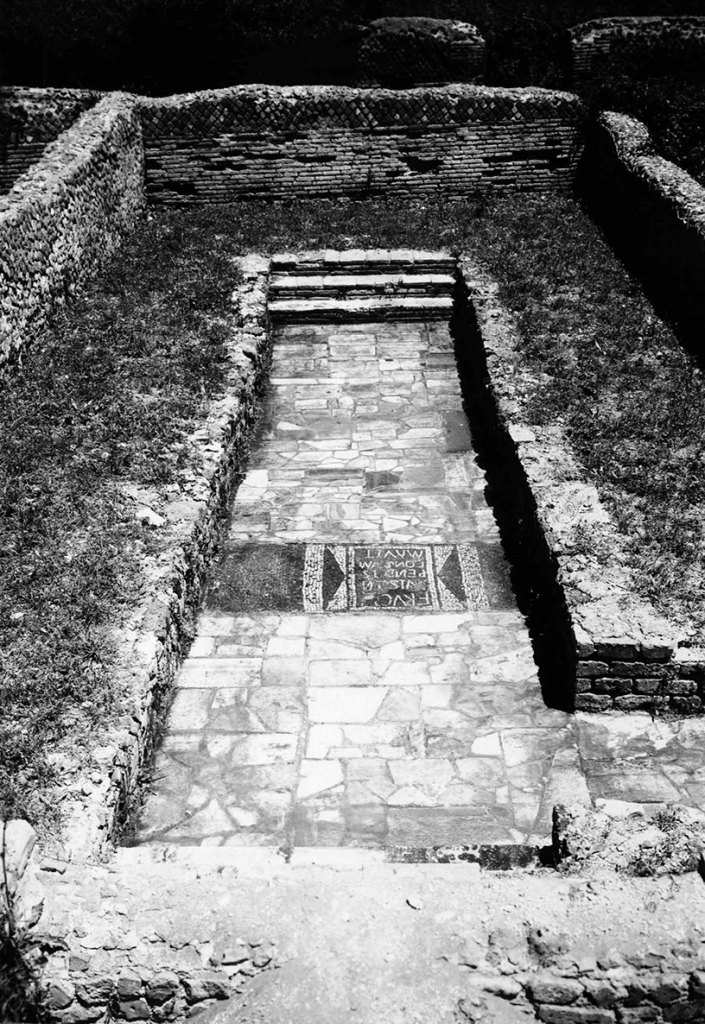
The Mithraeum of Sabazeus was found in one of the rooms of the Horrea built in the years 120 - 125 AD. The installation of the shrine may have taken place in the first half of the third century.
A small cippus from the Mithraeum of Sabazeus records the rebuilding of the sanctuary after its collapse.

Marble torso found at Ostia in 1912 between the Decumanus and the Via dei Molini, dedicated to Mithras by a certain Atilius Glyco.
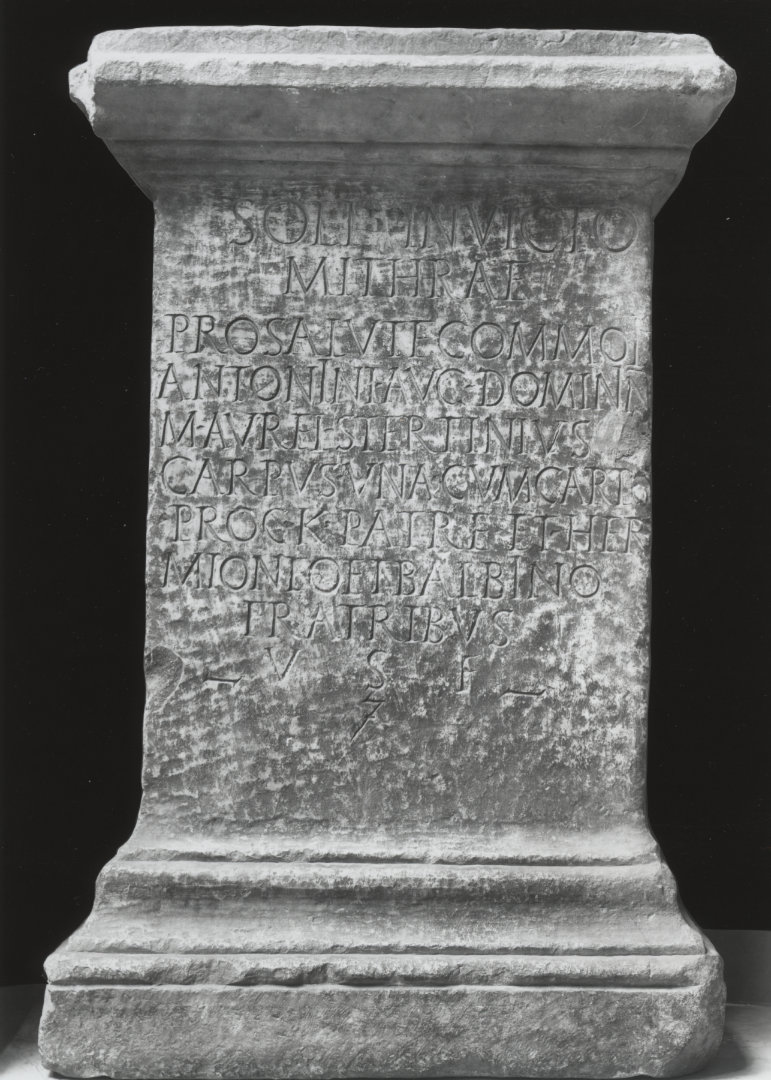
This altar bears an inscription to the health of the emperor Commodus by a certain Marcus Aurelius, his father and two other fellows.
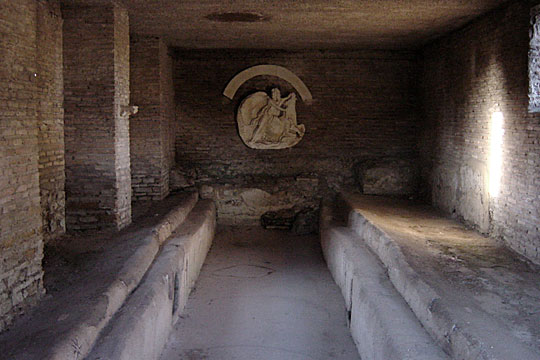
The Mithraeum of the Seven Spheres (Sette Sfere) is of great importance for the understanding of the cult, because of its black-and-white mosaics depicting the planets, the zodiac and related elements.
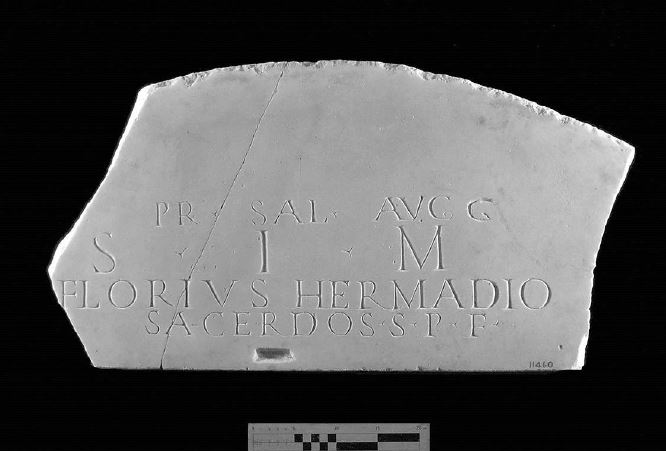
Marble revetment inscription from the cult niche of the Mitreo della Planta Pedis recording a dedication to Sol Invictus Mithras by the priest Florius Hermadio for the welfare of two emperors.
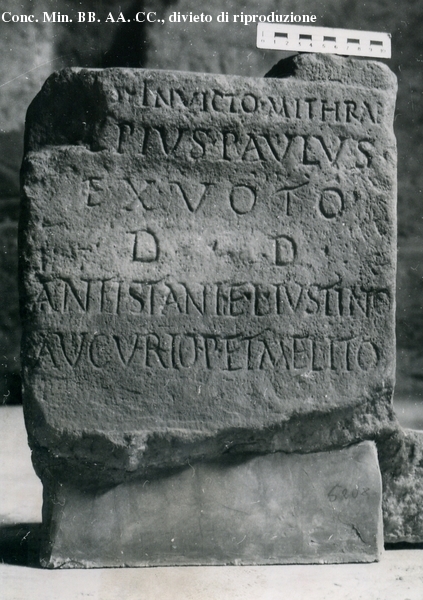
Small marble base, found in one of the private houses along the Via Sacra nearly opposite to the Basilica of Constantine, Rome.

Yellow lenticular carnelian gem probably from Aquileia, now in Udine, depicting a Mithraic scene nearly identical to the Florence jasper.
A small limestone votive altar from Pola (modern Pula) bearing on its front face a damaged relief head of a youthful Sol with long curly hair, above which is carved the inscription Soli and below the dedicatory text by Atticus (No. 757).
A fragmentary limestone tauroctony relief found on the south slope of the Castellhügel at Pola (modern Pula) during the demolition of a wall, now in the Lapidary Museum at Pula, preserving the bull's body, the dog, the serpent, the scorpion and a standing cross-legged torchbearer…
A brief inscribed fragment found in the ruins of the Temple of Isis at Aquileia, attesting to the veneration of Sol in proximity to the Isiac sanctuary.
An altar in the shape of a mystic chest found at Aquileia in 1828, inscribed with a brief dedication to the Deity Mithras Sol.
An altar found at Milan (ancient Mediolanum), dedicated to the Invincible Mithras by Varia Severa, daughter of Quintus; because the dedicant is a woman, Cumont suggests it may alternatively be dedicated to the Dis Manibus.
Two terracotta lamps formerly in the Coll. Passeri and now probably in the Museo Olivieri at Pesaro: the first showing Mithras as a bullkiller, the second in the shape of a bull's head inscribed Μέθρα ἱερός on the horns, both regarded as probably forged…
