
Marble slab of unknown provenance from Moesia Inferior, preserving only the opening of a dedication to Soli invicto Mithrae.
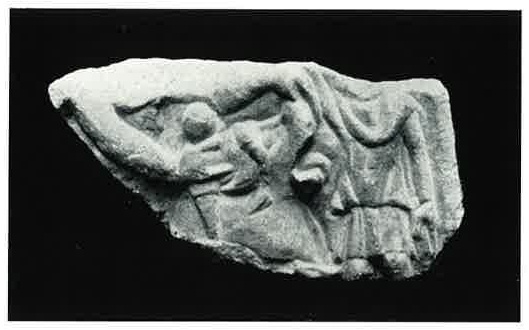
Marble tauroctony relief fragment from an unknown provenance, preserving part of Mithras's body, his right arm and dagger, and his left arm grasping the bull by the nostrils.
Fragmentary inscription of unknown provenance, preserving only a pro salute formula and the name Attius Valerianus.
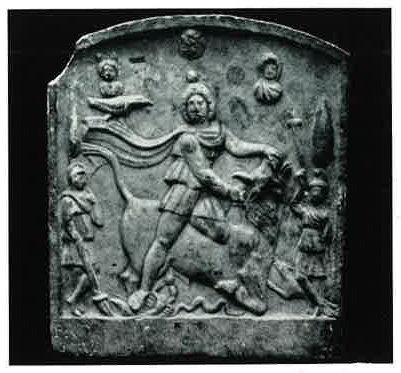
Marble tauroctony relief of uncertain but probably Apulum/Dacian provenance, depicting Mithras tauroktonos with raven, serpent, scorpion, and dog.
Limestone tauroctony relief fragment of unknown provenance, preserving the upper part of Mithras as bull-slayer with the flying cloak on which the raven is perched.
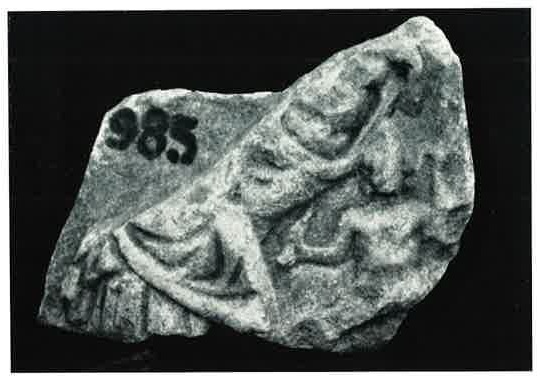
Limestone tauroctony relief fragment of unknown provenance, preserving the upper part of the right torchbearer of a bull-slaying scene.
White marble tauroctony relief fragment of unknown provenance, preserving the foremost part of the bull and part of Mithras as bull-slayer.
Inscription of unknown provenance, recording a dedication by Aurelius Victor, veteran ex praetoriano(?).
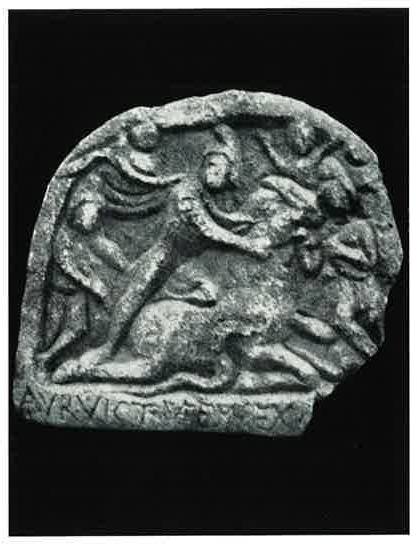
Arched white marble tauroctony relief of unknown provenance, depicting the standard bull-slaying in the usual attitude with dog and serpent.
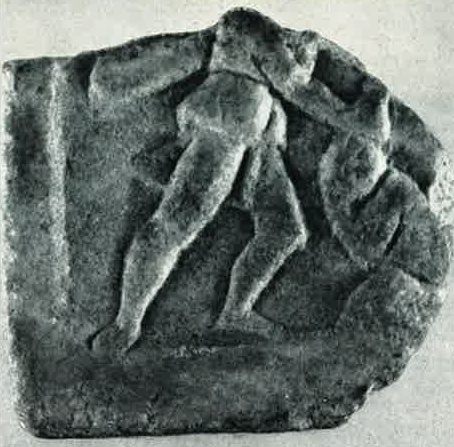
Marble relief fragment from Dacia, depicting Mithras placing a Phrygian cap on the kneeling Sol — one of the more unusual variants of the Mithraic iconographic programme.
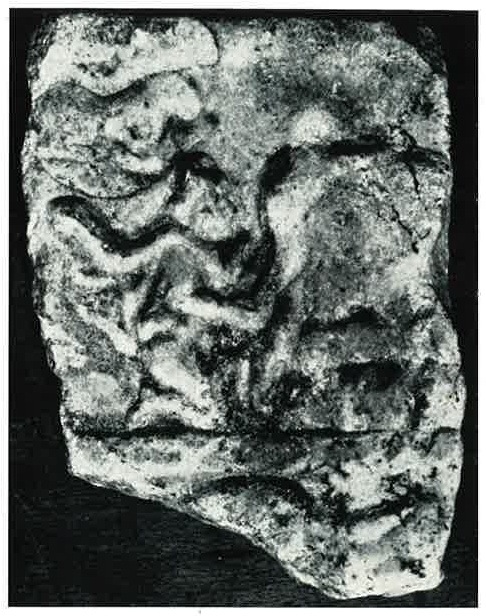
Marble tauroctony relief fragment from Dacia, preserved in Bucharest, with only Mithras's head and part of his flying cloak visible; above this a water-miracle scene and above that the bull in a small boat.
Two limestone statue fragments from Mithraeum II at Aquincum, Pannonia Inferior, representing Mercury in a shoulder-pinned garment with wings in his hair; probably stood in room A on base y.
A head in a Phrygian cap, possibly belonging to a torchbearer statue, formerly kept at St. Wendel in Belgica but possibly transported to the Provinzialmuseum in Trier, where it may be identical with CIMRM 993.
Two small stone altars from Apt (ancient Apta Iulia) in Narbonensis, one bearing a carved upraised torch representing Cautes and the other a downturned torch representing Cautopates.
A silver votive leaf from Deneuvre in Belgica, bearing a dedication to the unconquered god by a devotee named Germanus, with an archaic spelling of invicto.
Two stone relief fragments from Interanum (modern Entrains-sur-Nohain) in Lugdunensis: one showing the dressed bust of Luna with a whip and crescent, and another showing the head of Sol with a crown of seven rays and a raven on the cave border.
A scholarly note recording that the concentration of Mithraic finds at Interanum (modern Entrains-sur-Nohain) in Lugdunensis indicates the existence of one or more Mithraea there, with stone heads in the Delimoges collection possibly being Mithraic representations…
A fragment of a limestone relief from Interanum (modern Entrains-sur-Nohain) in Lugdunensis, with the bull best preserved showing a belt round its body, together with traces of polychromy and remnants of the dog and serpent.
A fragment of a stone relief from Interanum (modern Entrains-sur-Nohain) in Lugdunensis, showing the arched end of Mithras's flying cloak and an ear emerging from the bull's tail, possibly belonging to CIMRM 946.
A fragment of a stone relief from Interanum (modern Entrains-sur-Nohain) in Lugdunensis, preserving only the head of Mithras in his Phrygian cap and vague remnants of the flying cloak.
