Filtering by Province: Belgica in monuments gave 44 results.
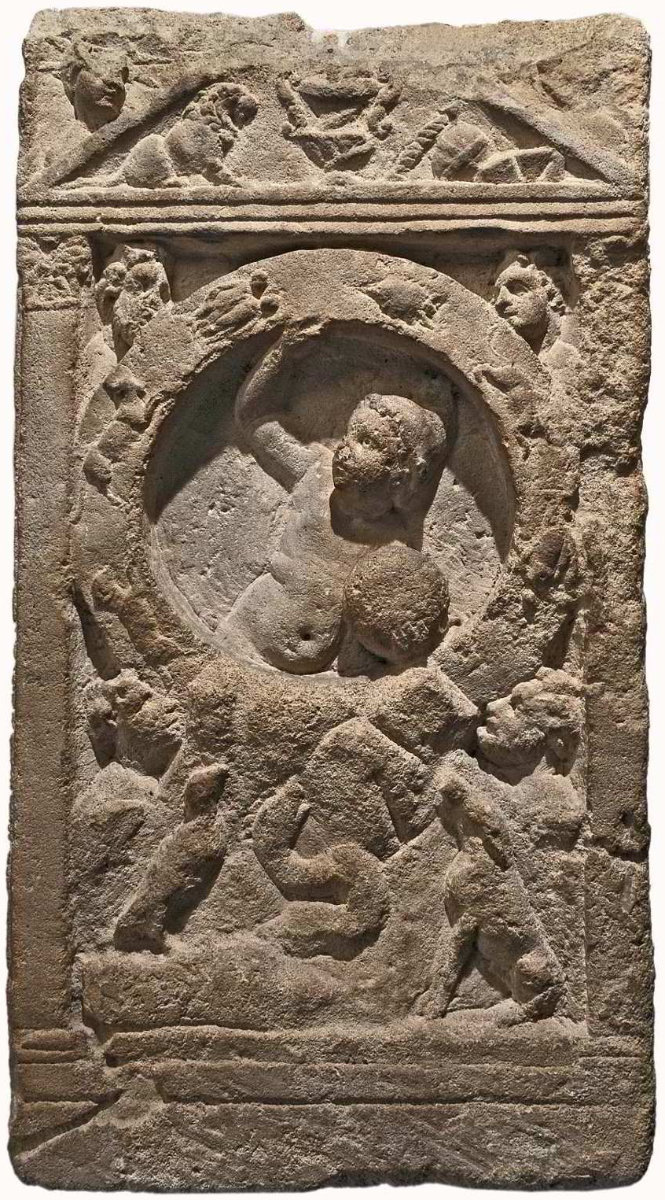
Temple-front relief from Trier showing Mithras’ rock birth within the zodiac, surrounded by the four Winds and associated divine and animal figures.

A head in a Phrygian cap, possibly belonging to a torchbearer statue, formerly kept at St. Wendel in Belgica but possibly transported to the Provinzialmuseum in Trier, where it may be identical with CIMRM 993.
A silver votive leaf from Deneuvre in Belgica, bearing a dedication to the unconquered god by a devotee named Germanus, with an archaic spelling of invicto.
A funerary inscription from Besançon (ancient Vesontio) in Belgica, bearing the title mater sacrorum, but correctly excluded from the Mithraic corpus, as women were barred from Mithras sanctuaries.
Two red pottery fragments from a plate found near the Schützenstrasse at Augusta Treverorum (modern Trier) in Belgica, showing the forepart of a horned bull and the hindquarters of a lion, possibly Mithraic in character.
A small pottery fragment of uncertain find-spot, probably from Augusta Treverorum (modern Trier) in Belgica, showing a lion walking to the right before a bull's head, with palm-like foliage, tentatively interpreted as Mithraic by Loeschcke but considered too doubtful by Vermaseren…
Three fragments of a pottery plate bearing a relief of Mithras as bullkiller, with Cautes holding an upraised torch and sickle-shaped object and the bust of Luna above, found in the pottery workshops along the Ziegelstrasse at Augusta Treverorum (modern Trier) in Belgica…
A fragment of a white marble head in a Phrygian cap, facing right, probably representing Mithras, with an uncertain find-spot but likely from Augusta Treverorum (modern Trier) in Belgica.
A scholarly note recording that finds at Heiligkreuz, including a lion's head and leg fragment, the head of a genius, and a knife with a gold handle, support the hypothesis of a Mithraeum at that location in Augusta Treverorum (modern Trier) in Belgica.
A bronze votive slab bearing a dedication to the unconquered god, found on a hill at Heiligkreuz near the proposed Mithraeum at Augusta Treverorum (modern Trier) in Belgica.
A small limestone head of Cautopates, facing right, with a damaged nose and a stone pin on the reverse indicating it belonged to a relief, found on the slope of a hill near Heiligkreuz at Augusta Treverorum (modern Trier) in Belgica.
A collection of 284 coins, spanning from 254 to 395 AD and mostly of the fourth century, found in the Mithraeum at Pons Saravi (modern Saarburg) in Belgica, indicating that the sanctuary was founded under the Severan dynasty and destroyed in the fourth century…
A skeleton of a man aged approximately thirty to forty years, with arms tied behind his back and wrists bound with an iron chain, found lying on a fragment of the main relief at the back of the Mithraeum at Pons Saravi (modern Saarburg) in Belgica…
A small terracotta lamp from the Mithraeum at Pons Saravi (modern Saarburg) in Belgica, bearing a beardless head on its upper surface and the inscription SOLI on its underside, found among numerous lamp fragments.
Numerous animal bones including birds, beasts of prey, and the muzzle of a wild boar, found as ritual deposits in the Mithraeum at Pons Saravi (modern Saarburg) in Belgica.
A collection of ritual vessels from the Mithraeum at Pons Saravi (modern Saarburg) in Belgica, including a stone vase, a plate with a lion's head in relief, a terra-sigillata plate with a hunting scene, and an urn filled with ash, bird bones, and rings.
A fragmentary inscription from the Mithraeum at Pons Saravi (modern Saarburg) in Belgica, recording a dedicant's gift made a second time.
Several fragmentary stone bases and altars without identifying marks, one of which has a semicircular hole in one of its sides, found in the Mithraeum at Pons Saravi (modern Saarburg) in Belgica.
A stone hand of more than natural size from the Mithraeum at Pons Saravi (modern Saarburg) in Belgica, with the thumb touching the index finger and a rectangular projection in the palm on which an object was probably fastened.
Two female stone heads of varying sizes, found in the Mithraeum at Pons Saravi (modern Saarburg) in Belgica.
