Mithras in Africa
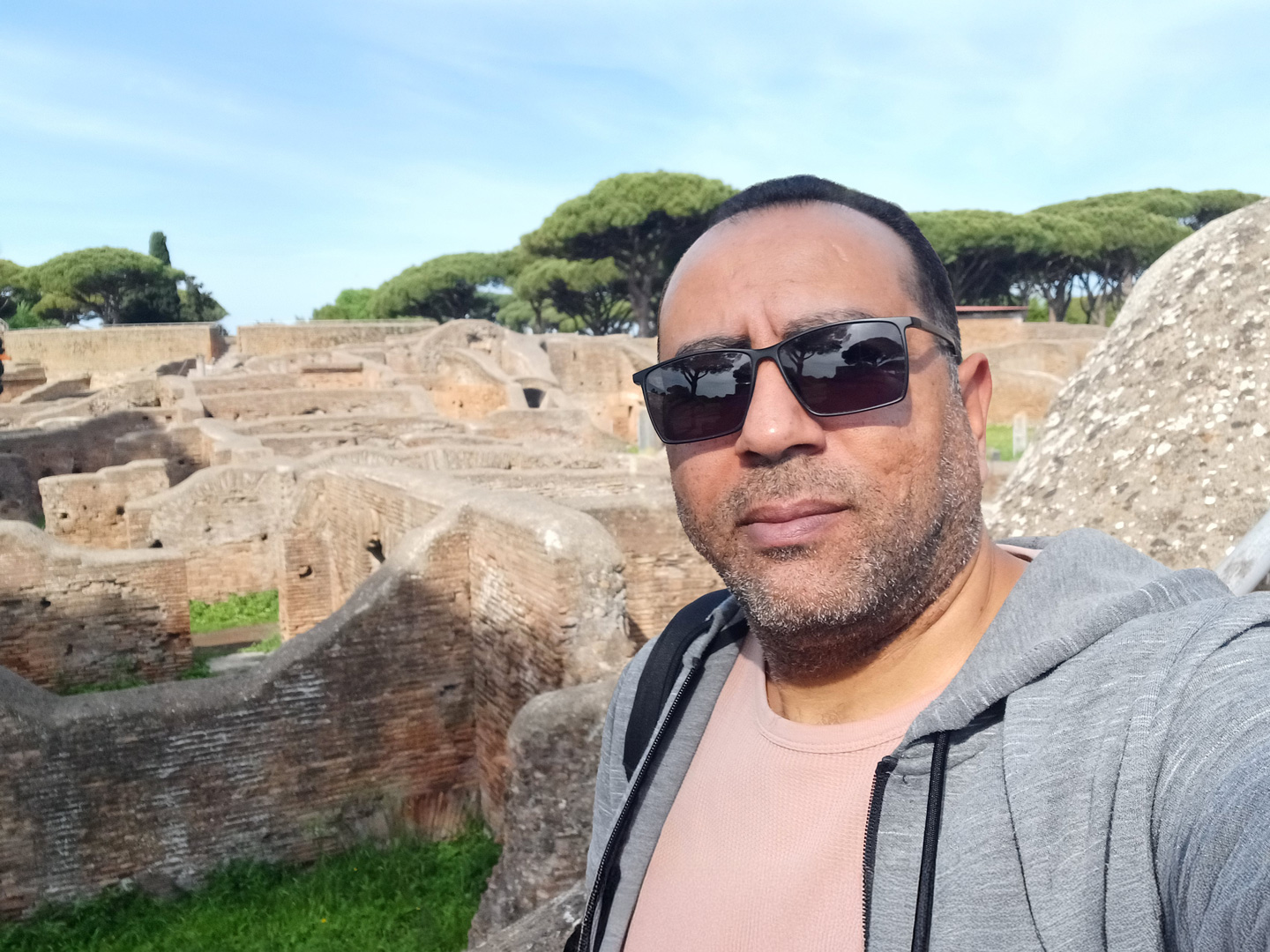
Fahim Ennouhi in Ostia.
Fahim Ennouhi
Fahim Ennouhi is a historian of Antiquity and holds a doctorate from Ibn Tofaïl University, where he dedicated his thesis to Eastern cults in Roman North Africa, including, of course, the cult of Mithras. He teaches within the Ministry of National Education in Morocco and has also participated in several archaeological excavations and surveys, notably at Lixus and in the Larache region.
His first book, Le culte de Mithra en Afrique du Nord antique, offers an overview of known Mithraic attestations in the region. It brings together available epigraphic and archaeological documentation, reexamines inscriptions attributed to the cult, and questions the reality of Mithraism’s spread in the African provinces.
The study highlights an ultimately limited dossier: a few fragmentary inscriptions, a limited number of reliefs, and a cult presence essentially linked to military circles, with no evidence of documented or structured establishment in local communities.
Before getting to the heart of the matter, I’d like to know a bit more about your personal motivation: where does your interest in antiquity, and particularly in the cult of Mithras, come from?
My interest in the Roman cult and Mithras in particular is part of a personal and intellectual journey. Since my youth, ancient civilizations and especially religious beliefs have fascinated me. Despite a baccalaureate in mathematical sciences, I chose to pursue studies in history, driven by this passion. During my undergraduate degree, I worked on a translation thesis with commentary on part of Louis Chatelain’s work, Le Maroc des Romains, which allowed me to delve into documentation on ancient North Africa and better understand this region’s place in the Roman world.
Then, for my master’s degree, I continued this approach with work devoted to the tribes of ancient North Africa, notably based on Jehan Desanges’ work, Catalogue Des tribus africaines de l’Antiquité classique à l’ouest du Nil. This research made me aware of the region’s complexity. In continuation of this path, I devoted my doctoral thesis to Eastern cults in North Africa, highlighting Egyptian, Phrygian, Persian, Syrian cults, etc. Working on this subject, I found that the provincial religious landscape was much richer than one might think.

Jehan Desanges, author of Catalogue Des tribus africaines de l’Antiquité classique à l’ouest du Nil
Creative Commons
Regarding the cult of Mithras, I can say that what particularly caught my attention was its discretion, which poses a methodological challenge. This situation invites reflection on the cult’s diffusion but also its limits, its absences, its gray areas. It was these questions about reception, adaptation, and sometimes rejection by local populations that ultimately led me to make ancient cults my main research focus.
To set the context, can you briefly describe the religious and social landscape of Roman Africa before and after the arrival of the Romans?
Before the Romans’ arrival, North Africa’s religious and social landscape is characterized by great diversity. Socially, we find Libyco-Berber populations organized into tribes with their own power structure. On the other hand, we find more developed urban centers dominated by Carthage and by the Numidian and Mauritanian kingdoms. Religiously, this world is marked by the coexistence of local cults, linked to ancestors, forces of nature, stars, certain animals, and Punic cults, particularly those of Baal Hammon and Tanit.
After the Romans’ arrival, the progressive integration of this region into the Empire brings about social transformation. Romanization is accompanied by significant urban development, the spread of the municipal model, the rise of Romanized Libyco elites, and the army’s lasting presence. This creates a new space of sociability where identities and hierarchies are redefined. At the religious level, Roman gods, imperial cult, and the divinities of colonists, soldiers, and merchants are added to already existing cults. There’s no shift from one system to another by substitution, but rather to a composite religious landscape where phenomena of superposition, identification, and syncretism are frequent.
To summarize, we can say that before Rome, Africa already presented a plural religious landscape, rooted in local and Punic traditions, and that after integration into the Roman empire, this landscape becomes more complex with the addition of cults brought by the Romans. It’s within this framework that we must situate the appearance and spread of Eastern cults. These cults don’t replace either local gods or Roman gods, but they offer particular forms of religiosity often marked by initiation, associations of faithful, and promises of salvation.
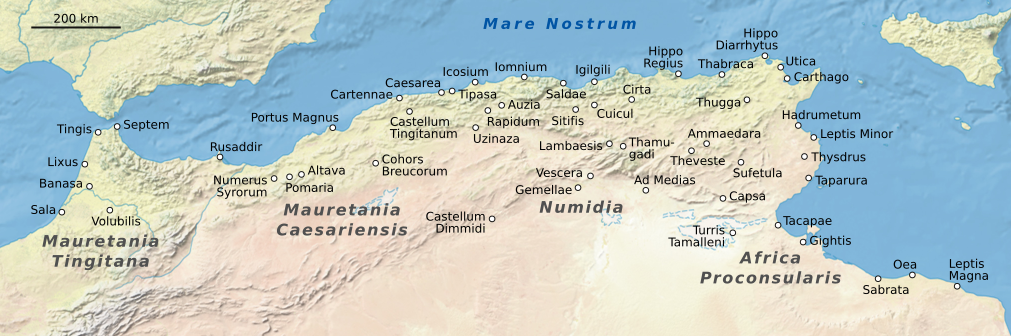
Cities and camps of Roman Africa.
NordNordWest (Creative Commons by-sa-3.0 de)
How do cults from diverse horizons, such as those of Cybele, Isis, or Serapis, integrate into the religious context of Roman Africa? Why, in your view, do some of them achieve notable success while the cult of Mithras seems, on the contrary, to "take" much less well?
I could say that Eastern cults like those of Cybele, Isis, or Serapis integrate into Roman Africa through very concrete channels. They first appear in major urban centers, especially in Proconsularis and Numidia, where networks of power, commercial exchanges, and movement of people are concentrated. They’re carried by clearly identifiable groups—I’m speaking of high officials, priests, soldiers.
What facilitates—and this is the important point—their integration is that they adopt epithets, iconographies, and functions more reconcilable with Africans. If we speak of Serapis, for example, he combines power, celestial and infernal aspects. Isis becomes protector of navigation, guarantor of prosperity. Cybele enters into profound syncretism with the local goddess Caelestis to such a degree that we can’t distinguish between the two. They’re called Cybele-Caelestis. These cults are capable of blending at least partially into the existing religious landscape while maintaining their own identity.
They also benefit from a certain form of quasi-official recognition and social visibility—this is very important. We think, for example, of the attested link between certain Eastern divinities and imperial power and their presence on coins. If we speak of presence on coins, I can cite for example the coins of Serapis found in Tripolitania, dating from the mid-first century BC. Or we can speak of the role played by civil authorities in promoting these cults through dedications, temple construction, and organizing public ceremonies.
Also, we speak of processions, festivals, public rites, such as the opening of the navigation season, the Navigium Isidis, or the lavatio rite of Cybele. These moments, we can say, are visible to the entire population, they can reach a wider audience, even if this participation is sometimes more in the order of spectacle than deep adherence.
For the cult of Mithras, here’s the point—it takes much less well in North Africa. Several factors can explain this. First, the very nature of Mithraism. It’s a strongly initiatic mystery cult, reserved for men, organized in closed spaces. It’s a barely visible cult. It doesn’t offer large processions or public festivals found in Cybele or Isis. It doesn’t have the same visual and collective impact on local society.
Next, Mithra’s social base in North Africa seems much more restricted. Epigraphic testimonies link them mainly to specific circles: military, officials, notables, that’s all, and not to the entire civic body. Unlike Isis, Mithras doesn’t address women or slaves to the same extent, which immediately limits its scope of diffusion.
We can also add that Mithras integrates less well than other Eastern divinities into syncretism dynamics with local or Roman gods. Where Isis can be associated with already known divinities, inserted into the urban pantheon and used by elites as vectors of prestige and political display, Mithras often remains a group cult, marked by strong internal cohesion but weak openness to the outside. We could, generally speaking, differentiate other cults from Mithras for integration within this African religious landscape.
You cite Alain Cadotte, who suggests that certain Roman or Romanized gods durably influenced African divinities, even without massive establishment. How might this phenomenon apply to Mithra’s case?
Cadotte’s observation rests on a general finding. What matters isn’t only the number of sanctuaries or faithful, but also a cult’s capacity to propose models, images, religious schemas reusable by others. In Mithra’s case, this idea can only apply with much caution. My documentation shows indeed that Mithraism in Africa on one hand remains marginal, socially very selective, and poorly integrated into syncretism games with local divinities. We therefore can’t identify an African divinity that would have absorbed Mithras or directly taken up his name, titles, or iconography in a stable way. The influence isn’t of that order.
If we widen the focus a bit, we can envision a more structural form of influence, for example, on the mode of representing salvation. The cult of Mithras proposes a structured vision of salvation, initiation, grades, passage, and banquet of the beyond. There, it’s difficult to show a direct transfer to a specific African divinity.
If we apply to Mithra’s case Cadotte’s intuition, it’s not a spectacular and easily identifiable influence on a particular African divinity, but rather a discreet and indirect influence. Mithras doesn’t shape an identifiable African divinity, but he participates in the march, in the reconfiguration of the African religious landscape at the end of Antiquity.
So should we speak of resistance or indifference, or are there a few cases of appropriation?
Based on currently available documentation, it’s very difficult to speak of genuine articulation between Mithraism and local Berber cults. We don’t have sufficient evidence to evoke explicit resistance, nor even clearly identifiable indifference. In reality, what appears, above all, is the absence of direct contact. We rather have the impression of a non-encounter, neither confrontation nor dialogue.
On the level of theological contents, the gap is profound. The cult of Mithras is conveyed by ideas of the beyond, salvation, immortality, resurrection, etc., which are largely foreign to African populations accustomed to cults of spirits, ancestors, sun, moon, and certain animals, and strongly marked by the heritage of Punic divinities. At this stage there’s no obvious meeting point or structuring convergence between these forms of religiosity and the esoteric, initiatic, and masculine character of the cult of Mithras.
I think we can speak neither of appropriation nor even of genuine confrontation. Mithraism remains contained in specific circles—there I mean military and administrative—without succeeding in entering into the syncretism game with local Berber cults.
According to your study, how did the cult of Mithras arrive in Roman Africa? Through which vectors and at what times?
The main vectors of this establishment could be divided into three. First, the army, particularly circles linked to the Third Augustan Legion and auxiliary troops stationed in Numidia. Then certain administrative and Romanized urban circles, notably officials and officers who may have been initiated into the cult of Mithras in other provinces before being transferred and installed in Africa. We can also add a third vector linked this time to the commercial environment. Mithras being after all a god of contract, he very probably circulated with merchants.
In ancient North Africa, we’ve noted a significant number of coastal cities where traces of his presence have been uncovered, such as Carthage, Rusicade, Caesarea. At Caesarea, where we have an inscription of a freedman, classified by Marcel Le Glay, very likely among testimonies of merchants.
This predominance of the military vector is not specific to Africa. On the Empire’s scale, Mithras is a cult strongly associated with soldiers who circulate between frontier provinces. In North Africa, the cult follows comparable logic. It appears where the army is strongly present. We can suppose that Mithras probably doesn’t arrive in Africa directly from Iran or Syria, but through the intermediary of provinces where the cult is already well established.
We can say in summary, in the African context, the cult of Mithras spreads neither through popular roots nor through a major political project, but according to the movements of the army.
What are the first reliable attestations of the cult of Mithras in North Africa?
The first reliable attestations of the cult of Mithras in North Africa are relatively late compared to other regions of the Empire. Most researchers—here I can cite Charles Daniels or Marcel Le Glay—agree in situating Mithraic establishment from the second half of the 2nd century AD, based on epigraphic data.
If we truly rely on inscriptions known today, the first attestations of the cult of Mithras in North Africa are therefore situated from the second half of the second century AD and are closely associated with the military environment and urbanized cities of the provinces, especially the Caesarean ones. The first epigraphic attestation dates, according to reliable analysis, to 183-184 AD, and it’s a dedication made by a legate named Marcus Valerius Maximianus who was legate of the Third Augustan Legion. So any hypothesis of an earlier presence remains at this stage devoid of solid epigraphic foundations.
Do the four mithraea identified in North Africa—those of Lambaesis, Rusicade, Tiddis, and Cirta—present specifically African architectural characteristics?
Not really. From the dossier I’ve assembled, it’s difficult to speak of architectural characteristics that are specifically African for the mithraea of Lambaesis, Rusicade, Tiddis, or even Cirta. What the corpus shows above all is these sanctuaries’ inscription in the grand architectural model of Roman Mithraism, with occasional adaptations to terrain, urban fabric, and local religious context, rather than a genuine original African school.
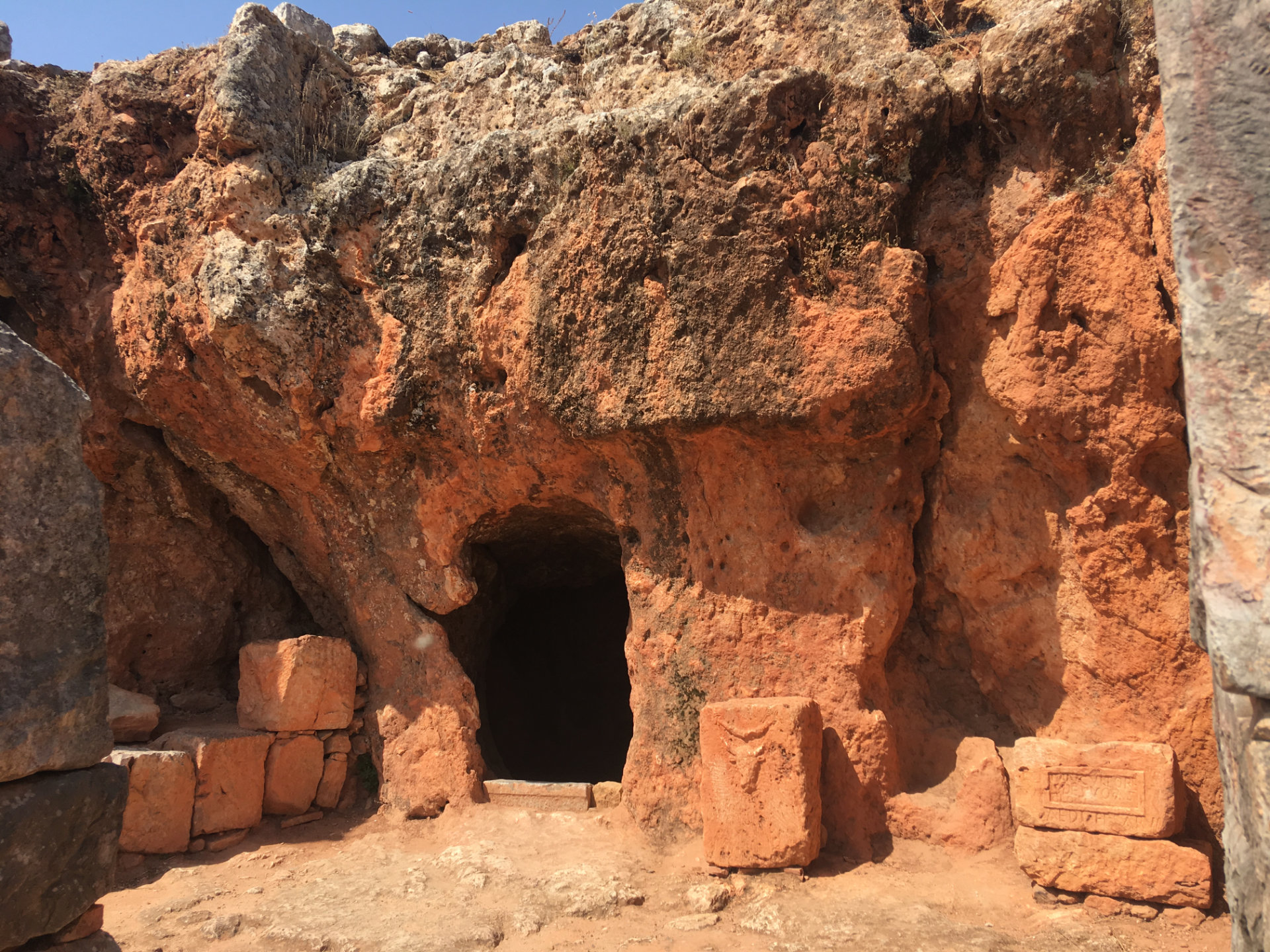
Entrance to the Mithraeum of Tiddis
James Patterson
On one hand, the mithraeum of Lambaesis is located in the heart of the military capital, with architecture conforming to the classic Mithraic type. Analysis shows that its plan more closely resembles Danubian models and Western examples than Eastern sanctuaries. It’s a Roman mithraeum established in Africa rather than an original African creation.
On the other hand, the sanctuary of Tiddis introduces an interesting nuance without however constituting an autonomous African type. It indeed combines a natural cave and a building constructed on a mountainside. This mithraeum envisions the hypothesis of a double Mithraic-Cybelian sanctuary with the existence of an underground room possibly linked to the taurobolium. Here again, the recourse to cave, underground spaces, vertical circulation fits fully into the logic of the spelaeum.
For Cirta, the documentation is read mainly through the cryptic characters of the cult place. The governor offers a spelaeum, a crypt endowed with statues and decor probably located in an area rich in caves, what were called the pigeon caves. Here again we find the Mithraic preference for cavernous spaces inserted in a first-rate urban center. Cirta’s singularity lies less in an unprecedented architectural form than in its profile as a major interior capital, commercial and religious crossroads, far from the great ports and major military bases usually associated with the cult.
Finally, at Rusicade, we don’t have a plan of the mithraeum itself, but only a set of cultic elements: altars, a tauroctony relief, statues of Cautes and Cautopates, leontocephalic Mithras, rock surrounded by serpents, purification vases. Everything converges toward the hypothesis of a very classic underground or semi-underground temple.
The four mithraea identified in North Africa don’t properly speaking present specifically African architectural characteristics. They generally fit into the grand model of Roman Mithraism. That’s what we can say. There’s no specifically African particularism.
You note that these sanctuaries show closer affinities with the Danubian provinces than with the Roman East. Why is this significant?
According to Marcel Le Glay, the sanctuary of Lambaesis is closer to Danubian models and Mithraic temples of the West and not Oriental sanctuaries. In other words, the architecture itself here can function as a trajectory marker. It reveals the path followed by the cult. This means that African Mithraism wasn’t established directly from the Orient, but that it arrived through the intermediary of Western provinces and more particularly the Danubian sector and perhaps through Rome.
This architectural kinship perfectly accords with the social composition I’ve highlighted. A community formed largely of soldiers and officials. If we return to the inscriptions, we find that several dedicants were foreigners. We have Marcus Valerius Maximianus and Marcus Aurelius Sabinus from Upper Pannonia. The soldiers of the 7th and 10th legions, of the 2nd Herculean legion mentioned in the Tiddis fragment, are also from Pannonia. We also have Publilius Albinus and Marcus Aurelius Decimus, both from Rome. As well as Aurelius Nestorius, a centurion of the British standard-bearers installed at Volubilis.
We thus see taking shape essentially military and administrative diffusion networks, linking the Danubian provinces to Africa. Troop transfers, officers’ careers, movements of imperial cadres, who import with them their religious practices, including their sanctuary model.
In sum, architectural kinship with the Danubian provinces confirms that African Mithraism fits into a Western circuit and into a mode of cult diffusion carried by the army and Romanized elites rather than in a current directly from the Roman East or indigenous circles as well.
The case of the Tiddis mithraeum raises questions. In what way can it be considered singular, and why? What importance do you give it?
The Tiddis mithraeum occupies a quite particular place in the African dossier, precisely because of its singular architectural configuration. Unlike the mithraeum of Lambaesis which illustrates a classic Mithraic model of Danubian influence, inserted in an urban framework, Tiddis associates a natural cave and a building constructed on a mountainside, in immediate proximity to the main road and entrance, it’s approximately, if I remember correctly, about 40 meters from the great city gate, on the right. This location highlights a very advanced adaptation to terrain and an original integration of the sanctuary into the local urban and religious landscape.
Its significance lies first in its architectural dimension. The site comprises a paved courtyard, columns, a stepped staircase, and a ritual cave, all of which suggest a complex itinerary articulating an open space and a cavernous space, an upper level and a lower level. The inscription referring to the cultores of Mithras shows that the local community of devotees played a direct role in the construction of the sanctuary. The mithraeum of Tiddis is not merely a temple introduced by the army or by senior officials, it also bears witness to a collective commitment by an organised body of worshippers, making it a particularly valuable observatory for the forms of Mithraic associations in North Africa.
The discovery of sculpted phalluses and bull heads, together with the hypothesis of a possible double Mithraic-Cybelian sanctuary linked to the taurobolium further reinforces the site’s interest. It appears as a place where several ritual traditions intersect, which makes it a valuable laboratory for reflecting on interactions between Eastern cults in an African context.
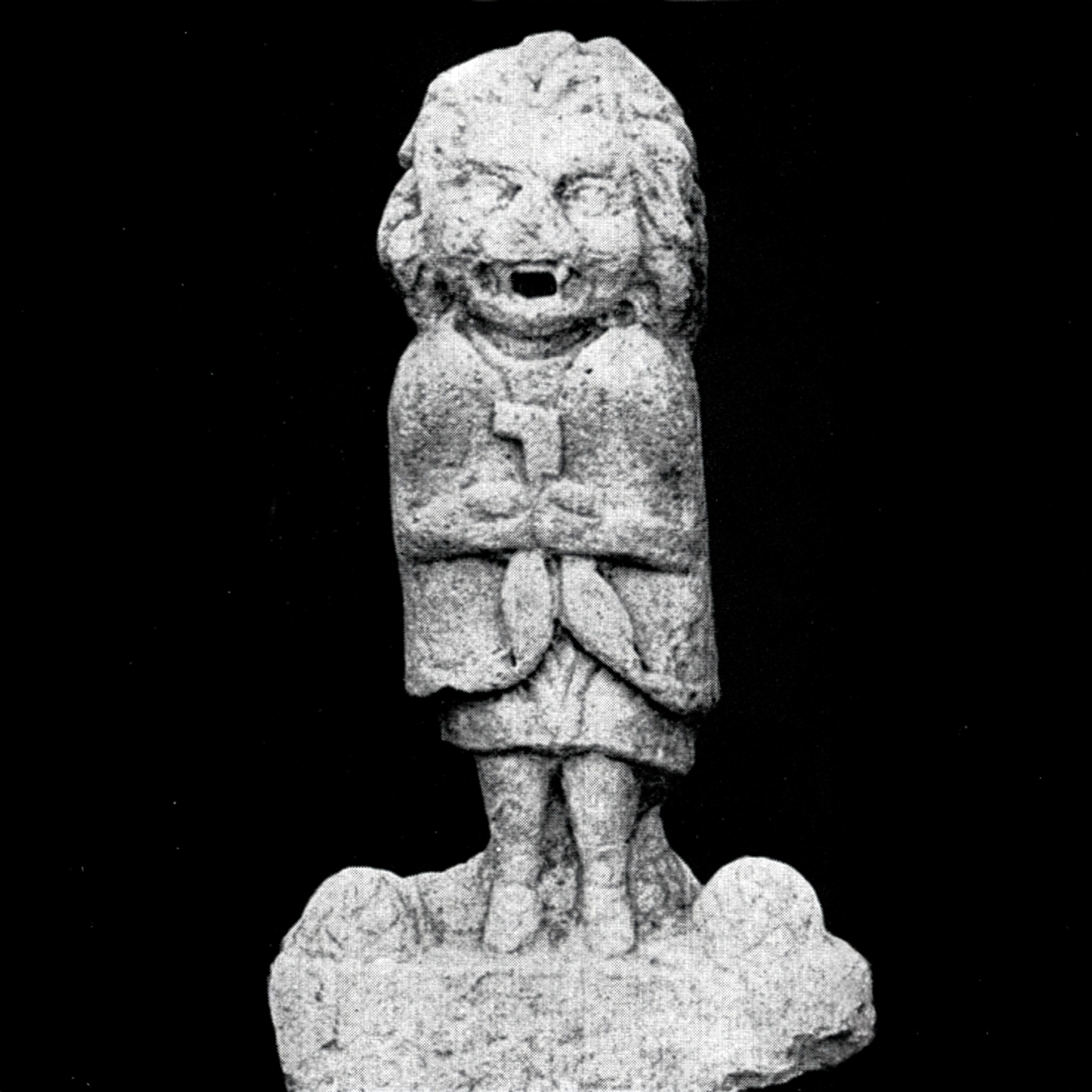
In this same mithraeum, we find two reliefs representing phalluses with rooster feet. This motif has sometimes been associated with the cult of Mithras, while it’s very rarely attested elsewhere in the Empire. Recent works, notably those of Salima Siada, instead propose seeing in it an apotropaic symbol, with protective aim, or an element borrowed from other traditions. How do you interpret the presence of these reliefs in this sanctuary?
The phallus with rooster feet discovered at Tiddis really poses a problem. Indeed, it’s a troubling piece and at the same time very revealing of the limits of our Mithraic reading of objects. It’s sculpted on a parallelepiped block in a form that clearly evokes a rooster standing on miniaturized feet. It was found in the context of the sanctuary dedicated to Mithras. It’s this topographical association, more than the motif itself, that led part of research to make it a Mithraic index.
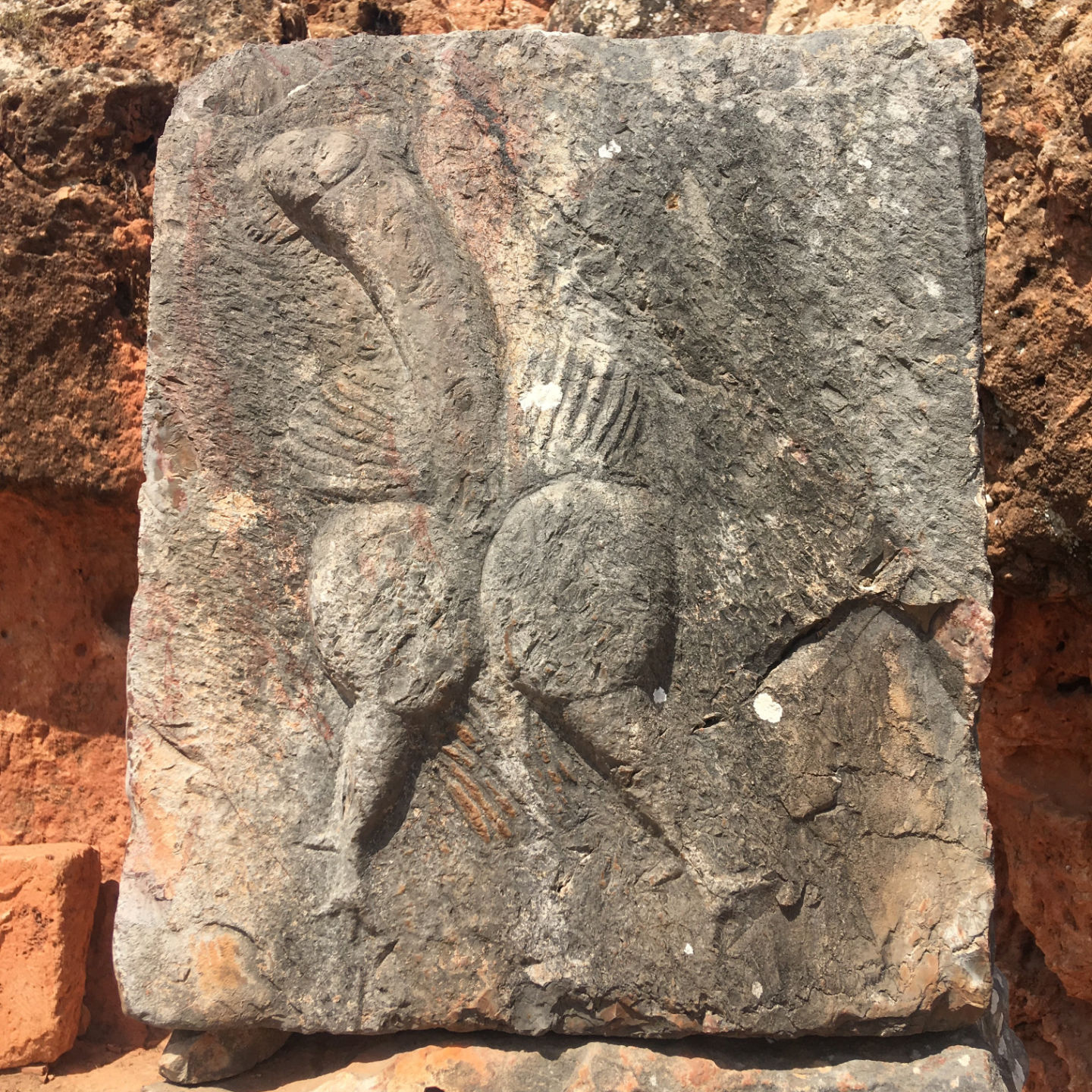
Phallus cock from Tiddis Mithraeum.
James Patterson
In my approach, I would be rather cautious and I’d insist on three points. The first point is it’s a contextual object, not a classic Mithraic symbol. The motif of phallus with rooster feet doesn’t properly belong to the usual iconographic repertoire of the cult of Mithras. We don’t find it or almost not in the great known Mithraic ensemble at present in the Empire. Its interpretation as a symbol of Mithras therefore rests above all on its presence in the sanctuary’s area and not on a widely attested Mithraic tradition. From this point of view, it’s more accurate to speak of a contextual object than a sure Mithraic marker.
Secondly, we can speak of a probably apotropaic symbol linked to another tradition. The simultaneously phallic and animal character of the piece, its aggressive aspect and its location in a cultic space invites seeing in it a symbol with strong apotropaic charge, intended to protect the place, ward off evil, and channel vital forces. This type of symbolism largely exceeds the Mithraic framework alone. In the Tiddis sanctuary, I myself recall the presence of elements referring to the taurobolium and cults of Cybele as well as the hypothesis of a double Mithraic-Cybelian sanctuary. In this perspective, the phallus may very well belong to a broader symbolic horizon shared by several oriental cults and not exclusively Mithraic.
The third point is that there’s an important piece but with open interpretation in the African dossier. For African Mithraism, this piece remains important in two ways. First because it illustrates the richness and complexity of Tiddis sanctuary’s decor, where caves, basins, bull heads, etc. coexist. Next, because it recalls that African Mithraic sanctuaries and that of Tiddis in particular can’t be read as purely Mithraic spaces, but as places of superposition and ritual hybridization. There you are. We should also bear in mind that, if we take into consideration the inscription of the cultores, these may have been African adepts who took part in the construction. That can have a relationship with other African beliefs.
In summary, I would be reluctant to make the phallus with rooster feet a properly Mithraic symbol. I understand it rather as an apotropaic or polymorphic element inserted in a sanctuary where Mithras probably coexists with other oriental cults. Its place in the African Mithraic dossier is therefore real, but above all as witness to overlap, acceptance, of traditions and fluid boundaries between different oriental cults in North Africa, rather than as doctrinal emblem of the cult of Mithras itself.
Moreover, I haven’t found other phalluses like this in Africa. And even when I consulted Vermaseren, I don’t remember having found another phallus in his corpus.
The discovery of a bust of Caracalla in a potentially Mithraic temple at Rusicade has sometimes been interpreted as a sign of association between Mithraism and imperial cult. What is your position on this hypothesis?
The discovery of a bust of Caracalla in a potentially Mithraic space at Rusicade doesn’t seem to me sufficient to postulate a genuine fusion between Mithraism and imperial cult. It rather testifies to a more general phenomenon, the presence of the imperial image in numerous public religious spaces, including where oriental cults are practiced. We can see in it a form of cohabitation, even ritual complementarity. One honors both the god and the emperor, but not necessarily a structural integration of Mithraism into imperial cult.

Emperor Caracalla ordered one of Rome’s largest temples to the god Mithras to be built in the baths bearing his name.
CC0 1.0
If we consult inscriptions found on African soil, we find three that mention emperors’ names. The Simitthus inscription dating from the reign of Emperor Elagabalus, and is dedicated to Emperor Marcus Aurelius Antoninus and Julia Maesa. The Lambaesis inscription is dedicated to Gaius Julius Verus Maximus, while the third found at Ain Toukria is dedicated to Marcus Antonius Gordianus.
The aspect these inscriptions give can be deceptive. The real number of these dedications remains limited compared to the total of available inscriptions. Many fall into the well-known logic of complaisance and loyalty of municipal elites toward imperial power. For all oriental cults, the emperor’s presence in a cultic context isn’t enough to make this cult an imperial cult. Mithra’s case is very different from that of Isis or Cybele.
The Isiac cult in North Africa took on a quasi-official character, particularly thanks to its explicit links with emperors and their representatives, as well as its presence on the coins I mentioned earlier, the coins of Serapis. The Phrygian cult itself is frequently associated with the imperial family from Tripolitania to Tingitana, as numerous inscriptions testify.
Conversely, the relationship between Mithras and emperors remains weak. The cult never acquired official status, that’s clear. Although certain emperors may have been personally devoted to Mithras, I would therefore be very cautious facing this hypothesis of a close association between Mithraism and imperial cult based on a single bust of Caracalla found at Rusicade.
In your book, Le culte de Mithra en Afrique du Nord antique, you emphasize that the dossier remains "opaque but promising." In your view, what archaeological discoveries could advance our understanding of African Mithraism? What other sites, still little explored, would merit particular attention?
When I speak of an opaque but promising dossier, I first mean that it rests today on very little. We have eleven sites across the entire African region, four mithraea, twenty inscriptions, poor archaeological remains, and a very narrow social base. In this context, a few well-targeted discoveries would suffice to profoundly shift the picture.
For example, a well-preserved mithraeum with dated inscriptions and complete decor. What I mean by complete decor is decor that has cultic scenes, murals, colored, statues, religious materials. This would allow us to specify local chronology, the social profile of adepts, the degree of community organization, and the cult’s place in the city.
Also, if we come across dedications clearly emanating from non-elite local populations, we’d really like to have that. Today, my study shows that artisans, merchants, workers, ordinary people are almost absent from the dossier. The discovery of Mithraic inscriptions by ordinary townspeople or rural people, bearing indigenous or Romanized African names, would transform the question of the cult’s popularity. We’d move from a closed group Mithraism to a cult at least partially shared by the civic fabric.
Also what I wish is to have explicit indices of articulation with local cults. I’m speaking of Berber or Punic cults. For now I rightly insist on the absence of clear syncretism between Mithras and African divinities. No Mithras with Caelestis or Mithraic equivalent of Baal Hammon for example. Discoveries showing systematic co-dedication with African or Punic divinities would force us to reconsider the idea of a non-encounter between Mithras and Berber cults.
Regarding places, my book allows us to identify several promising research directions, even if we remain cautious. The four already known sites, but still partially exploited. Why at Lambaesis don’t we deepen excavation research around the surroundings of the sanctuary? At Tiddis, already, we have a sanctuary complexity that groups caves, terraces, stairs, basins, etc. The sector around the cave and underground structures clearly remain conducive to discoveries.
At Cirta, the mention of spelaeum and the hypothesis of the pigeon cave suggest that more systematic work on the numerous cavities around the urban rocks could reveal additional cultural levels, even other phases of Mithraic development. At Rusicade, the Mithraic material we found indicates a very probable mithraeum, but poorly located. Targeted excavations in the Bou Yala hill area could eventually recover the temple plan and clarify its relationship to port spaces.
I recall that mithraea have sometimes been proposed at Volubilis and at Leptis Magna, but their identification should be reconsidered. These are typically dossiers where archaeological and stratigraphic reexamination would be indispensable, possibly associated with new excavations that could either confirm Mithraic presence or invalidate it.
We can even speak of a mithraeum at Carthage, and there it’s very important since there are mentions by Tertullian of the existence of the Mithraic cult at Carthage. We must search especially under Christian and Byzantine churches because a considerable number of churches in Rome are built on mithraea. That would be about it. If we manage to find something, it will be really very useful for understanding Mithraism in Africa.
Aion of Skikda.
CIMRM
More broadly, what does the study of the cult of Mithras bring to understanding religious dynamics in Roman Africa?
In my view, the main interest of African Mithraism is precisely its weakness. The fact that it’s poorly attested, socially very selective, and poorly integrated into local traditions makes it an excellent observatory of the limits of oriental cult diffusion in Roman Africa.
First, this helps us show that Roman Africa isn’t a simple homogeneous receptacle for cults coming from the Orient. The trajectories of Isis, Cybele, Serapis on one side and Mithras on the other are very different. Some cults find strong relays, open to the population, enter into syncretism with local divinities, and can acquire quasi-official status. Mithras remains confined to specific networks. There I’m speaking of military, administrative, and masculine, with very limited impact on urban and rural populations. This forces us to think of oriental cults not as a block but as a constellation of cults with unequal fortunes.
Next, the African case well highlights the role of circulation networks in cult establishment. The architecture of mithraea, especially Lambaesis, points toward a Danubian rather than Oriental origin, which reveals the importance of army routes and officials’ careers. African Mithraism also shows that an oriental cult’s diffusion can pass through Western circuits and not by a simple east-west flow.
Moreover, the almost total absence of syncretism between Mithras and Berber or Punic divinities recalls that a cult can be present without however fitting into the game of local religious correspondences. Where Isis or Cybele dialogue with the African pantheon, Mithras on the contrary illustrates the possibility of coexistence without genuine encounter, marked by doctrinal distance and the cult’s esoteric character.
Finally, the African Mithraic dossier invites us to take minority cults seriously to understand overall religious dynamics. Even marginal, Mithras reveals the way certain social groups—there I’m speaking of soldiers, imperial cadres, foreigners—use specific cults to construct identities, solidarities, spaces of sociability proper to the interior of the African religious landscape.
If you accept, we can say that African Mithraism mainly brings a series of counter-examples. It shows what happens when an oriental cult becomes neither popular, nor official, nor integrated, nor truly Africanized. It’s precisely in hollow, by contrast with other better established oriental cults, that it illuminates modes of establishment, silent resistances, and internal hierarchies of the religious field in Roman Africa.
To conclude, what projects are you currently working on, and what research directions would you like to explore in coming years?
I think I’ll develop and deepen a more prosopographic and social reflection on this cult’s adepts, soldiers or officials, also when sources permit, faithful from more modest circles, of course, if we find them, the idea being to better understand how these individuals fit into the careers, networks, and identities of these characters.
For coming years, I’d like to explore two particular directions. On one hand, a mapping and spatial analysis project of GIS type of oriental cults in North Africa to visualize their diffusion networks in connection with military axes, ports, and major regional capitals. On the other hand, comparative work on the disappearance of oriental cults by integrating Mithraism into broader reflection on the end of oriental cults and religious transformations of Roman Africa between late Antiquity and the first centuries of Christianity.
Le culte de Mithra en Afrique du Nord antique. Etude épigraphique et archéologique is available for sale on Amazon in its original French version.

Comments
Add a comment