
Biography
of Aelia Arisuth
- Aelia Arisuth may have been associated with a Mithraic community.
- Attested in c. 400.
- Attested at Oea, Africa Proconsularis, Africa (TNMM 575).
TNMP 308
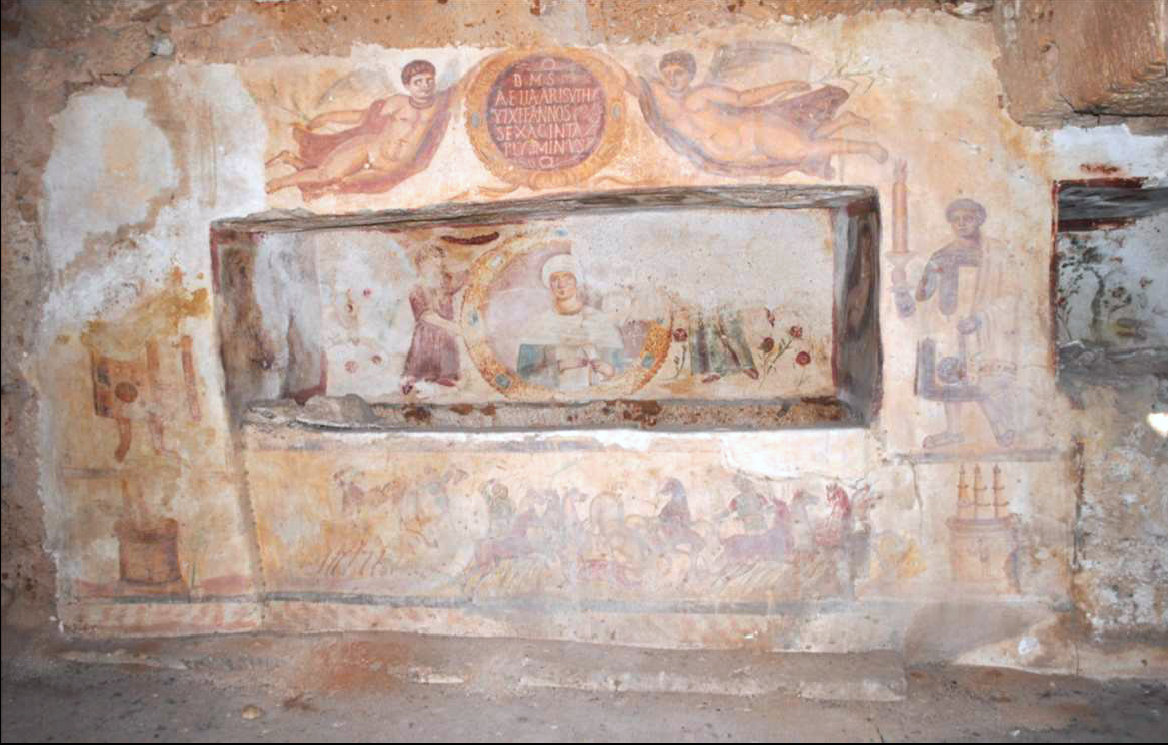
Aelia Arisuth was a woman buried at Oea, modern Tripoli, in a richly decorated rock-cut tomb dating to the late third or early fourth century CE. Together with the neighbouring burial of Aelius Magnus, her tomb became famous after the discovery of painted inscriptions ending with the phrases qui leo iacet and quae lea iacet (“here lies the lion” and “here lies the lioness”). On this basis, Franz Cumont proposed that the couple had belonged to a Mithraic community and that leo and lea referred to Mithraic initiation grades. This interpretation was later accepted, with reservations, by Vermaseren, who also pointed to certain iconographic similarities between the tomb paintings and figures known from Mithraic contexts (Cumont; Vermaseren, 1956).
More recent scholarship has largely rejected this interpretation. The tomb itself lacks unequivocal Mithraic imagery, is dedicated to the Di Manes, and provides no secure evidence that either occupant belonged to a Mithraic congregation. Furthermore, the exclusively male character of Mithraic communities makes the existence of a female grade lea highly problematic. Detailed re-examinations of the monument have instead connected its imagery with broader funerary traditions of Roman North Africa and, in the case of Aelia Arisuth, possibly with the cult of the Great Mother or with local civic symbolism associated with circus patronage. For these reasons, several modern scholars exclude the tomb from the corpus of reliable Mithraic evidence altogether (Chalupa 2005; Griffith 2006).
References
- Aleš Chalupa (2023) Římský kult boha Mithry.
- Aleš Chalupa (2005) ‘Hyenas or Lionesses? Mithraism and Women in the Religious World of the Late Antiquity’. Religio Studie, XXIV(1), 20-52, XIII(2), 198-230, pp. XIII(2), 198–230.
- Alison Griffith (2006) Completing the Picture: Women and the Female Principle in the Mithraic Cult.
Attestations
Frescoes from the tomb of Aelius Magnus and Aelia Arisuth in Oea
TNMM 575
The Mithraic nature of the frescoes of Oea, according to the scholars Cumont and Vermaseren, is now questioned.
