This site uses cookies to offer you a better browsing experience.
Find out more on how we use cookies in our privacy policy.

 
Provincia

Mithras in Africa Proconsularis

Africa Proconsularis formed one of the principal urban and administrative centres of Roman North Africa where Mithraic cults circulated through prosperous civic networks.

The Mithraic material documented in Africa Proconsularis reflects the province’s exceptional urban development and integration within Mediterranean trade and imperial administration. Cities, ports and regional mobility contributed to the spread of cults across Roman North Africa.

Mithraic monuments of Africa Proconsularis


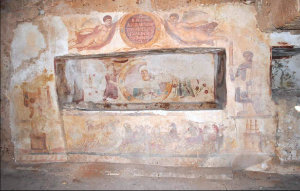
Frescoes from the tomb of Aelius Magnus and Aelia Arisuth in Oea

The Mithraic nature of the frescoes of Oea, according to the scholars Cumont and Vermaseren, is now questioned.

CIMRM 113


CIMRM 118

According to AA 1900, 63 a mosaic with lion and panther was found near an old Punian cemetery at Duimes.

CIMRM 118


CIMRM 119

In the upper layer of the "tophet" at Carthago, under which a very old sanctuary was situated, a small Mithras-relief was found by Cintas in 1949 (Br. 0.50).

CIMRM 119


CIMRM 120

Ph.

CIMRM 120


Inscription of Chemtou

Dedication from Simitthus mentioning the restoration of a monument and a vow fulfilled to Cautes and Cautopates during the reign of Caracalla and Julia Maesa.

Places in Africa Proconsularis


Oea

Oea was an ancient city in modern-day Tripoli, Libya, founded by the Phoenicians in the 7th century BC. It became a Roman-Berber colony in the second half of the 2nd century BC.


Simitthus

Chemtou or Chimtou was an ancient Roman-Berber town in northwestern Tunisia, located 20 km from the city of Jendouba near the Algerian frontier. It was known as Simitthu (or Simitthus in Roman period) in antiquity.

Inscriptions from Africa Proconsularis

Frescoes from the tomb of Aelius Magnus and Aelia Arisuth in Oea

D[is] M[anibus] s[acrum] / Aelia Arisuth / vixit annus / sexaginta plus minus. // Quae lea iacet.
Sacred to the gods of the dead. Aelia Arisuth lived sixty years, more or less. She lies here.

Inscription of Chemtou

[------] Imp[eratoris] Caes[aris] M[arci] Aurel[i] An]/tonini ⟦---⟧ et Iuliae Ma[esae ---]/re novo et carmine sign[---]/legionis restituit auxil[---]/solvit Cauten Cautopate[n ---].
[…] of Emperor Marcus Aurelius Antoninus […] and of Julia Maesa […], anew and according to the directive […], the auxiliary unit of the legion restored […], and fulfilled a vow to Cautes and Cautopates […].
Back to Top