Your selection gave 488 results.

The settlement of Bingerbrück formed part of the Rhine crossing zone opposite the lower Nahe valley.
Bingen occupied a strategic position at the confluence of the Rhine and Nahe rivers.
Besigheim stands at the confluence of the Enz and Neckar rivers in the frontier region of southwestern Germania.
Beihingen occupied a position within the Neckar frontier communications zone.
Bedaium occupied a position near the Chiemsee lake region within the northern Alpine frontier zone.
Bandorf lies within the Rhine frontier region associated with the military landscape of Germania Superior.
The site of Alteburg-Heftrich formed part of the frontier landscape connected with the Upper Germanic limes.
Abudiacum occupied a position along the important road network linking Raetia with the Alpine regions.
St. Wendel is associated with archaeological material from the Roman-period Moselle-Saar region.

A head in a Phrygian cap, possibly belonging to a torchbearer statue, formerly kept at St. Wendel in Belgica but possibly transported to the Provinzialmuseum in Trier, where it may be identical with CIMRM 993.
Roman military settlement in Germania superior, generally identified with present-day Ober-Florstadt and known for its well-preserved Mithraic sanctuary.
Two red pottery fragments from a plate found near the Schützenstrasse at Augusta Treverorum (modern Trier) in Belgica, showing the forepart of a horned bull and the hindquarters of a lion, possibly Mithraic in character.
A small pottery fragment of uncertain find-spot, probably from Augusta Treverorum (modern Trier) in Belgica, showing a lion walking to the right before a bull's head, with palm-like foliage, tentatively interpreted as Mithraic by Loeschcke but considered too doubtful by Vermaseren…
Three fragments of a pottery plate bearing a relief of Mithras as bullkiller, with Cautes holding an upraised torch and sickle-shaped object and the bust of Luna above, found in the pottery workshops along the Ziegelstrasse at Augusta Treverorum (modern Trier) in Belgica…
A fragment of a white marble head in a Phrygian cap, facing right, probably representing Mithras, with an uncertain find-spot but likely from Augusta Treverorum (modern Trier) in Belgica.
A scholarly note recording that finds at Heiligkreuz, including a lion's head and leg fragment, the head of a genius, and a knife with a gold handle, support the hypothesis of a Mithraeum at that location in Augusta Treverorum (modern Trier) in Belgica…
A bronze votive slab bearing a dedication to the unconquered god, found on a hill at Heiligkreuz near the proposed Mithraeum at Augusta Treverorum (modern Trier) in Belgica.
A small limestone head of Cautopates, facing right, with a damaged nose and a stone pin on the reverse indicating it belonged to a relief, found on the slope of a hill near Heiligkreuz at Augusta Treverorum (modern Trier) in Belgica.
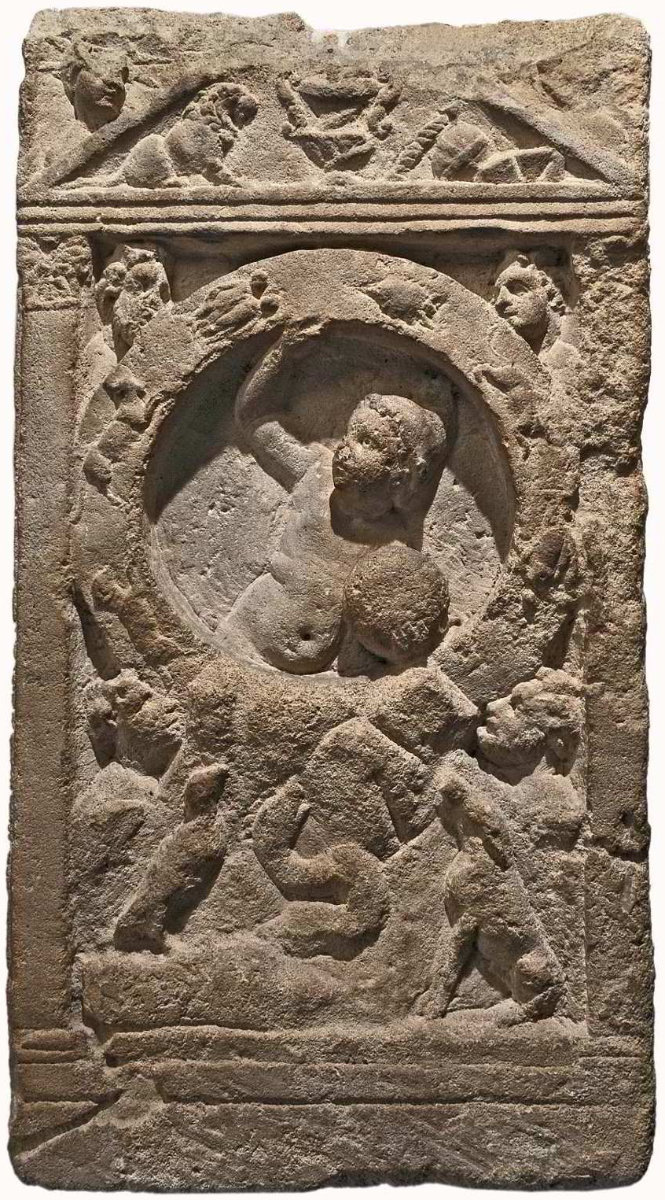
The relief depicts the birth of Mithras, holding a globe, surrounded by the zodiac.
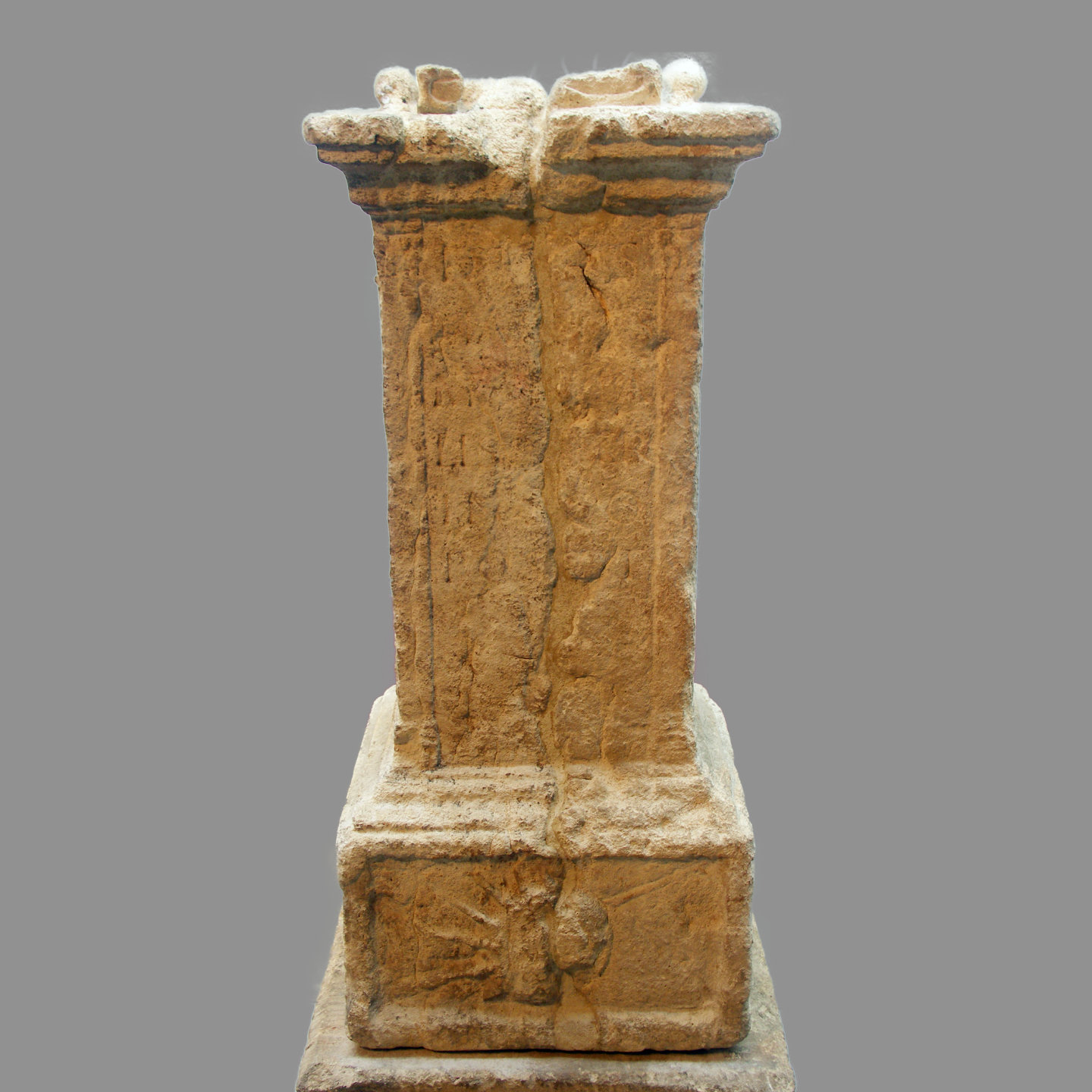
This stone altar fround in Altbachtal bears an inscription by a certain Martius Martialis.
