Your selection gave 80 results.


Limestone stele recording endowments for the feast of the Mithrakana by Antipater and his son Gaios, found at Amorium (modern Hisarköy), Phrygia.
Rough-hewn statuette found at Emir Ghasi in Lycaonia, once thought to represent a Mithraic soldier; according to Cumont, a modern forgery.
Rock inscription of Sagarios, strategus of Ariaramneia, recording a Mithraic ceremony near Farasha (ancient Ariaramneia), Cappadocia, likely 1st century A.D.
Marble funerary stele dedicated to the soldier Aurelius Lucanus, a devotee of Mithras, found at Amasya (ancient Amasia), Pontus.
White marble plate inscription dedicated to Soli Invicto pro salute, from Caesarea of Mauretania (modern Cherchel).
Altar inscription dedicated to Deus Invictus, found at Cherchel (ancient Caesarea of Mauretania).
Great royal inscription of Antiochus I of Commagene carved on the thrones at Nemrud Dağı, invoking Apollo-Mithras-Helios among the guardian deities of the kingdom, 69–34 B.C.
Possible Mithras sanctuary at a grotto entrance in the Kavag-Dağ, Lycia; the identification remains purely hypothetical according to Cumont.
Limestone base bearing a dedication to Helios Mithras by Midon son of Solon, with a bust of Mithras in Phrygian cap, found at Savçilar on the border of Phrygia and Mysia, 78/77 A.D.
Sepulchral inscriptions from Lycaonia bearing the titles leo and aetos, previously interpreted as Mithraic grades but now understood as referring to tomb architecture.
Brief dedicatory inscription to Mithras the Just, found at Tyana (modern Kemerhisar), Cappadocia.
Commagenean sanctuary preserving relief fragments of Mithras greeting royal figures at the hierothesion of Mithridates Kallinikos.

Subterranean sanctuary at ancient Atchana tentatively interpreted by Woolley as an early precursor to later Mithraic temples.
Antioch was the capital of Roman Syria and gateway between the Mediterranean and the eastern provinces.
Latin dedication to the invincible Mithras reportedly discovered north of ancient Colophon in Lydia.
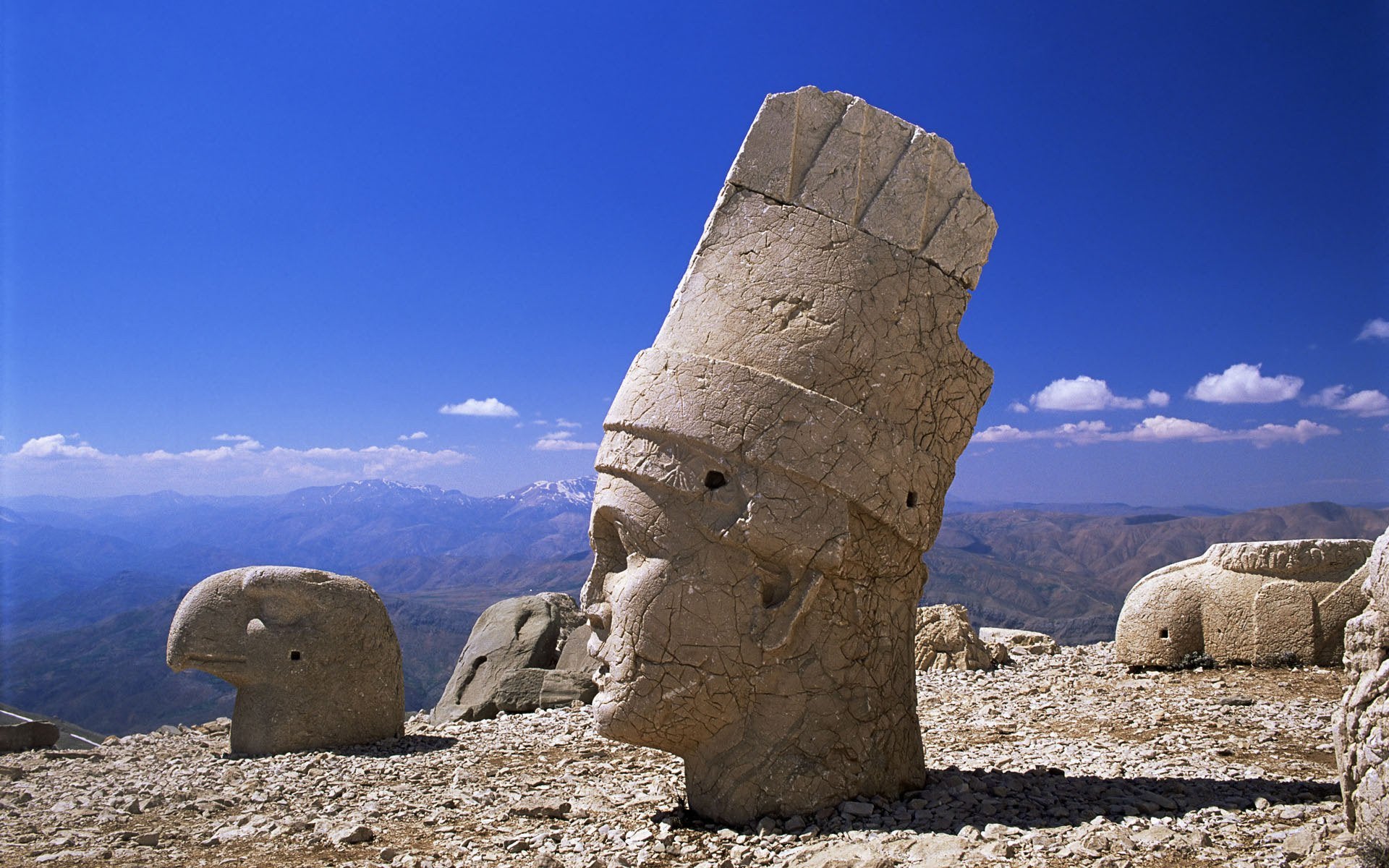
The colossal head has been identified as a solar god, Apollo-Mihr-Mithras-Helios-Hermes.

This dedicatory inscription by Aurelius Seleucus, found in Cilicia, aligns with Plutarch’s account of Cilician pirates performing foreign sacrifices and secret rites of Mithras.

This votive silver plaque depicting Mithras was found at the site of Pessinus, Ballıhisar, in Turkey.
