Filtering by Location: Roma in monuments gave 309 results.
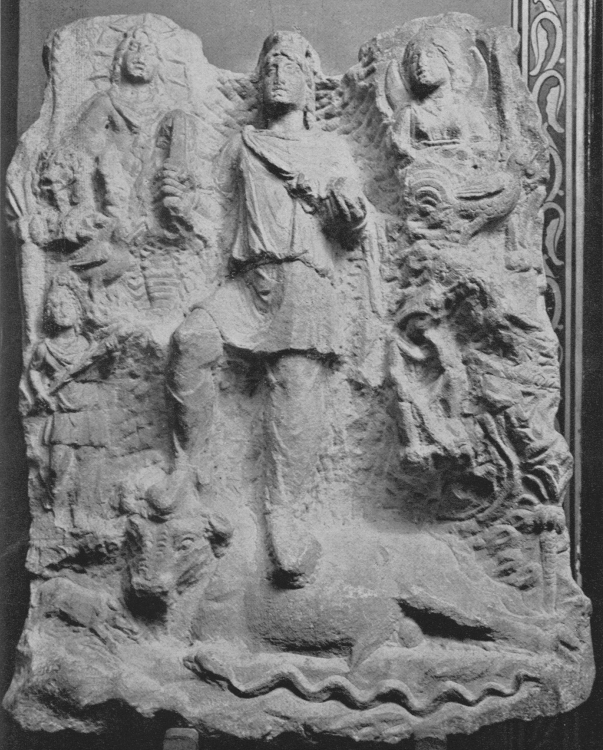
This unusual representation of Mithras standing on a bull was kept in the Casino di Villa Altieri sul Monte Esquilino until the 19th century.

This marble monument was dedicated in Rome by the slave Fructus and his son Myro.

This marble altar was found ’in the street called di Branco’, behind the palace of the Cardinal of Bologna, in Rome.
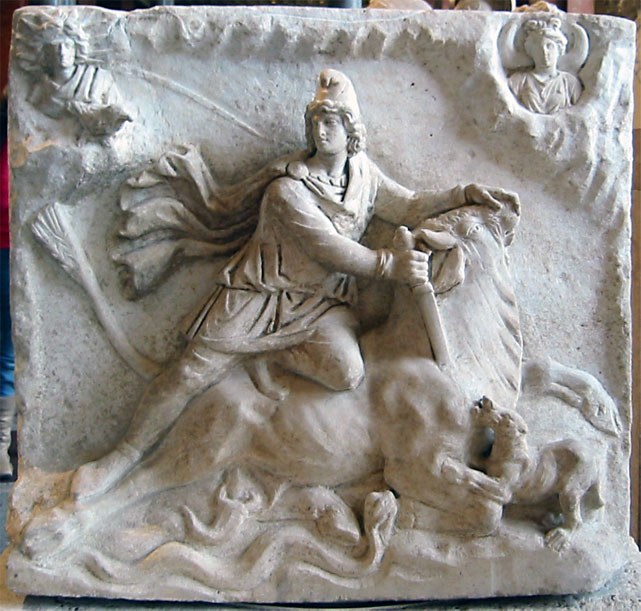
The marble shows Mithras slaying the bull, on one side, and Sol and Mithras feasting on a bull skin, on the other.
Relief of bluish marble in the Casino of the Villa Doria Pamphili showing Mithras slaying the bull with the usual animals, cross-legged torchbearers, and Sol in a quadriga and Luna in a biga in the upper corners.
This monument records the transmission of the patrica and the presentation of the cryfii, ritual acts associated with Mithraic initiation.
One of the earliest securely dated Mithraic inscriptions, documenting the cult’s early presence within the imperial household.
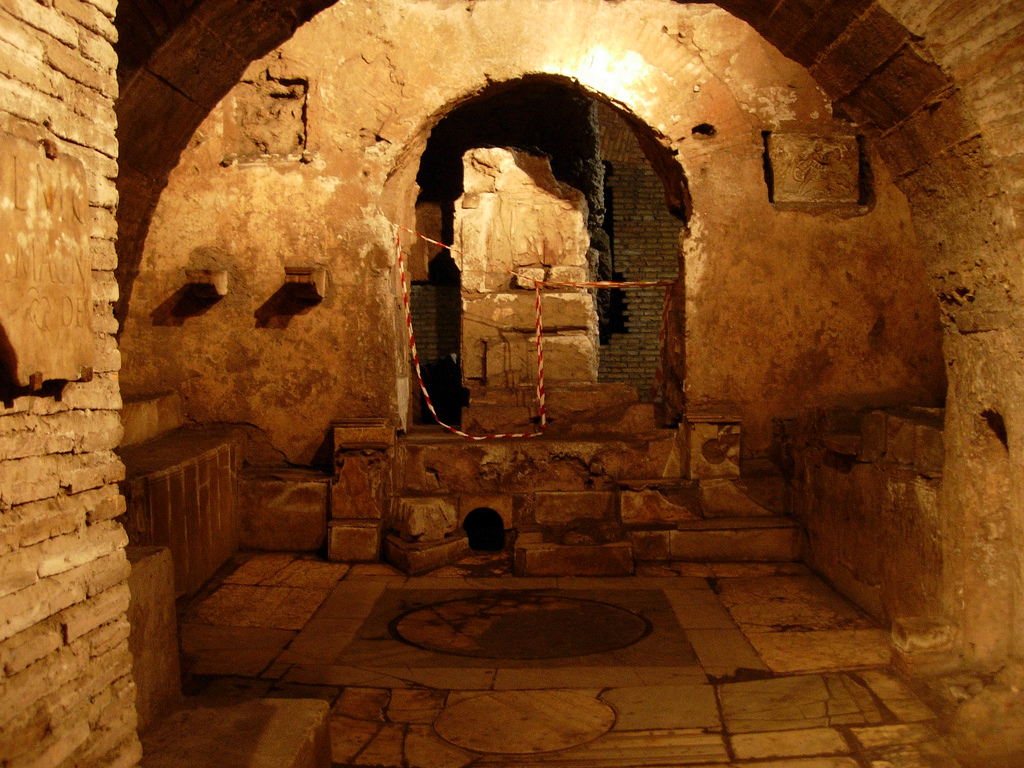
The Mithraeum near the Circus Maximus was discovered in 1931 during work carried out to create a storage area for the scenes and costumes of the Opera House within the Museums of Rome building.
Large marble slab found in 1648 near S. Silvestro in Capite, inscribed with a Latin dedicatory poem forming a cypher-acrostic for TAMESIUS and AUGENTIUS, with records of leontica and chrysos initiations, dated to 362 A.D.
Inscription recording the transmission of the leontica grade by Nonius Victor Olympius and Aurelius Victor Augentius at the Mithraeum of Piazza S. Silvestro in Capite, dated to 359 and 358 A.D.
Inscription CIL VI 750 recording the transmission of the Persica and Heliaca grades by Nonius Victor Olympius and Aurelius Victor Augentius at the Mithraeum of Piazza S. Silvestro in Capite, dated to 358 A.D.
Small marble relief from the Aventine showing a primitive representation of Mithras slaying the bull, without torchbearers or Sol and Luna.
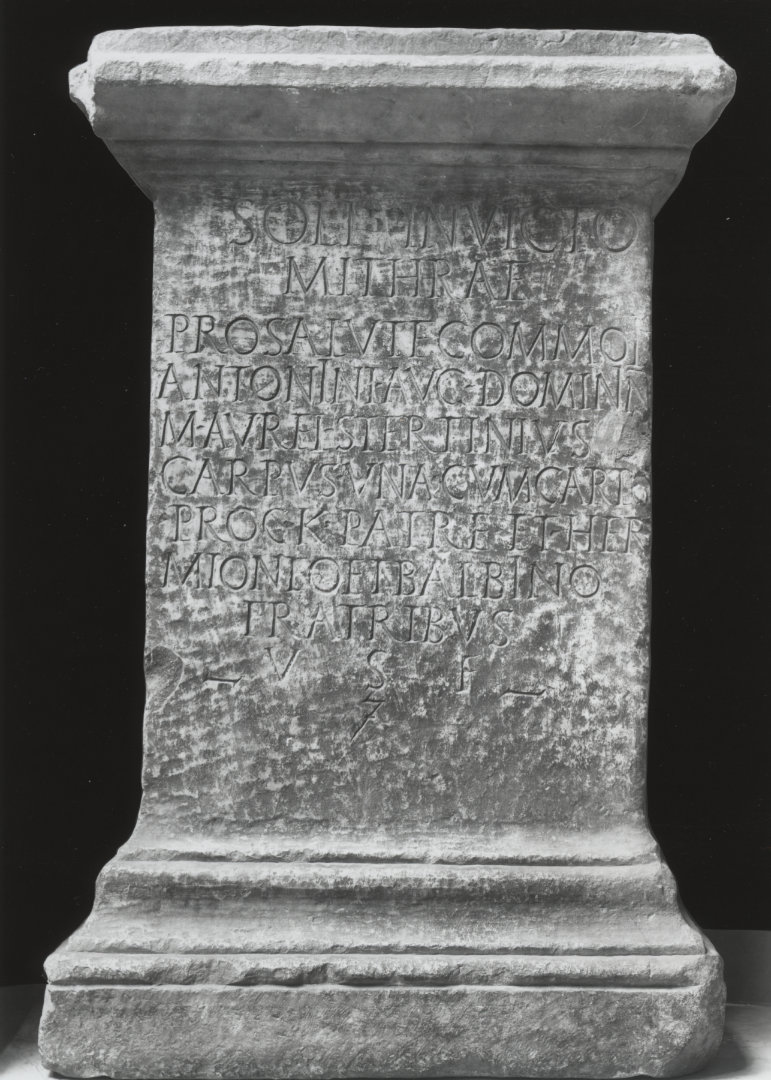
This altar bears an inscription to the health of the emperor Commodus by a certain Marcus Aurelius, his father and two other fellows.
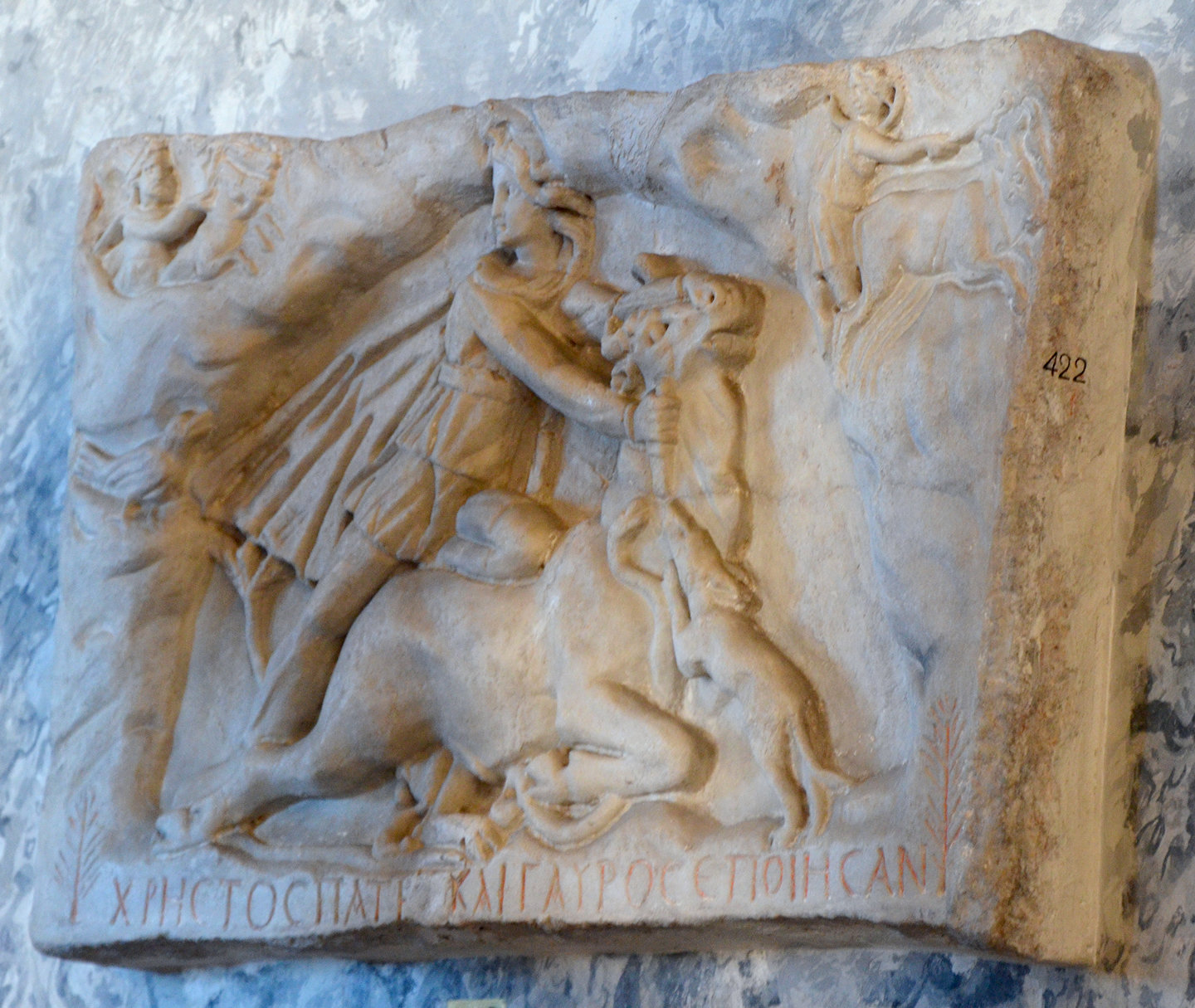
This relief of Mithras killing the bull, signed by a certain Χρῆστος, is on display in the Sala dei Animali of the Vatican Museum.
Upper fragment of a marble relief depicting Cautes, discovered in the Forum of Caesar in Rome.
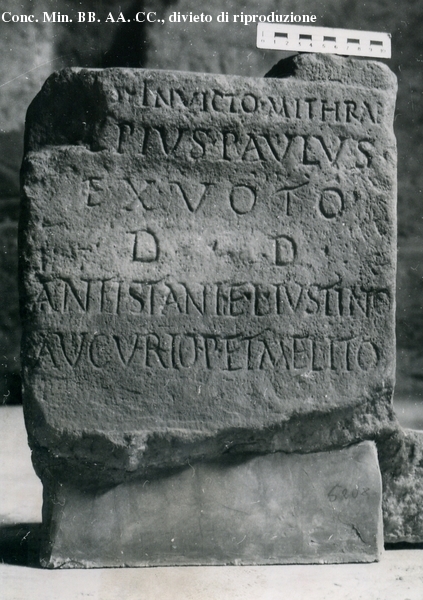
Small marble base, found in one of the private houses along the Via Sacra nearly opposite to the Basilica of Constantine, Rome.
A marble inscription fragment found in the cemetery at the Duos Lauros along the Via Labicana outside Rome, commemorating a sacerdos of Sol Invictus Mithras who lived forty years.
A marble altar found in 1873 between the Baths of Diocletian and the Via di Porta Pia in Rome, dedicated to Sol Invictus Mithras by Sextus with Titus Flavius Ianuarius as antistes.
An inscription to Sol Invictus Mithras found in the Vigna Patritii outside the Porta Pia in Rome, dedicated by Aelius Victorinus, a veteran of the emperors honourably discharged, with M. Aurelius Romulus as antistes and sacerdos of the cult.
A marble slab reused as a tombstone in Comodilla's catacombs near the Via Ostiense in Rome, originally inscribed by Titus Flavius Eutychus as a gift to the Invincible and Holy god.
