Your search Ain Zana gave 1332 results.

An inscription on the base CIMRM 940 from Interanum (modern Entrains-sur-Nohain) in Lugdunensis, recording a dedication to Augustus and to the unconquered god Mithras Sol, made by a dedicant named Castor.
A small stone base with a rectangular decorated box on its right side, found in the bed of the river Nohain during railway construction at Interanum (modern Entrains-sur-Nohain) in Lugdunensis, bearing on its top the feet of a statue and the inscription of CIMRM 941…
A skeleton of a man aged approximately thirty to forty years, with arms tied behind his back and wrists bound with an iron chain, found lying on a fragment of the main relief at the back of the Mithraeum at Pons Saravi (modern Saarburg) in Belgica…
A bronze fountain mouth and a square spout, together with other fragments of round spouts, from the Mithraic sanctuary at Angleur near Liège in Belgica.
Wall-painting of Mithras tauroktonos in fresco, discovered in 1886 in an underground room of the house of the Nummi Albani on the Quirinal (Via Firenze); the god wears a red cap and tunic, the torchbearers wear yellow or orange tunic and cap with green or brown anaxyrides…
Altar and a relief of a figure tearing a lion to pieces, found along the Otočac–Gospić road near the mountains Veliki and Mali Vitalj, Dalmatia; the tauroctony interpretation of the lion-tearing relief was subsequently disputed.
Two surviving wall paintings from the side-benches of the Mithraeum at Spoleto, out of an original six, depicting a cloaked bearded man identified as Saturn holding a sickle and a youth in a red shoulder-cape holding a money-bag, probably representing the seven planets…
Under-layer wall-paintings in the S. Prisca Mithraeum on the Aventine showing a further procession of Mithraic initiates in different colours, with partially legible dipinti including liturgical verses and acclamations.
Wall-painting on the last column of the left bench in the Palazzo Barberini Mithraeum, showing a standing person pressing his left hand to his breast and extending his right hand towards a kneeling person whose head is covered with ivy.
Fragments of large-scale painted heads belonging to paintings of considerable size, from the Mithraeum of Dura-Europos, Syria, 3rd century A.D.
Painted zodiac signs covering earlier figures in Phrygian cap in the arched niche of the Later Mithraeum of Dura-Europos, Syria, 3rd century A.D.
Two painted decorative phases from the Santa Prisca Mithraeum whose figures became clearer after later conservation work.
Upper section of a small altar preserving traces of ancient red paint from the Mithraeum of Taunus.
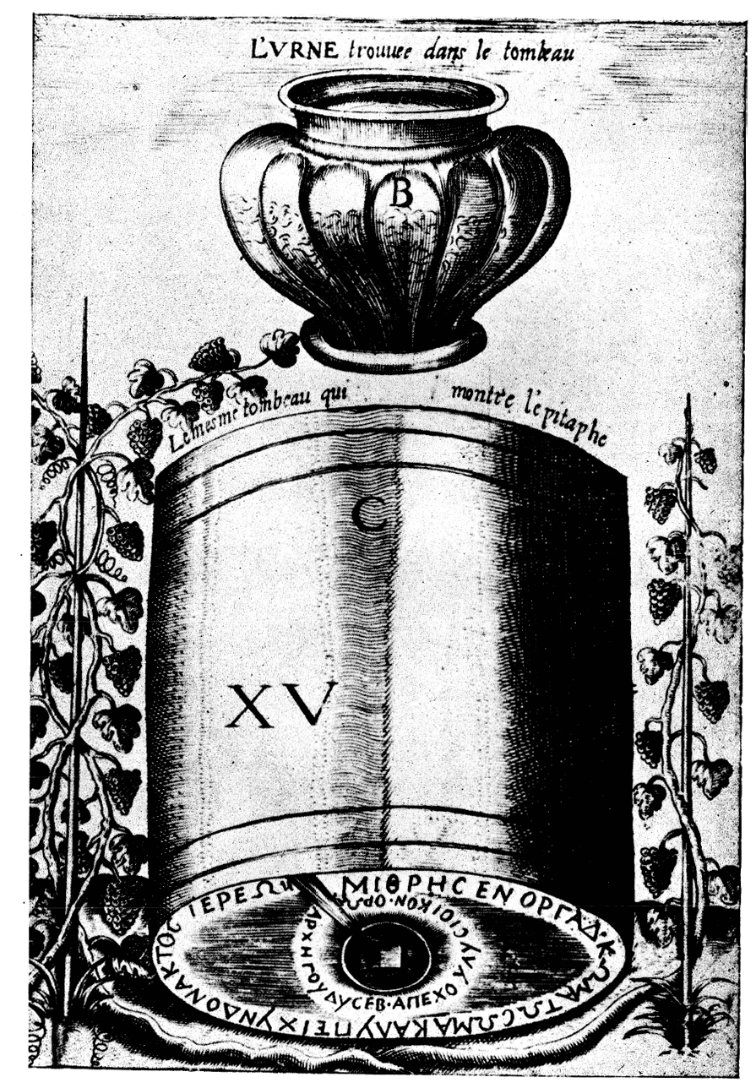
This funerary inscription, engraved on a stone urn discovered near Roman Dijon, mentions a certain Chyndonax, described as a priestly leader of Mithras.
This inscription by a certain Ioulianos, found at the entrance to the Dolichenum at Dura Europos, bears an inscription to Zeus Helios Mithras et Tourmasgade.
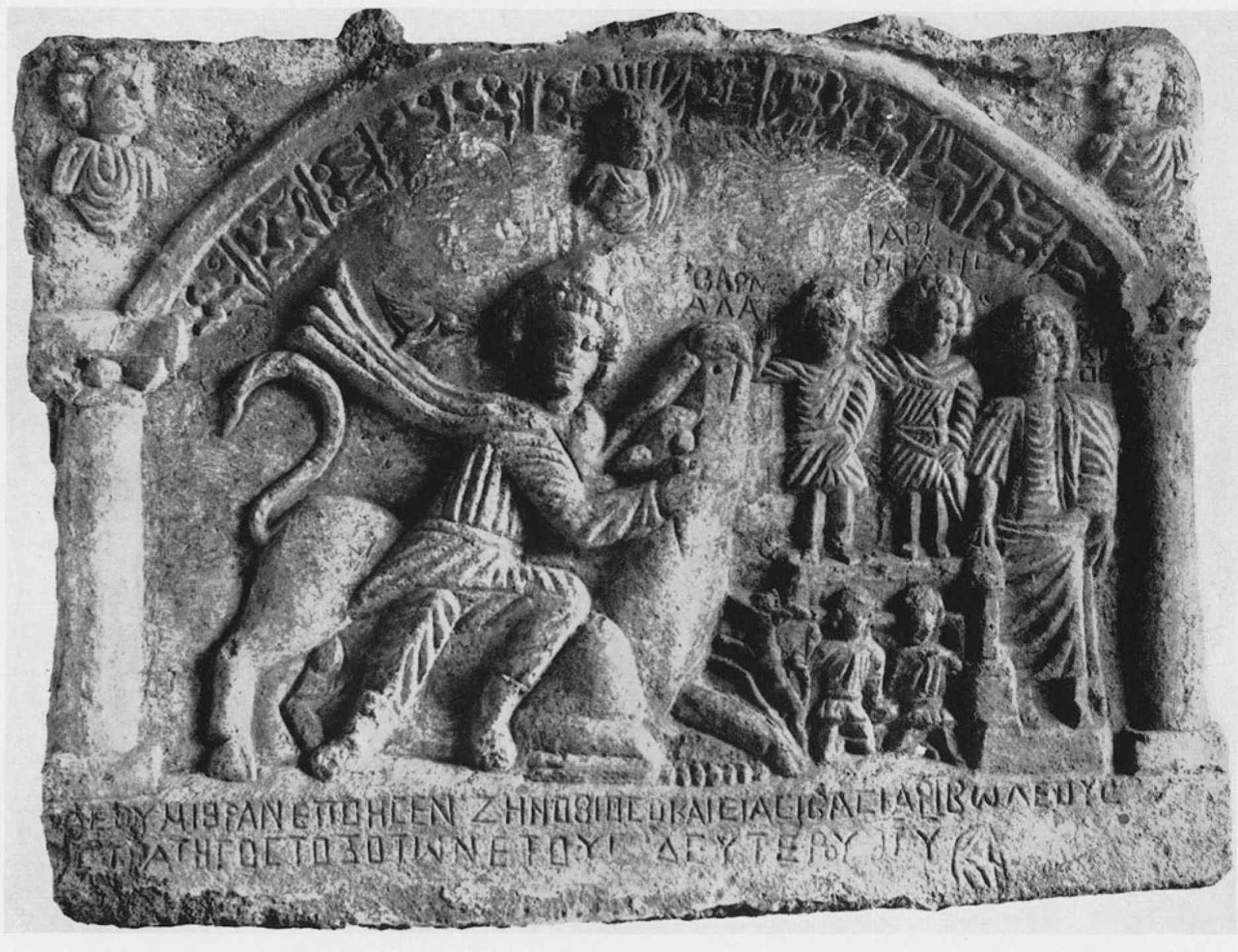
The main relief of Mithras killing the bull from the Mithraeum of Dura Europos includes three persons named Zenobius, Jariboles and Barnaadath.
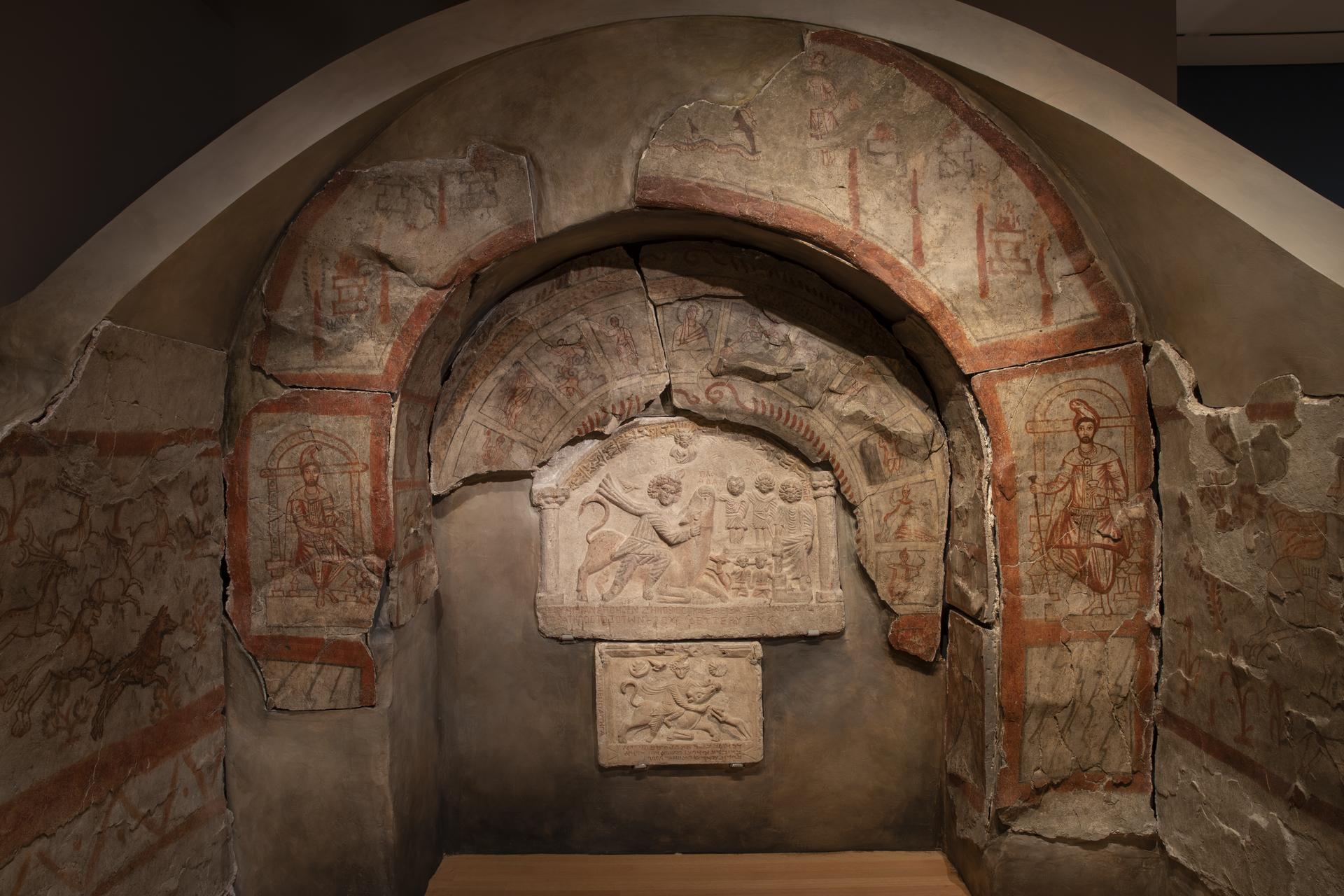
This enigmatic fresco on top of the main tauroctony shows Mithras killing the bull, accompanied by Cautes and Cautopates, surrounded by burning altars and cypress trees.

Around the relief with Mithras as a bullkiller, a number of scenes from the Mithras Iegend have been painted in the Mithraeum of Dura Europos.

Around the niche of the Dura Europos Mithraeum fragments of a series of small paintings set in a semicircular band of panels were found.
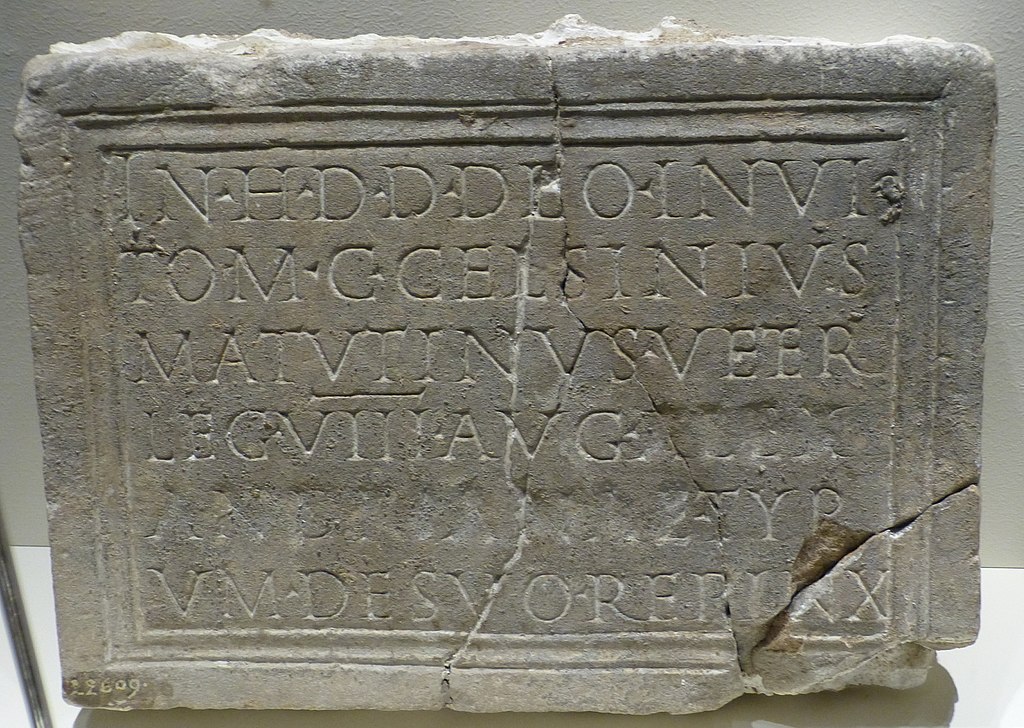
The inscription reports the restoration of the coloured painting of the main relief of the Mithraeum by a veteran of the Legio VIII Augusta.
