Your search Al-Bahnasa gave 3013 results.
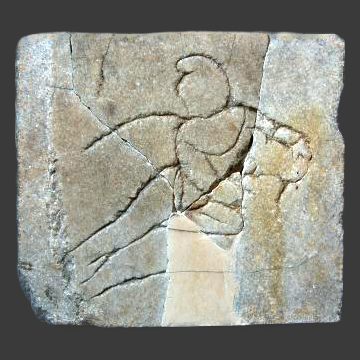
This unfinished Mithras tauroctonos without the usual surrounding animals was found in 1923 in Italica, near Seville, Spain.

A marble inscription fragment found in the cemetery at the Duos Lauros along the Via Labicana outside Rome, commemorating a sacerdos of Sol Invictus Mithras who lived forty years.
A marble slab reused as a tombstone in Comodilla's catacombs near the Via Ostiense in Rome, originally inscribed by Titus Flavius Eutychus as a gift to the Invincible and Holy god.
A marble dedication tablet found in the Vigna Curtii Palloni outside the Porta Sant'Agnese near the Praetorian Camp in Rome, recording the construction of a sacrarium dedicated to Sol Invictus by Q. Pompeius Primigenius, pater and sacerdos, under Septimius Severus and Caracalla…
A marble funerary cippus from the Vigna Dionigi at Torre Pignatara outside Rome, dedicated to Sextineius Restitutus as most indulgent pater sacrorum by his children and mother, with a crown carved to the left of the final line.
A funerary inscription found in the Vigna Nari outside Rome in 1734, set up by Iunia Thallusa for her husband Equitius Arescon, who held the rank of pater sacrorum in the Mithraic mysteries.

Mithraic relief from Rome reproduced in figure 169 of the corpus.

Roman Mithraic relief illustrated in figure 171 of Vermaseren’s catalogue.
Marble head in the Museo Baracco, Rome, generally described as an Alexander but very probably representing Mithras with his eyes lifted towards heaven; the back of the head is finished obliquely with a small hole for fastening a Phrygian cap.
Fragment of a relief from the Villa Wolkonsky showing the usual representation of Mithras slaying the bull, with the dog, serpent and scorpion; the bull's head, Mithras' head and right foot are lost.
Large limestone jar from room Z of the S. Prisca Mithraeum, fitted with a small cylindrical vase and a lid bearing the graffito "Te cauterio i Saturne i Ata[r i] Opi".
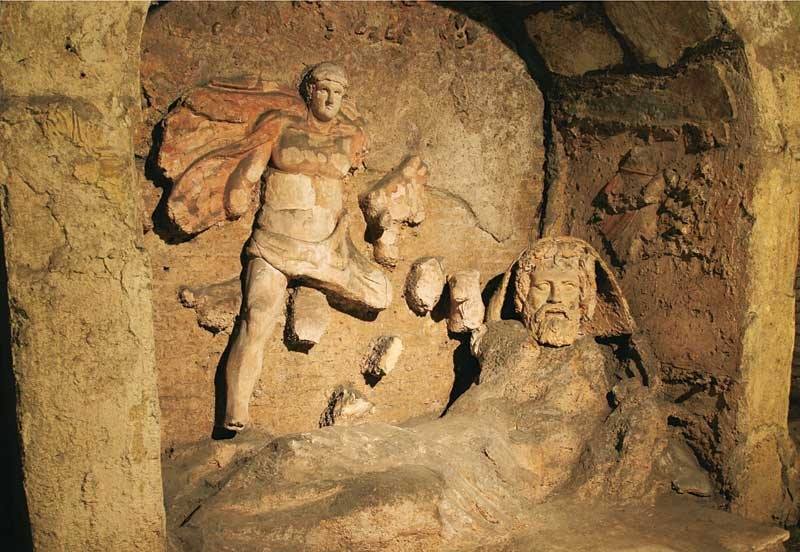
Even if only a few fragments remain, it is very likely that the main niche of the Mitreo di Santa Prisca contained the usual representation of Mithras killing the bull.
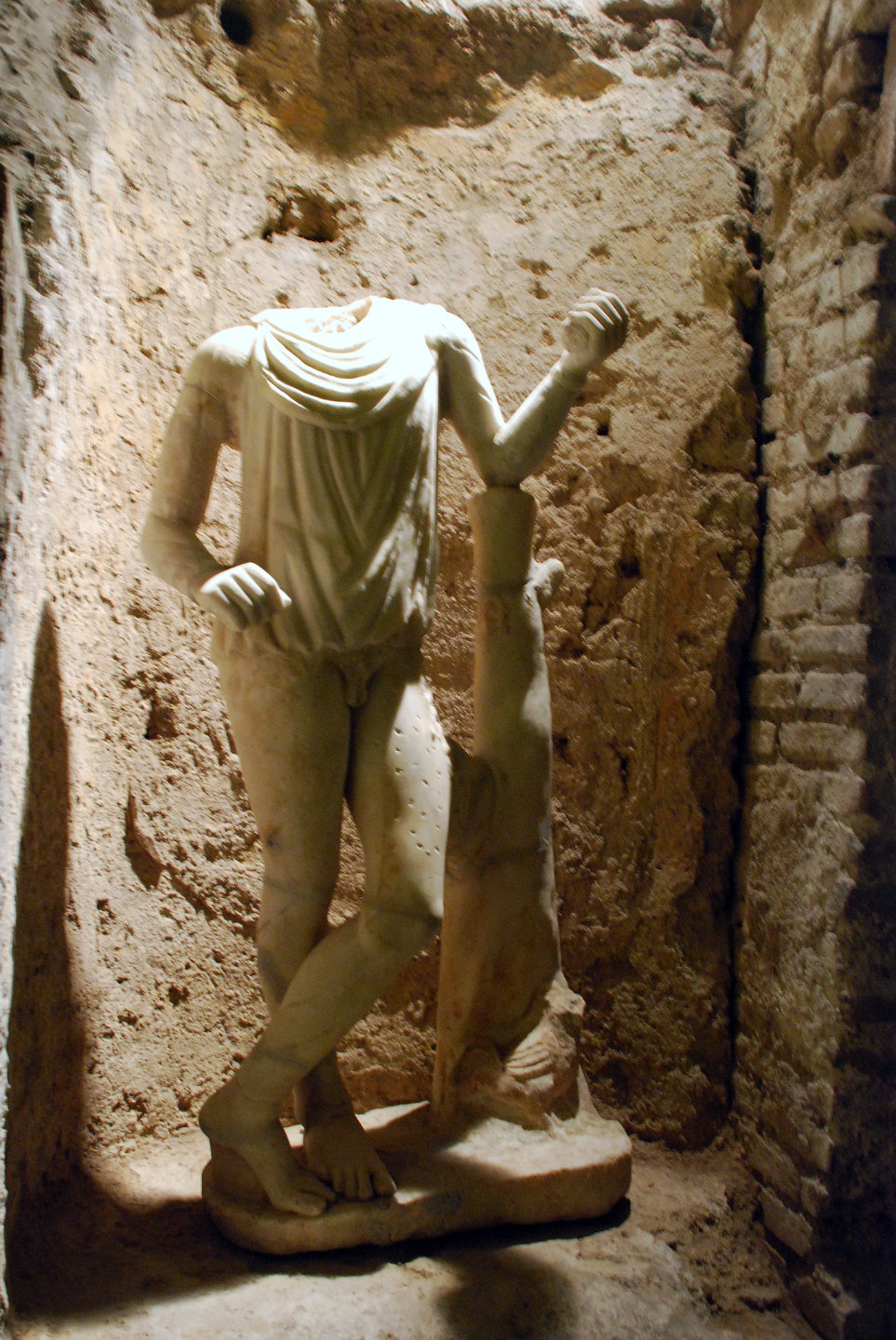
The marble statue of Cautes, found in the Mithraeum of Santa Prisca, was originally a Mercury.
Marble inscription found near the Church of S. Susanna on the Quirinal, with a dedication to Sol Invictus as a votive offering by Cornelius Maximus, centurion of the tenth praetorian cohort.
Lower part of a candelabrum-shaft in the form of a palm trunk on an acanthus base, with a dedication to Mithras by T. Aelius Iustus on three faces of the plinth, found between the churches of SS. Eusebius and Vitus, Rome.
Upper part of a small marble column with late 2nd- or 3rd-century lettering, bearing a dedication to Sol Invictus Mithras and his sodality by actors from the Forum Suarium, excavated on the Esquiline.
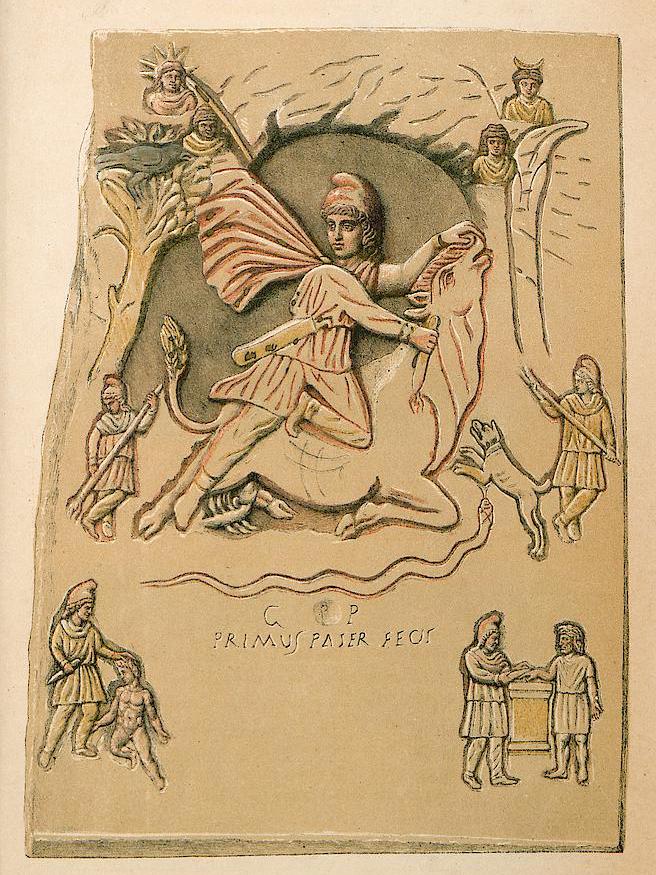
The relief of Mithras slaying the bull found on the Esquiline Hill includes two additional scenes with Mithras and two other figures.

This unusual mural depicting Mithras killing the bull was found near the Colosseum in 1668.
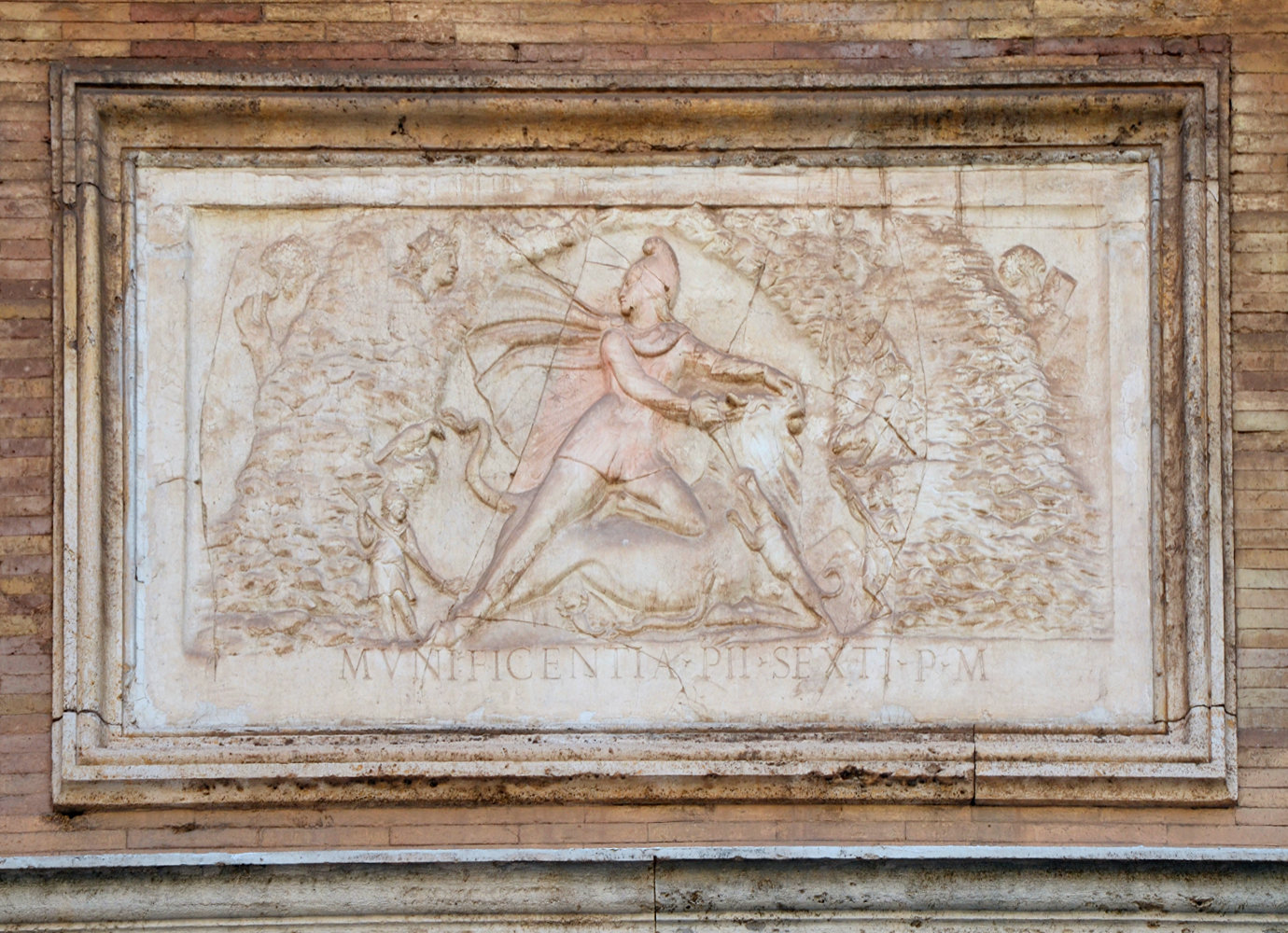
The Tauroctony relief of Mithras killing the bull walled in the Cortile of the Belvedered, Vatican City, was found by Fagan near Ostia.
Graffito on a wall of the Caseggiato del Sole adjacent to the Mitreo dei Serpenti at Ostia, reading "Dominus Sol hic avitat" (Lord Sun dwells here).
