Your search Bourg-Saint-Andéol gave 169 results.

Three epigraphical fragments that together form the word magister, with traces of fire, found at the Mithraeum of Les Bolards (ancient Venetonimagus) in Lugdunensis.
A fine white marble bust of Venus, a head of a helmeted deity possibly Minerva, small female heads, and bronze eye-plaques analogous to those from the temples of Sequana and Apollo Vindonnus, found at the building south-west of the Mithraeum at Les…
A large red and white granite marble disc surrounded by rays, possibly representing the sun, found at the building south-west of the Mithraeum at Les Bolards (ancient Venetonimagus) in Lugdunensis.
Architectural elements including marble plaques, mouldings, entablature sections, and acanthus friezes, found in a building about 30–40 metres south-west of the Mithraeum at Les Bolards (ancient Venetonimagus) in Lugdunensis, suggesting the possible existence of a second sanctuary…
Two small stone fragments, possibly from a base, found at the Mithraeum of Les Bolards (ancient Venetonimagus) in Lugdunensis.
Fragments of a slab bearing an inscription mentioning Sol Aeternus and cohors II, found at the Mithraeum of Les Bolards (ancient Venetonimagus) in Lugdunensis.
A small white marble column decorated in high relief with spiral oak-leaves and acorns, together with fragments of two legs and two hands holding votive offerings, found at the Mithraeum of Les Bolards (ancient Venetonimagus) in Lugdunensis.
A small woman's head crowned with flowers, found at the Mithraeum of Les Bolards (ancient Venetonimagus) in Lugdunensis.
Two small heads in Phrygian caps, possibly belonging to a tauroctony of Mithras, together with a fragment of a bull's foot and the mouth and neck of the dog, found at the Mithraeum of Les Bolards (ancient Venetonimagus) in Lugdunensis.
Fragmentary remains of a statuette of Cautopates in a short tunic, including a thigh, knee, and hand holding the end of a torch, found near the entrance of the Mithraeum at Les Bolards (ancient Venetonimagus) in Lugdunensis.
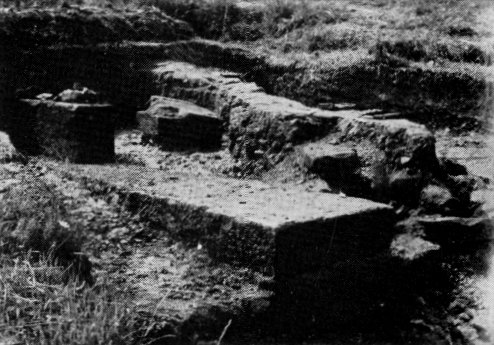
The Mackwiller Mithraeum was built in the middle of the 2nd century, during the reign of Antoninus the Pious, on the site of a spring already worshipped by the natives.
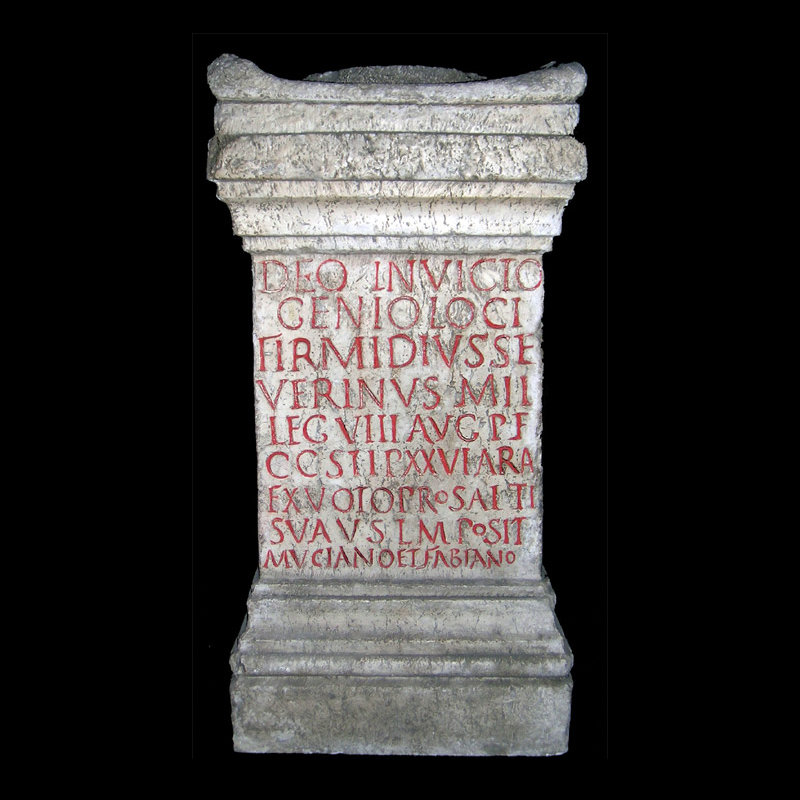
This limestone altar bears an inscription from its donor, Firmidius Severinus, in honour of Mithras after 26 years of service in the Legio VIII Augusta.

This white marble relief of Mithras killing the bull was found on the Esquilino near the Church of Saint Lucy in Selci in Rome.
Group of Mithraic monuments preserved in the museums of Liège.
Oval relief fragment from the outskirts of Split near ancient Salona, Dalmatia, preserving two zodiacal signs — probably from a border decoration of a Mithraic monument.

Dijon is the prefecture of the Côte-d'Or department and of the Bourgogne-Franche-Comté region in eastern France. The earliest archaeological finds within the city limits of Dijon date to the Neolithic period.
Mandeure is a commune in the Doubs department in the Bourgogne-Franche-Comté region in eastern France.
Dyo is a commune in the Saône-et-Loire department in the region of Bourgogne-Franche-Comté in eastern France.
Member of the Mithraic community of Les Bolards and dedicator of a statue of Cautes.
This heavily damaged relief from Narbo preserves the figure of a cross-legged Mithraic torchbearer carved in low relief near the church of Saint-Sébastien in Narbonne.
