Your search Cabrera de Mar gave 1568 results.

A large red and white granite marble disc surrounded by rays, possibly representing the sun, found at the building south-west of the Mithraeum at Les Bolards (ancient Venetonimagus) in Lugdunensis.
A small white marble column decorated in high relief with spiral oak-leaves and acorns, together with fragments of two legs and two hands holding votive offerings, found at the Mithraeum of Les Bolards (ancient Venetonimagus) in Lugdunensis.
An altar found in 1898 in the east part of the sanctuary at Borcovicium (modern Housesteads), bearing a dedication to Mars and Victoria, possibly belonging to an adjacent shrine rather than the Mithraeum itself.
A small marble statuette of naked Mercury from the Mithraeum at Walbrook in London, sitting on a rock with the stumps of wings in his hair and a purse in his left hand, with a ram lying at his feet beside which is a tortoise.
A marble head of a woman from the Mithraeum at Walbrook in London, originally crowned with a diadem.
A marble torso of a male figure from the Mithraeum at Walbrook in London, flattened at the back, probably one of the attendant deities of Mithras, which would have stood about 2 ft. in complete height.
A fragment of a white marble statue from the Mithraeum at Walbrook in London, preserving the naked torso of a reclining figure with long hair and beard, with the end of a staff visible near his left shoulder, identified as Oceanus.
A white marble statue from the Mithraeum at Walbrook in London, depicting Bonus Eventus standing in a long hanging cloak, leaning on a ship's stem, holding a cornucopia against his shoulder and a patera above a burning altar from the back of which a…
A marble statue from Augusta Emerita (modern Mérida), depicting a standing woman in a long chiton, now in the museum at Mérida, with head lost.
A marble statue found at Augusta Emerita (modern Mérida) in 1913, depicting a standing woman in a long chiton, now in the museum at Mérida, with head lost.
A marble statue from Augusta Emerita (modern Mérida), depicting a standing dressed male person whose right leg leans against a tree-trunk and whose raised right arm once held a lance or trident, tentatively identified as Poseidon.
A small four-sided white marble relief of uncertain Mithraic attribution, found at Italica (modern Santiponce, near Seville), depicting a bull walking to the right on the front, a fig-tree on the back, five ears of wheat on the right side, and damaged vine tendrils with grapes on the left…
A fragmentary inscription from Aquileia, probably dedicated to Cautopates, recording a soldier named Marcianus, optio of the Second Adiutrix Legion, who fulfilled his vow for the welfare of himself and his family.
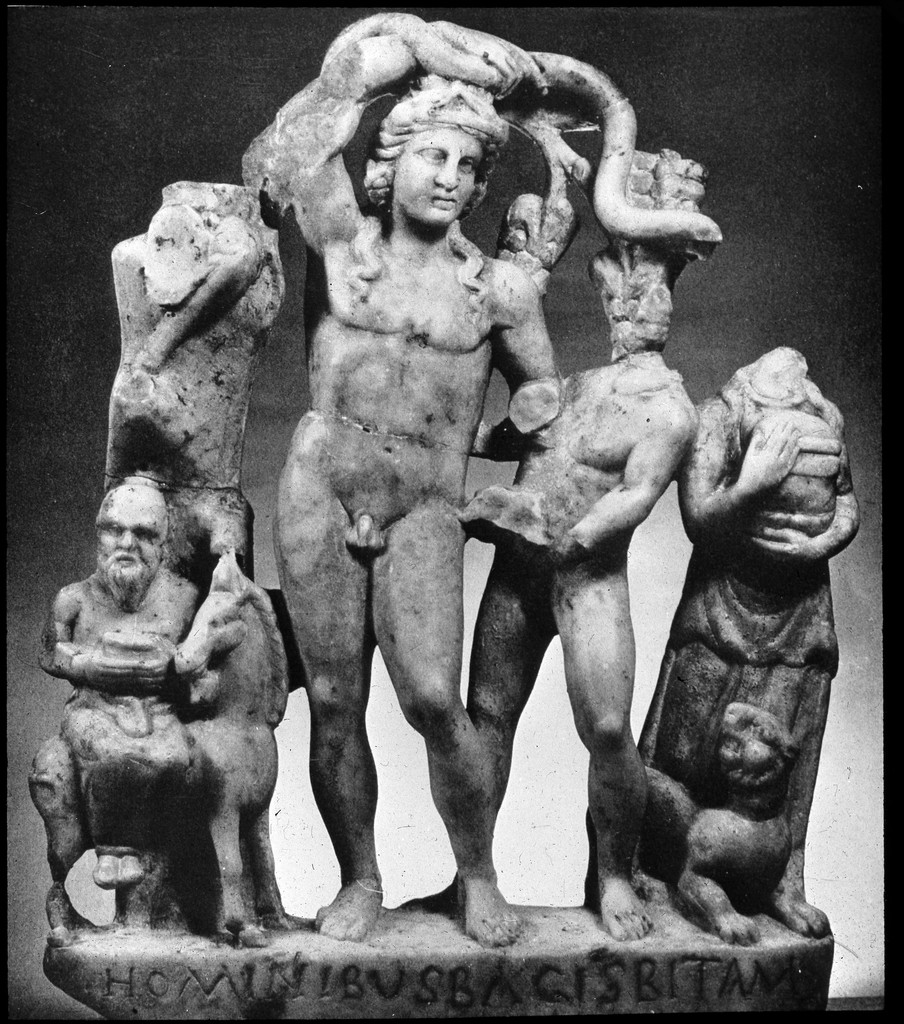
Marble group of Dionysus accompanied by a Silenus on a donkey, a satyr and a menead.
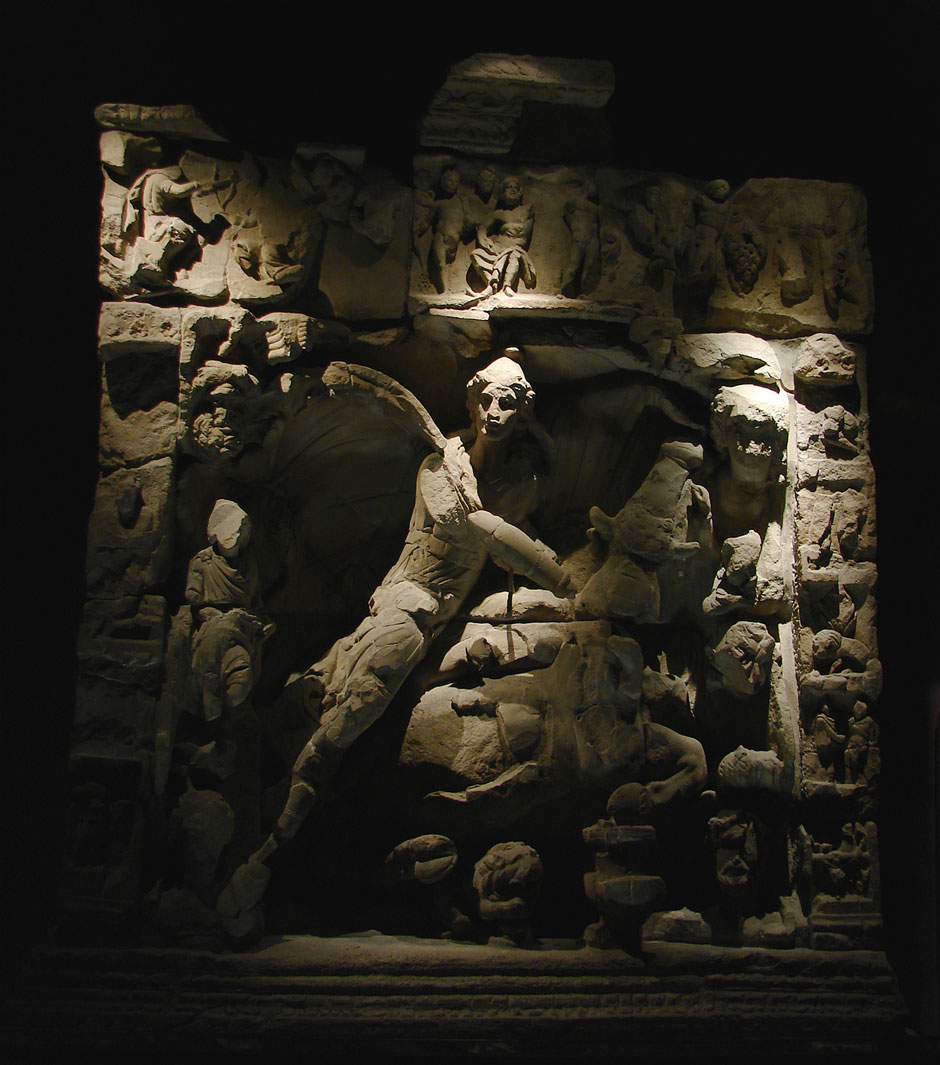
The Tauroctony of Saarbourg (Sarrebourg, ancient Pons Sarravi), France, contains most of Mithras deeds known in a single relief.
A marble altar found in 1873 between the Baths of Diocletian and the Via di Porta Pia in Rome, dedicated to Sol Invictus Mithras by Sextus with Titus Flavius Ianuarius as antistes.
A marble slab reused as a tombstone in Comodilla's catacombs near the Via Ostiense in Rome, originally inscribed by Titus Flavius Eutychus as a gift to the Invincible and Holy god.
A marble dedication tablet found in the Vigna Curtii Palloni outside the Porta Sant'Agnese near the Praetorian Camp in Rome, recording the construction of a sacrarium dedicated to Sol Invictus by Q. Pompeius Primigenius, pater and sacerdos, under Septimius Severus and Caracalla…
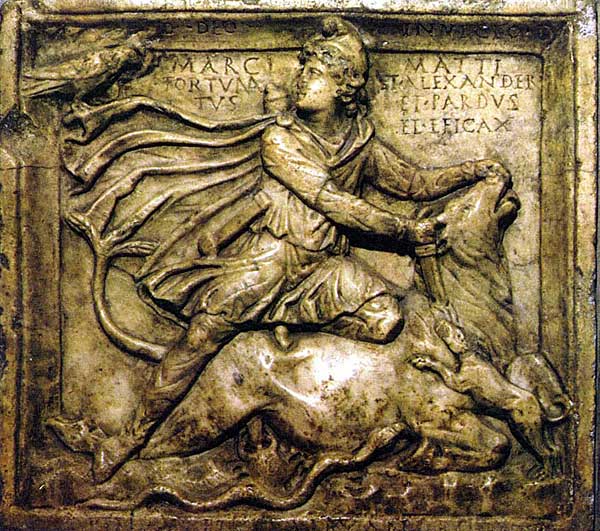
The relief marble of Mithras sacrifying the bull, exposed on the Hermitage Museum comes from Rome.
Marble head in the Museo Baracco, Rome, generally described as an Alexander but very probably representing Mithras with his eyes lifted towards heaven; the back of the head is finished obliquely with a small hole for fastening a Phrygian cap.
