Your search for Constantine gave 15 results.

Cirta, also known by various other names in antiquity, was the ancient Berber and Roman settlement which later became Constantina, Algeria.
Tiddis was a Roman city that depended on Cirta and a bishopric as Tiddi, which remains a Latin Catholic titular see. It was located on the territory of the current commune of Bni Hamden in the Constantine Province of eastern Algeria.

Assemblage of pottery fragments, lamps and late Roman coins recovered from Mithraeum II of Aquincum, including issues from Constantine II to Gratian.
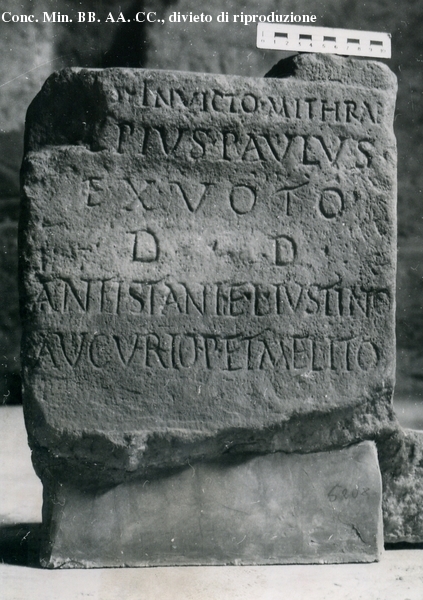
Small marble base, found in one of the private houses along the Via Sacra nearly opposite to the Basilica of Constantine, Rome.
A small figure of Aion, said to have been found in the Auvergne region of Lugdunensis, resembling a similar piece in the Museum of Constantine, though no further details are known.
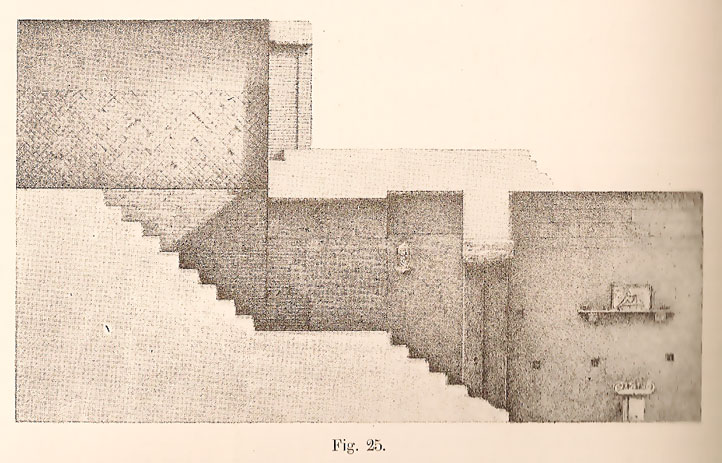
In a house from the time of Constantine, a Lararium was found with a statue of Isis-Fortuna. The Mithraeum was a door next to it, on a lower room.
Finds from the Mithraeum at Konjic, Dalmatia, comprising a large roof nail, fragments of a concentric-circle basin, pottery, glass, animal bones, 32 coins from Gallienus to Constantine, and a pine apple.
Deposit of 1,200 coins spanning Augustus to Constantine and a small bronze bell from Thun-Allmendingen, representing the longest chronological range of any coin assemblage from a Mithraic context in Germania.
An earthen lamp bearing the name of C. Dessi along with two coins of Constantine and one of Gratianus, found in the Mithraeum at Spoleto in Umbria.
Miscellaneous finds from the middle of the Mithraeum of Capua, including a terracotta antefix with centaurs, basins, marble bases, lamps with a Sol head, and coins of M. Aurelius and Constantine.

An Algerian chemistry student interested in roman culture I hope to be able to explore Mithras culture in my country because of the vast and important rule of this religion in my city tiddis
Inscription on a clepsydra dedicated to Sol Invictus Augustus by C. Amulius Pultarius, found on the site of the Mosque Sidi Biri Narze at Cirta.
This inscription shows that Publilius Ceionius, most distinguished man, dedicated a temple to Mithras at Mila, in the modern Constantina, Algeria.

An inscription mentioning a speleum decorated by Publilius Ceionius suggests the location of a mithraeum in Cirta, the capital of Numidia.