Your search Constantine gave 31 results.

Cirta, also known by various other names in antiquity, was the ancient Berber and Roman settlement which later became Constantina, Algeria.
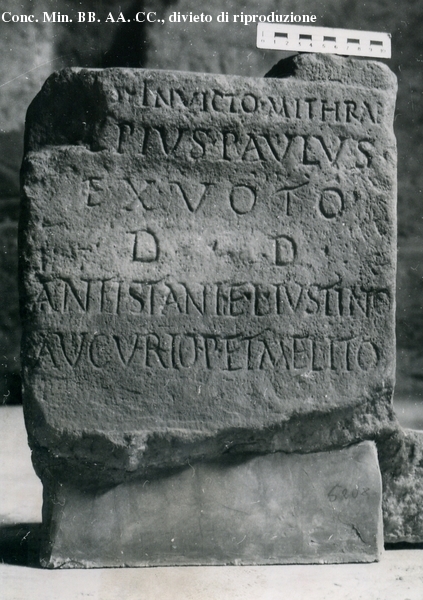
Small marble base, found in one of the private houses along the Via Sacra nearly opposite to the Basilica of Constantine, Rome.

A small figure of Aion, said to have been found in the Auvergne region of Lugdunensis, resembling a similar piece in the Museum of Constantine, though no further details are known.
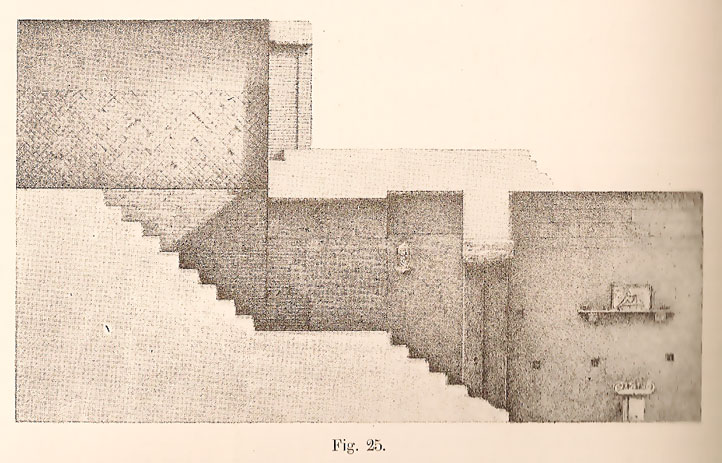
In a house from the time of Constantine, a Lararium was found with a statue of Isis-Fortuna. The Mithraeum was a door next to it, on a lower room.
Deposit of 1,200 coins spanning Augustus to Constantine and a small bronze bell from Thun-Allmendingen, representing the longest chronological range of any coin assemblage from a Mithraic context in Germania.
An earthen lamp bearing the name of C. Dessi along with two coins of Constantine and one of Gratianus, found in the Mithraeum at Spoleto in Umbria.
Miscellaneous finds from the middle of the Mithraeum of Capua, including a terracotta antefix with centaurs, basins, marble bases, lamps with a Sol head, and coins of M. Aurelius and Constantine.
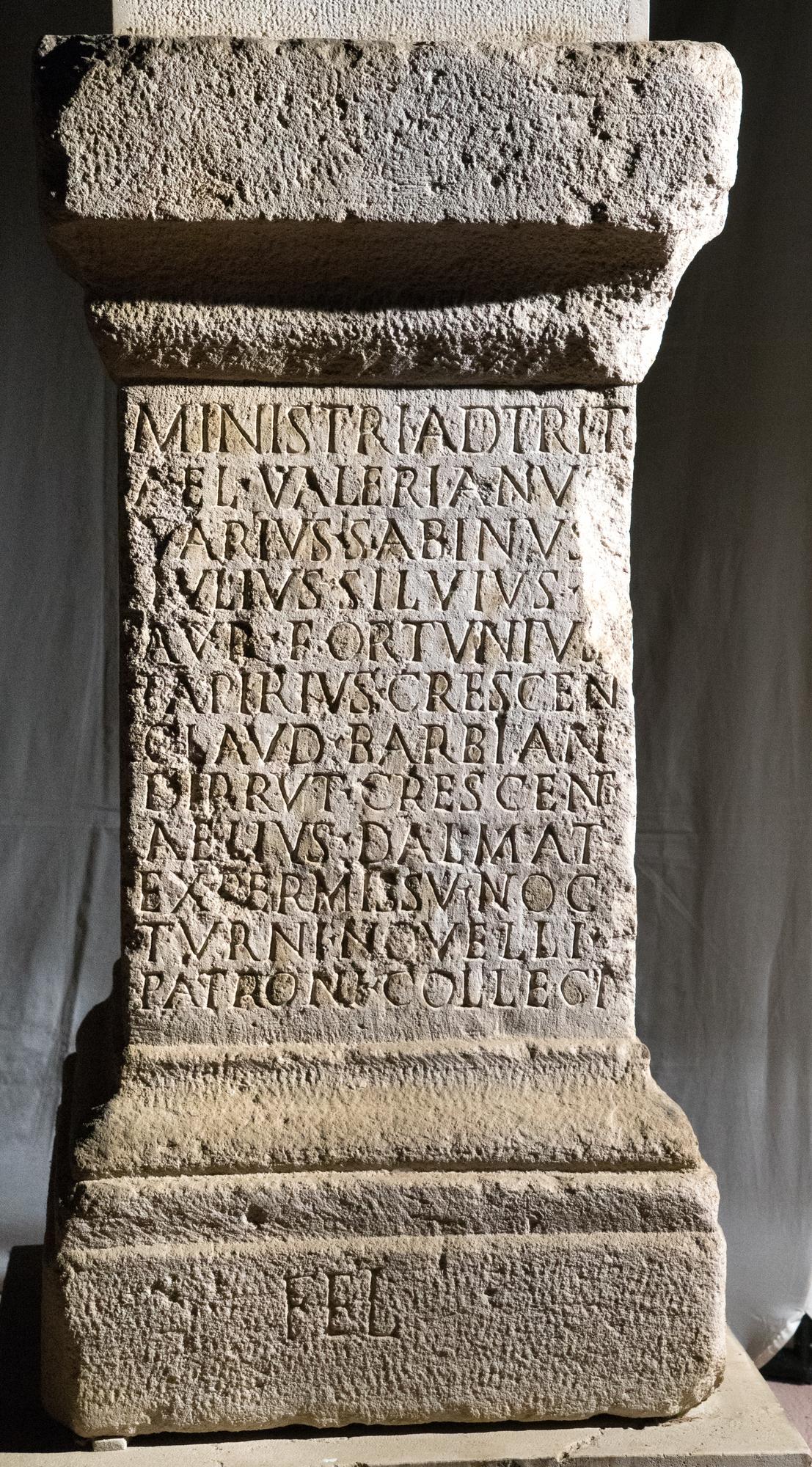
This inscribed limestone altar from Roman Salona preserves several lists of ministers associated with the Tritones collegium during the Tetrarchic period.
This inscription shows that Publilius Ceionius, most distinguished man, dedicated a temple to Mithras at Mila, in the modern Constantina, Algeria.
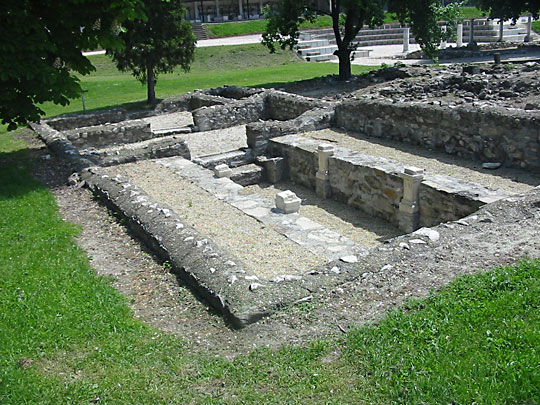
This temple of Mithras in Aquincum was located within the private house of the decurio Marcus Antonius Victorinus.
Finds from the Mithraeum at Konjic, Dalmatia, comprising a large roof nail, fragments of a concentric-circle basin, pottery, glass, animal bones, 32 coins from Gallienus to Constantine, and a pine apple.
Marble plate recording the construction of a centenarium Solis by the governor Septimius Flavianus, found at Bir Haddada in the Ager Sitifensis, dated 315/316 A.D.
Marble relief fragment from Romula, Dacia, bought in Resca in 1933, preserving the feet and forepart of a horse — possibly from a scene of Mithras ascending Sol's chariot.
Marble relief fragment from Romula, Dacia, showing traces of two bulls; the Mithraic attribution is uncertain.
Marble altar fragment from Romula, Dacia, with only the letters DE carved out, tentatively supplemented as De[o Soli invicto]; the attribution is questionable.
Deposit of twenty-three coins from the Mithraeum at Schachadorf, Noricum, spanning from Claudius II to Valentinianus II and providing a terminus for the sanctuary's use.
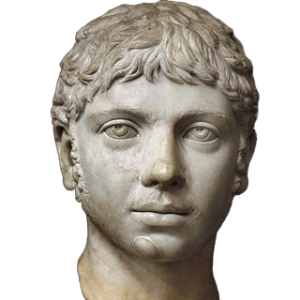
Roman emperor at the age of 14, from 218 to his death in 222, Elagabalus was a main priest of the sun god Elagabal in Emesa.
Founded on the site of ancient Byzantium and refounded in 330 CE, Constantinopolis became an imperial residence in the eastern Roman Empire. In the 4th century, it was a key setting for interaction between traditional cults and Christian authority.
Tiddis was a Roman city that depended on Cirta and a bishopric as Tiddi, which remains a Latin Catholic titular see. It was located on the territory of the current commune of Bni Hamden in the Constantine Province of eastern Algeria.

An Algerian chemistry student interested in roman culture I hope to be able to explore Mithras culture in my country because of the vast and important rule of this religion in my city tiddis
