Your search St Albans gave 2762 results.
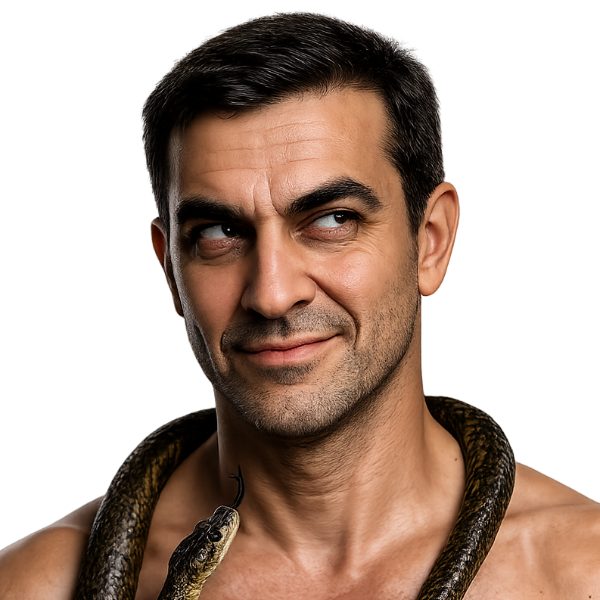
Syndexios in Ostia, his name Marsus suggests that he was a snake-charmer.

Professional author with a special interest in Greco-Roman ritual and sacred landscapes, art and philosophy.
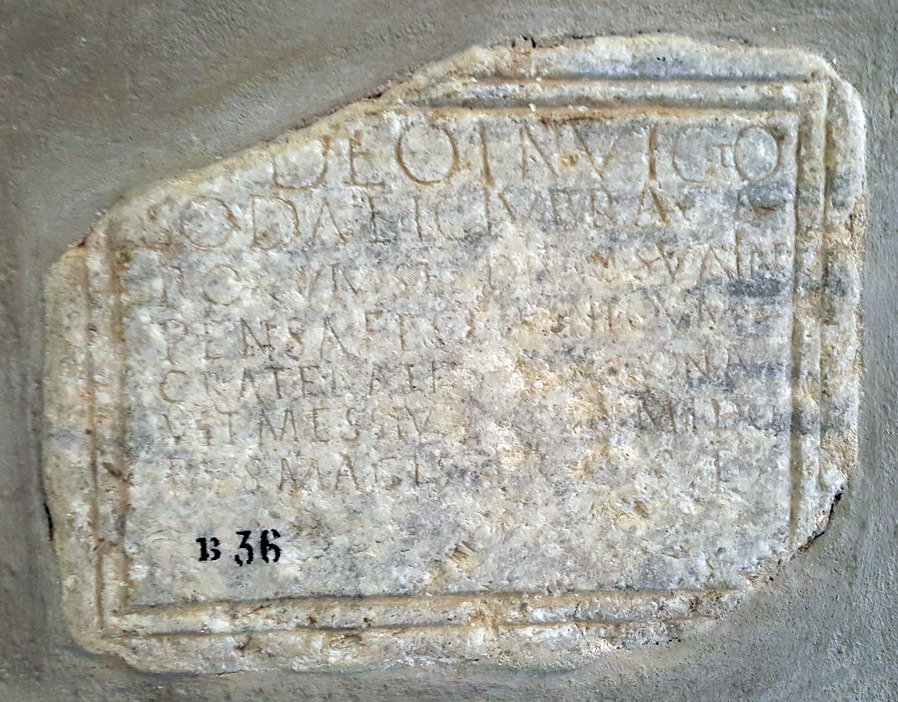
Marble inscription recording the construction of a Mithraic meeting place and the donation of a crater by Titus Flavius Artemidorus.
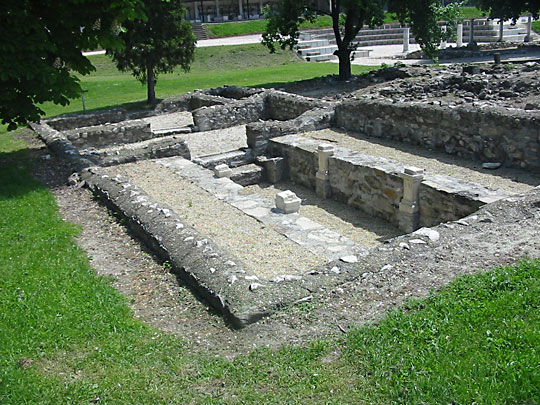
This temple of Mithras in Aquincum was located within the private house of the decurio Marcus Antonius Victorinus.
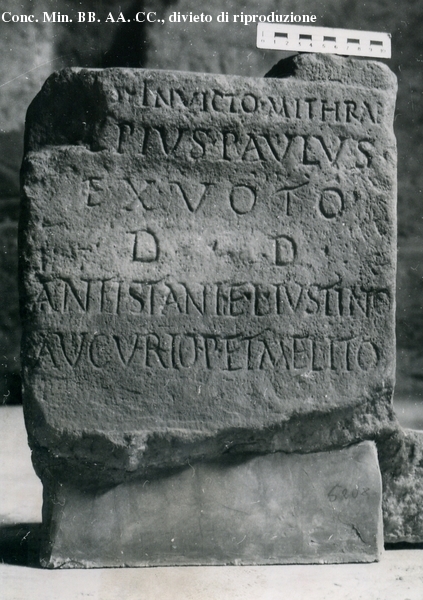
Small marble base, found in one of the private houses along the Via Sacra nearly opposite to the Basilica of Constantine, Rome.

Inscription from Corstopitum (modern Corbridge) recording a dedication to Sol Invictus by a vexillation of Legio VI Victrix under the governorship of Sextus Calpurnius Agricola in AD 163.
A small marble fragment from Augusta Emerita (modern Mérida) bearing the fragmentary inscription (S)arapi(s), attesting to the veneration of Sarapis in proximity to the Mithraic sanctuary.

The Moosham area lies within the Alpine territory historically connected with Roman Noricum.
An inscription found in the ruins of an old stone wall at Cambeck, near Petrianae, recording a vow willingly and with merit fulfilled to Deus Sol Invictus by Sextus Severius Salvator, prefect.
Two small heads wearing Phrygian caps, probably representing the Mithraic torchbearers Cautes and Cautopates, from Turin (ancient Augusta Taurinorum) and held in the Museum at Turin.
Two red pottery fragments from a plate found near the Schützenstrasse at Augusta Treverorum (modern Trier) in Belgica, showing the forepart of a horned bull and the hindquarters of a lion, possibly Mithraic in character.
A small pottery fragment of uncertain find-spot, probably from Augusta Treverorum (modern Trier) in Belgica, showing a lion walking to the right before a bull's head, with palm-like foliage, tentatively interpreted as Mithraic by Loeschcke but considered too doubtful by Vermaseren…
Three fragments of a pottery plate bearing a relief of Mithras as bullkiller, with Cautes holding an upraised torch and sickle-shaped object and the bust of Luna above, found in the pottery workshops along the Ziegelstrasse at Augusta Treverorum (modern Trier) in Belgica…
A fragment of a white marble head in a Phrygian cap, facing right, probably representing Mithras, with an uncertain find-spot but likely from Augusta Treverorum (modern Trier) in Belgica.
A scholarly note recording that finds at Heiligkreuz, including a lion's head and leg fragment, the head of a genius, and a knife with a gold handle, support the hypothesis of a Mithraeum at that location in Augusta Treverorum (modern Trier) in Belgica…
A bronze votive slab bearing a dedication to the unconquered god, found on a hill at Heiligkreuz near the proposed Mithraeum at Augusta Treverorum (modern Trier) in Belgica.
A small limestone head of Cautopates, facing right, with a damaged nose and a stone pin on the reverse indicating it belonged to a relief, found on the slope of a hill near Heiligkreuz at Augusta Treverorum (modern Trier) in Belgica.
Sculptural fragments from the Mithraeum at Augusta Emerita (modern Mérida), comprising a naked foot beside tree-trunk remnants and fragments of a marble seat or table decorated with an acanthus-leaf from which emerge the head and neck of a lion.
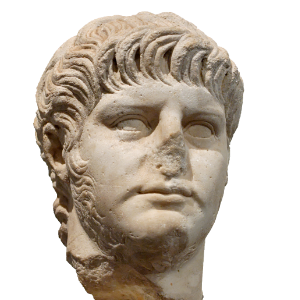
Roman emperor whose ceremonial reception of Tiridates I of Armenia established one of the earliest recorded links between Mithras and the Roman imperial court.
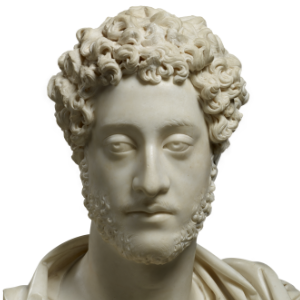
Roman emperor traditionally regarded as the first ruler initiated into the Mysteries of Mithras.
