
Limestone altar from Tropaeum Traiani, Moesia Inferior, dedicated in honour of the Domus Divina to Soli invicto sacrum by Quintus Lucilius Piscinus, centurion of Legio I Italica.
Altar from Kokardscha near Adam Klissi, ancient Tropaeum Traiani in Moesia Inferior, dedicated to Deo invicto for the welfare of Emperor Marcus Antoninus Verus by Annius Saturninus, centurion of Legio XI Claudia.
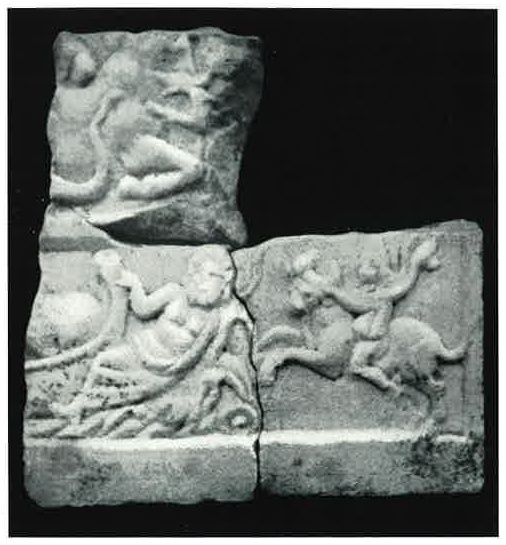
Three white marble tauroctony fragments from Gànt la Mangalia, ancient Callatis in Moesia Inferior, depicting part of the standard bull-slaying scene.
Small sandstone altar with red-painted lettering from the Mithraeum at Tirgușor, Moesia Inferior, dedicated by Horimos to the god Caute; the last letters of the inscription are uncertain.
Small sandstone altar with red-painted lettering from the Mithraeum at Tirgușor, Moesia Inferior, dedicated to the god by Horimos.

Sandstone tauroctony relief with pediment from the Mithraeum at Tirgușor, Moesia Inferior, depicting the bull-slaying with two cross-legged torchbearers both holding their torches upraised and Sol and Luna busts in the upper corners; no dog or scorpion.
Limestone base from the Mithraeum at Tirgușor, Moesia Inferior, bearing a Greek inscription dedicated to the invincible Mithras by Flavius Horimos.
Small Mithraic sanctuary discovered in 1958 in the grotto called Adam near Tirgușor, Moesia Inferior, about 30 km from Constanța; the monuments are remarkable for their Greek inscriptions.
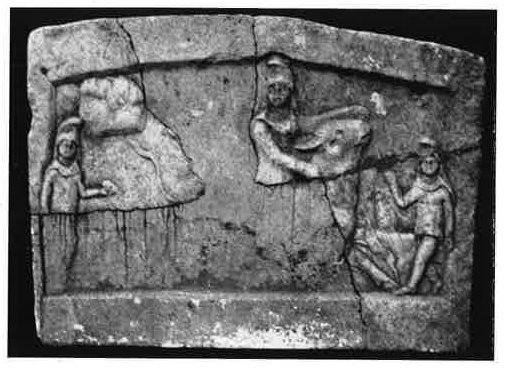
Three white marble tauroctony fragments from Constanța, ancient Tomis in Moesia Inferior, preserving the upper part of Mithras as bull-slayer with flanking divine busts.
Inscription from Constanța, ancient Tomis in Moesia Inferior, recording a dedication to Deo Soli for the welfare and victory of Emperors Diocletian and Maximianus invicti Augusti; a significant tetrarchic dedication from this region.
Two marble tauroctony fragments from near the station at Constanța, ancient Tomis in Moesia Inferior, depicting the bull-slaying with Sol visible above; lost during the war.
Fragmentary inscription from Tomis, Moesia Inferior, preserving only the garbled closing formula votum pusuit (for posuit).
Marble tauroctony fragment from Constanța, ancient Tomis in Moesia Inferior, depicting the bull-slaying with dog, serpent, and scorpion; Cautes holds both an upraised torch and a pedum.
White marble trapezium-shaped tauroctony relief probably from Constanța, ancient Tomis in Moesia Inferior, divided into three horizontal registers with the central tauroctony and subsidiary scenes.
Marble stele from Histria, Moesia Inferior, found reused in a late wall in the southern quarter of the city, bearing a Mithraic dedication or scene.
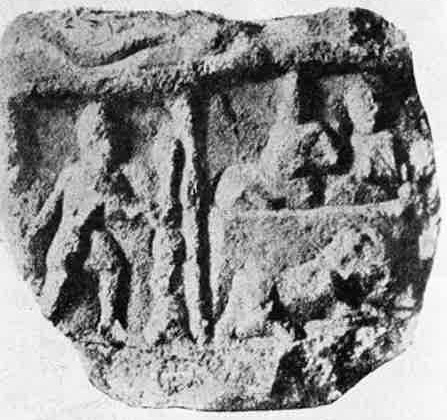
Marble tauroctony relief fragment from Kirk-Bunar near the monastery of St. Petka, Moesia Inferior, preserving part of the creeping serpent as proof of a bull-slaying composition.
Fragmentary inscription from Acbunar, Moesia Inferior, recording a votive fulfilment on the Kalends or Ides of January — one of the few Mithraic inscriptions with a calendar date.
Marble relief fragment from Acbunar, Moesia Inferior, preserving the foremost part of two horses — probably from a scene of Sol's biga — with remnants of an inscription below.
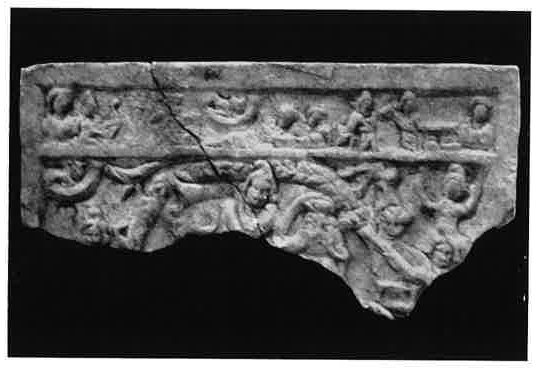
Upper portion of a yellowish marble tauroctony in two fragments from Acbunar, Moesia Inferior, preserving the divine busts of Sol and Luna in the upper register.
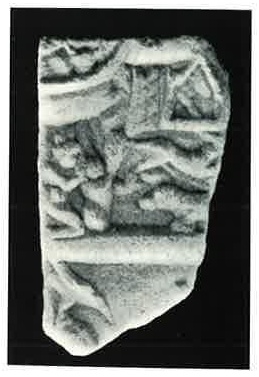
Two fragments of a yellowish marble tauroctony from Acbunar, Moesia Inferior, divided into three registers by two horizontal rims; the upper registers carry subsidiary Mithraic scenes.
