Your selection in monuments gave 624 results.
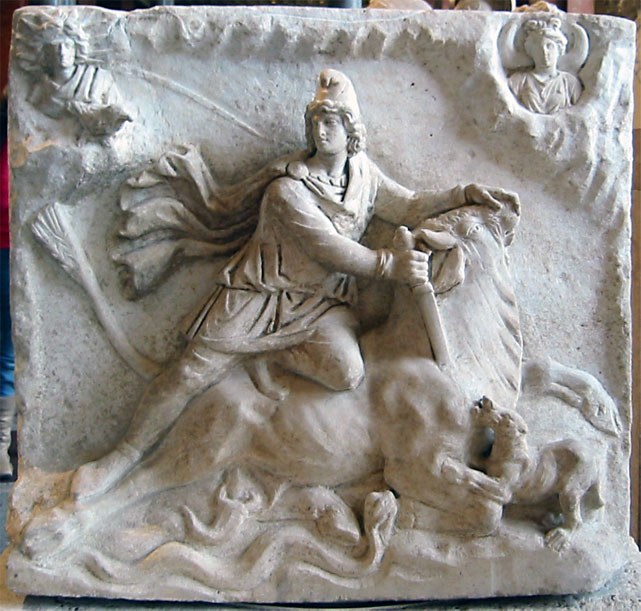
The marble shows Mithras slaying the bull, on one side, and Sol and Mithras feasting on a bull skin, on the other.

Relief of bluish marble in the Casino of the Villa Doria Pamphili showing Mithras slaying the bull with the usual animals, cross-legged torchbearers, and Sol in a quadriga and Luna in a biga in the upper corners.
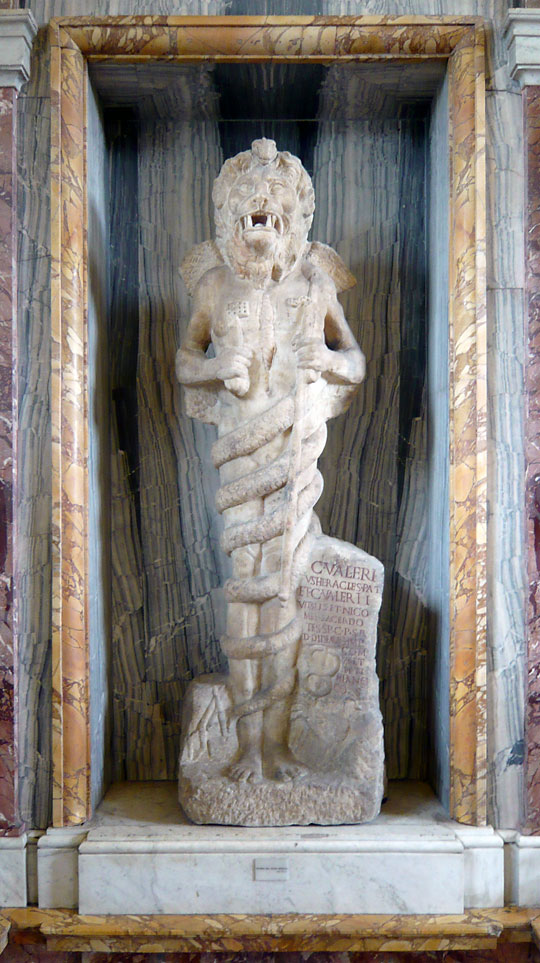
Marble leontocephalic Aion/Arimanus from the now-lost Fagan Mithraeum at Ostia, dedicated in AD 190 by three members of the local Mithraic priesthood.
This monument records the transmission of the patrica and the presentation of the cryfii, ritual acts associated with Mithraic initiation.
One of the earliest securely dated Mithraic inscriptions, documenting the cult’s early presence within the imperial household.
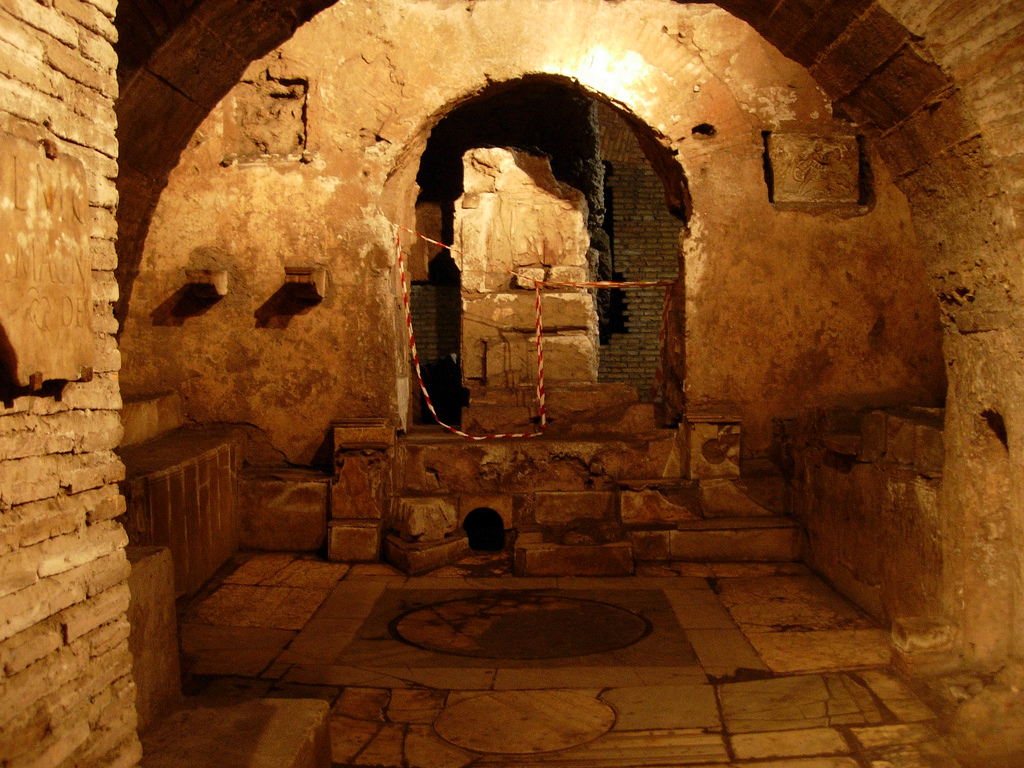
The Mithraeum near the Circus Maximus was discovered in 1931 during work carried out to create a storage area for the scenes and costumes of the Opera House within the Museums of Rome building.
,_found_in_Rome,_2nd_century_AD,_British_Museum_(15545876047).jpg)
The sculpture of Mithras slaying the bull was transported from Rome to London by Charles Standish in 1815.
Large marble slab found in 1648 near S. Silvestro in Capite, inscribed with a Latin dedicatory poem forming a cypher-acrostic for TAMESIUS and AUGENTIUS, with records of leontica and chrysos initiations, dated to 362 A.D.
Inscription recording the transmission of the leontica grade by Nonius Victor Olympius and Aurelius Victor Augentius at the Mithraeum of Piazza S. Silvestro in Capite, dated to 359 and 358 A.D.
Inscription CIL VI 750 recording the transmission of the Persica and Heliaca grades by Nonius Victor Olympius and Aurelius Victor Augentius at the Mithraeum of Piazza S. Silvestro in Capite, dated to 358 A.D.
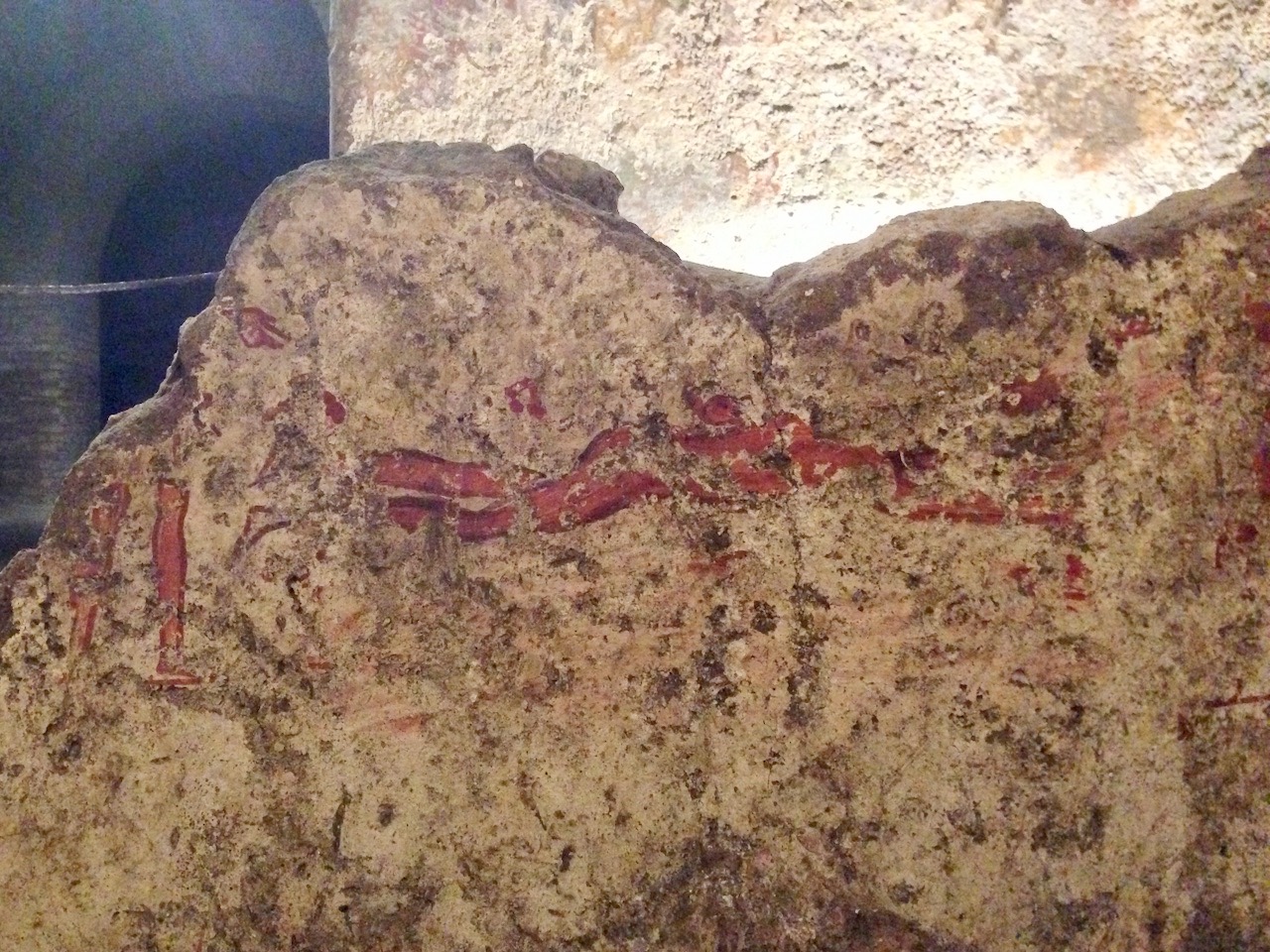
Representation of a person lying prostrate on the ground between two other walking figures on the Mitreo of Santa Capua Vetere.
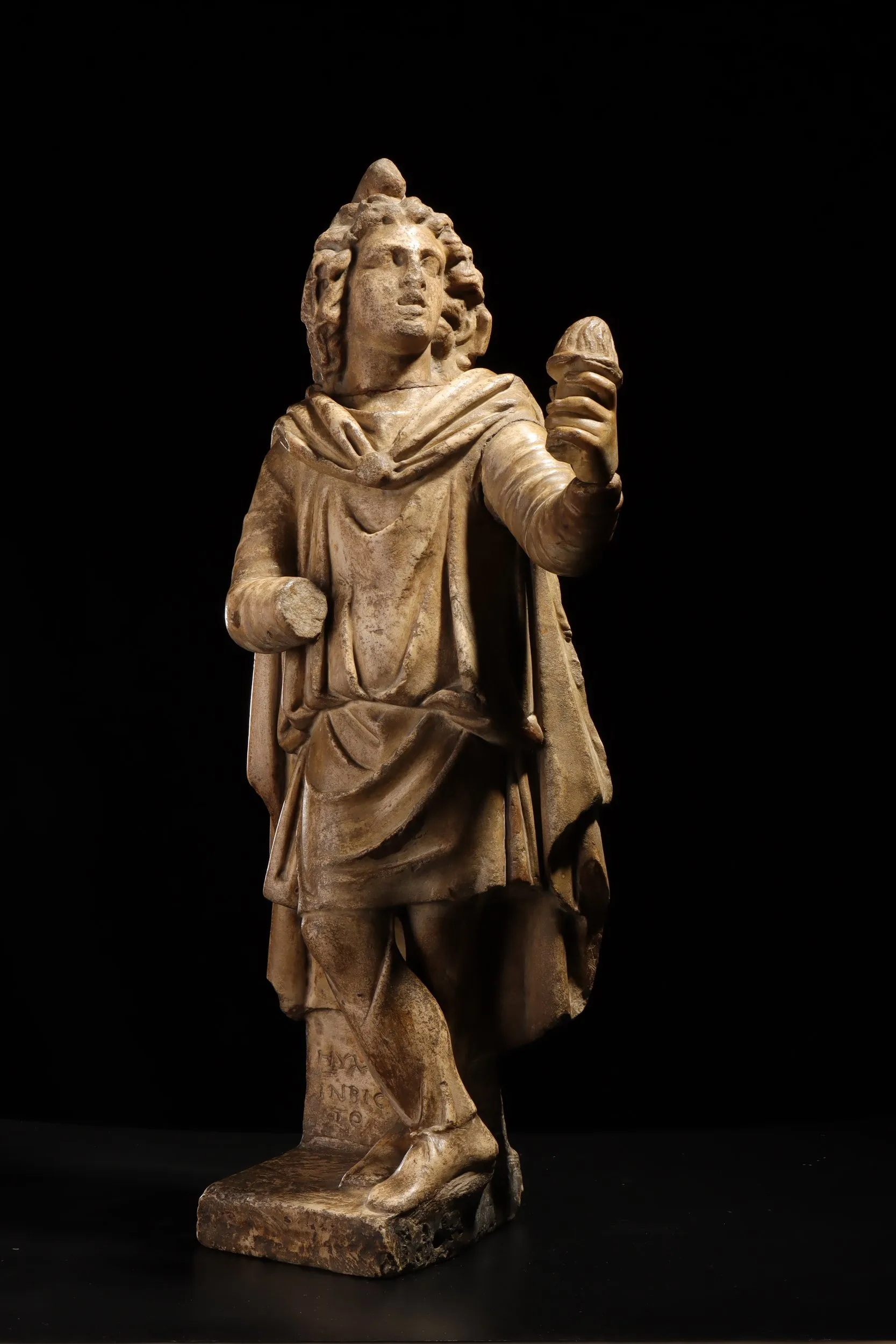
Marble statuette of the torchbearer Cautes bearing the votive inscription HYMNUS INBICTO, probably produced during the second or third century CE and preserved in an old European collection.
Small marble relief from the Aventine showing a primitive representation of Mithras slaying the bull, without torchbearers or Sol and Luna.
Altar of Varia Severa from Mediolanum, modern Milan, one of the few women associated with a possible Mithraic dedication.
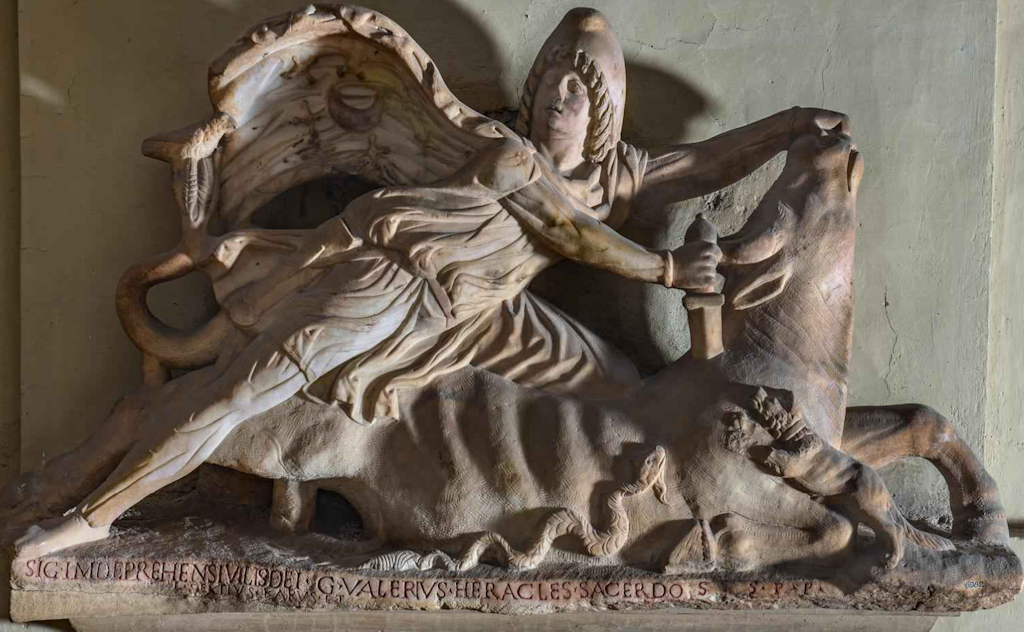
This sculpture of Mithras killing the bull was dedicated to the “incomprehensible god” by a certain priest called Gaius Valerius Heracles.
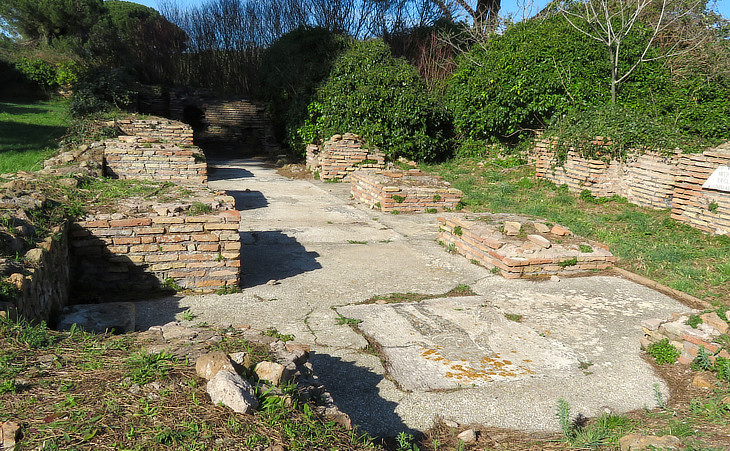
The Mithraeum of the Animals was decorated with a mosaic depicting a naked man, a cock, a raven, an scorpion, a snake and the head of the bull.
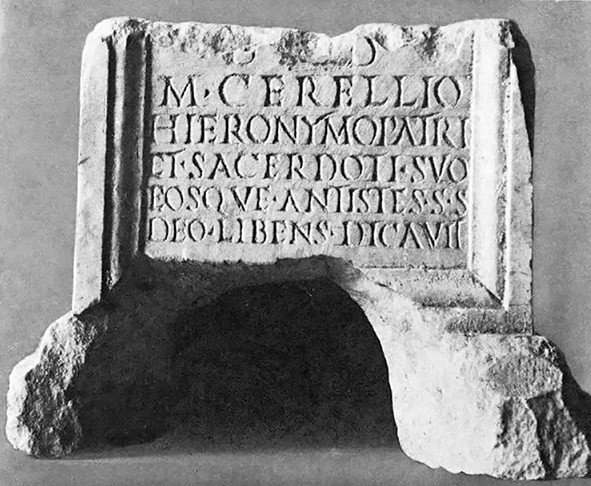
Small marble base recording a donation to M. Cerellio Hieronymo, pater and sacerdos, on behalf of an antistes who dedicated objects to the god, from the Mitreo degli Animali at Ostia.

The Fagan Mithraeum, also known as the Mithraeum of Tor Boacciana, yielded remarkable sculptures of lion-headed deities, several of which are now preserved in the Vatican Museums.
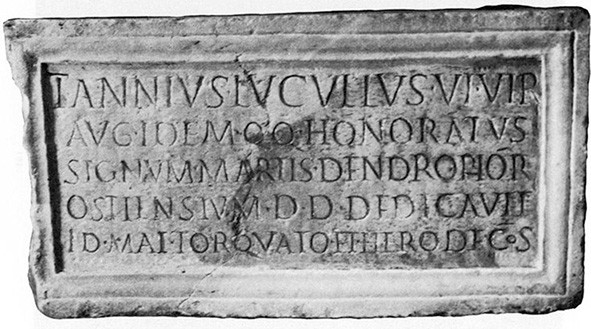
Small marble base with a dedication by T. Annius Lucullus, sevir and quinquennalis, to Martis Dendrophoris Ostiensium, from the Mitreo degli Animali at Ostia, dated to 143 A.D.

Small marble base dedicated by C. Atilius Bassus, freedman and apparator of a priest of the Great Mother, to Silvanus dendrophoris, from the Mitreo degli Animali at Ostia.
