CORAX: INTERVIEW WITH A FOLLOWER OF THE SOLAR CULT

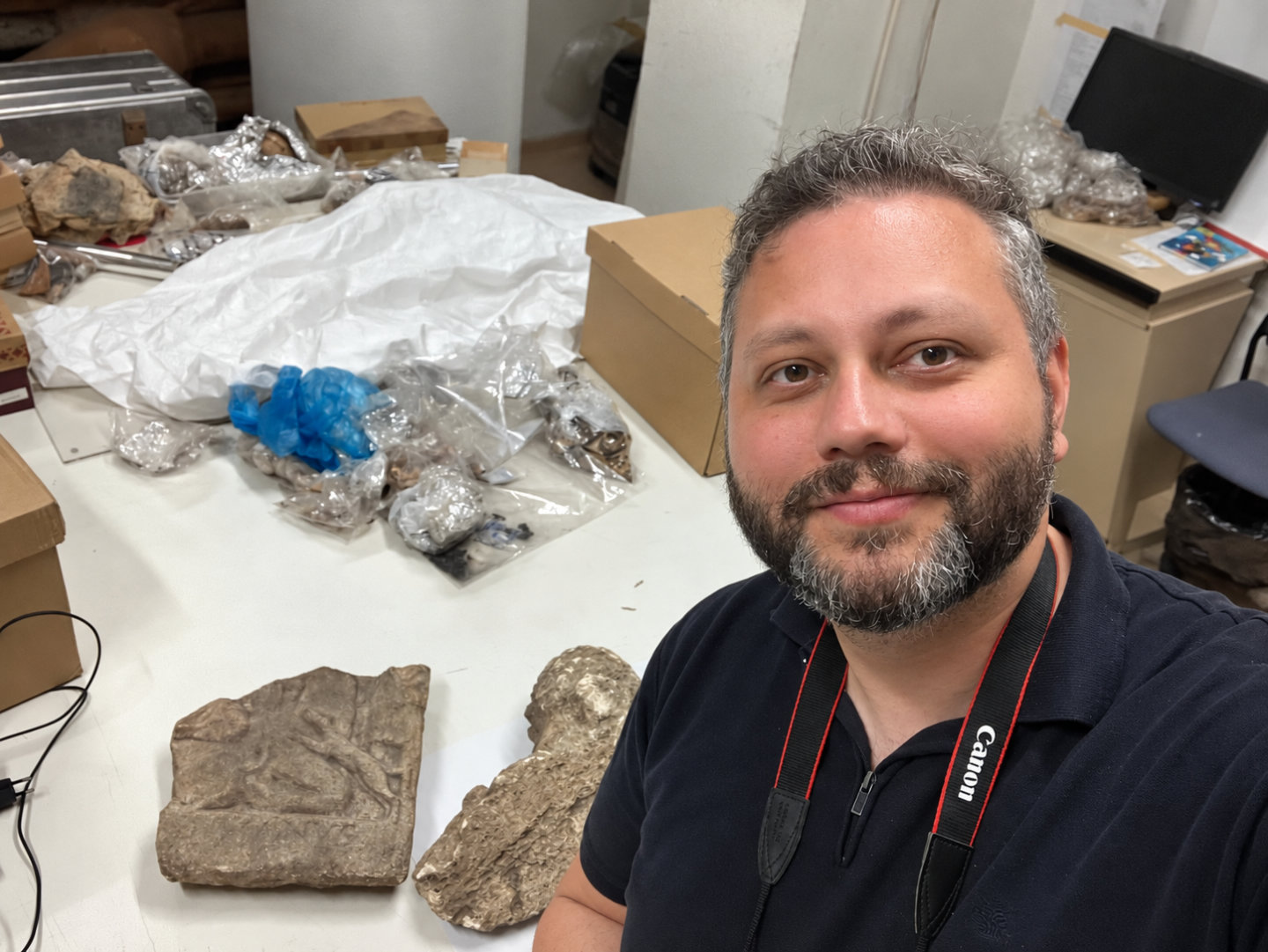
An anonymous figure in an urban setting.
F. Voss
ANTAIOS: CORAX, WHO ARE YOU?
CORAX: As a young European academic, I would define myself, at the risk of being seen as a provocateur, as a follower of Mithras, a devotee of Sol Invictus, in the spiritual tradition of Akhenaten and the Emperor Julian, known as the Apostate. Like them, my solar awakening stems from the encounter between a tradition and a personal quest.
A: WHY THE PSEUDONYM ‘CORAX’?
C: ‘Corax’, the raven in Ancient Greek, is one of the seven grades of initiation into the Mysteries of Mithras. In many mythologies (not only Indo-European ones), the raven is the messenger of the Sun.
A: WHAT DO THE MYSTERIES OF MITHRAS REPRESENT TO YOU?
C: Mithraism, or Mithriacism, was one of the most fully developed forms of European sun worship. A luminous path of self-mastery, piety and spirituality, it remains an essential reference for those who, today, are once again taking an interest in solar cults.
A: WHAT MESSAGE CAN MITHRIACISM OFFER OUR CONTEMPORARIES?
C: First and foremost, an ethic. Mithraism, like Christianity, developed in a declining Roman society, whose values were faltering, offering, moreover, some surprising parallels with our own time. Whereas Christianity preached renunciation, the cult of Mithras, by contrast, exalted the fulfilment that comes from duty accomplished, courage and friendship. Secondly, Mithraism conveyed a spirituality and a symbolism which, in my view, can still speak to people today.
A: AN EXAMPLE?
C: The mithraea were underground solar temples, the myth of Mithras revolving around the themes of the Sun and the cave. Yet our contemporary researchers study the Sun by placing their neutrino detectors… beneath mountains, for example at Gran Sasso, in Italy.
A: ISN’T REVIVING MITHRIACISM ANACHRONISTIC?
C: Mithraism is not as anachronistic as one might suppose, since, as you know, the God still has followers in Iran and especially in India, through Mazdaism.
Nevertheless, there remains the problem of the liturgy, of which we know almost nothing… except that it was splendid. This problem, moreover, applies to all ancient pagan liturgies, which were eliminated (or appropriated!) over the centuries by the various Christian churches.
If we cannot remain faithful to the letter, we can at least attempt to remain faithful to the spirit of the rites. Unlike certain modern Druids, we make absolutely no claim to any initiatory lineage (even though we spent years searching in vain for such ‘links’). More modestly, we experiment with the ‘techniques’ best suited to bringing forth the Sacred, always drawing as much inspiration as possible from what was practised in ancient times.
A: DO YOU CONDUCT INITIATIONS?
C: We have done so, but only at the request of the candidates themselves. The initiate-to-be must successfully undergo physical and psychological trials, as well as a test of knowledge. I should point out that each trial was first tested, among others, on myself before being proposed to anyone else.
Quite apart from their religious value, I believe that such trials are a good way of discovering one’s own limits and, consequently, of achieving self-realisation: this is what Jung called individuation.
A: WHAT ABOUT THE FAMOUS TAUROBOLIUM, THE SACRIFICE OF THE BULL?
C: Like many ancient cults, Mithraism had preserved bloody rites inherited from a distant past. These blood sacrifices were already criticised by Pagans in Antiquity: it would therefore be wrong to contrast Pagans, stained with blood, with immaculate Christians who, in fact, also practised sacrifices (the pyres of the Inquisition, the persecution of heretics and witches, etc.).
Our age, it seems to me, no longer needs such rites to ‘sustain’ its spirituality, which is more austere.
In any case, I would remind you that the taurobolium was practised above all… in the cult of Cybele and Attis during the Roman period. It seems, however, that the Metroac cult did not have a monopoly on this particular sacrifice, whose origins (the shores of the Black Sea?) are poorly understood.
The purpose was, in fact, to bathe the initiate, probably a high-ranking priest, in the blood of the bull: the man, having descended into a pit covered by a perforated wooden platform, was drenched in the vital fluid of a bull slaughtered above him. Archaeologists have discovered a series of taurobolic altars… notably at the Vatican, in front of the present-day Basilica of St Peter, which is rather piquant. The word Vatican, moreover, comes from the Latin vates, meaning seer (cf. vaticinate)! Indeed, only the goddess Cybele could, through the voice of her high priest, order the taurobolium. The dies sanguinis, the Day of Blood, was celebrated on 24 March, a spring festival that was very popular in Gaul, where the Metroac cult coexisted with that of the local Mother Goddesses. But by the end of Antiquity, initiates into the Phrygian cult were often convinced Mithraists: consider the Emperor Julian, author of a Discourse on the Mother of the Gods.
Finally, archaeology shows us that many other animals (pigs, sheep and poultry) were consumed during ritual meals (probably held monthly).
Perhaps such a sacrifice took place to celebrate the birth of the rock-born God, at the winter solstice (now Christmas), and during the initiation of candidates, but the texts are unclear on this point.
A: WHO IS YOUR TUTELARY DEITY?
C: It is a syncretic deity: Apollo-Helios-Mithras.
A: DO YOU REALLY BELIEVE IN THE EXISTENCE OF THE GODS, AND OF MITHRAS IN PARTICULAR?
C: This question, which is often asked, seems indecent to me: does one ask a practising Christian whether he ‘really believes in his God, in Christ, in the Holy Spirit’? If I answer yes, I risk being taken for a harmless visionary; if I answer no, for a charlatan. I shall therefore confine myself to replying that anyone can observe the existence of the Sun, without which we would not be here to ask such questions.
Let me add that, for a Pagan, ancient or modern, ‘believing’ or ‘not believing’ is a false dilemma imposed by Judaeo-Christianity (one God or no God).
A: HOW DID YOU COME TO EMBRACE YOUR SOLAR IDEAL?
C: This awakening came to me gradually, through a series of inner revolutions (in the Greek sense of metanoia). Raised in Catholicism, I was considered very devout because of the concentration I displayed during religious services. But at the time I was disappointed by my inability to feel God more deeply within the Church. At fifteen, I discovered astronomy and an extraordinary attraction to the Cosmos. I was then incapable of analysing this ‘thirst for the Universe’; it was only years later that I realised it was religious in nature. At the same time, I began searching for my path in religions other than Christianity. Islam initially attracted me through its mysticism and its demand for purity: five daily prayers, Ramadan… But I soon understood that a religion is inseparable from a people. And the people of Islam are not my people. After an excursion into Buddhism, founded by Siddhartha Gautama, himself an Aryan prince, I experienced another great revelation at the age of twenty-one when I read Jean Mabire’s essay Thulé, le Soleil retrouvé des Hyperboréens (Thule, the Rediscovered Sun of the Hyperboreans). I knew immediately that I had found the Path, my path. The three fundamental questions had finally found their answers:
‘Where do you come from?’ From the Sun.
‘Who are you?’ An Indo-European.
‘What do you want?’ To restore the worship of the Sun.
A: HOW WOULD YOU DEFINE THIS FORM OF SPIRITUALITY?
C: In short, I define myself as a pantheistic sun-worshipper.
Apollo-Helios-Mithras is at once God, the Universe and the Sun, the tangible form in which we can worship him. Contrary to what the ignorant believe, seeing sun worship as a regression towards primitive idolatry, it leads to highly elevated conceptions, such as those expressed by the Emperor Julian in his Discourse on King Helios. Let us also mention the Hymn to the Sun by the Neoplatonist Proclus…
A: IS THIS A UNIVERSALIST RELIGION?
C: The Sun is a universal symbol, just like water, the earth, etc. These symbols appear in the myths of all peoples. Sun worship is not universalist in the sense that each people’s image of the Sun God is shaped by its own culture. Sun worship is therefore a form of paganism, in the sense that it is rooted in the tradition of each pagus, each country, each local community. It is also pagan in that it in no way excludes the other Gods (polytheism).
A: ARE WE ON THE EVE OF A SOLAR RENAISSANCE?
C: To answer your question, I shall quote the famous verse from Virgil’s Eclogues (IV, 10): ‘casta, fave, Lucina: tuus iam regnat Apollo’. Which I would freely translate as: ‘Favour the birth of this child, chaste Lucina (goddess of childbirth): already your beloved Apollo reigns.’
Indeed, more and more of us know that the Sun will return…
A: THANK YOU FOR THIS INTERVIEW.