Mithras. Die and Become
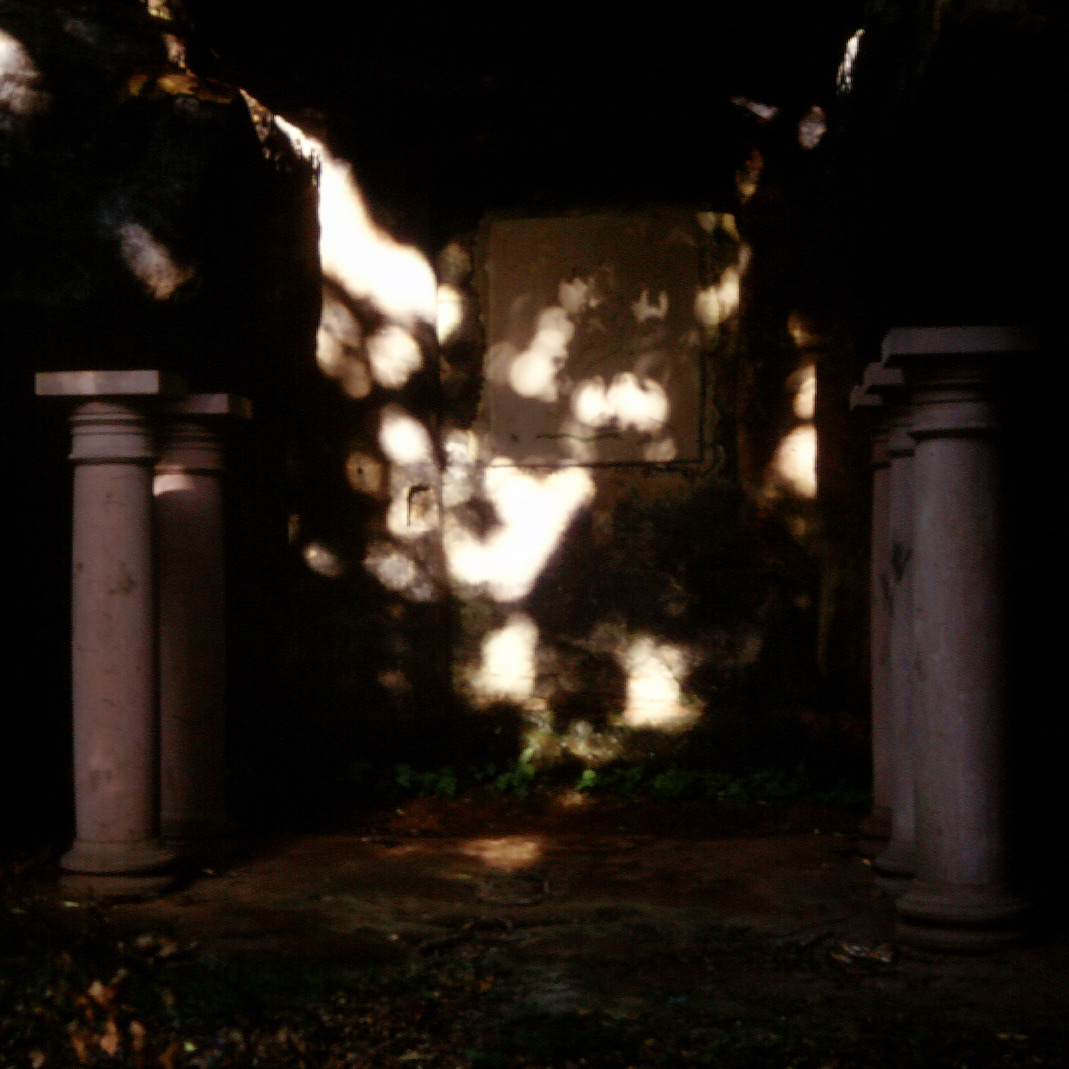
General view of the Mithraeum at Saarbrücken (ancient Saravum).
Gerhard Hallstatt
I
5 September. Leaves the colors of precious spices covered the ground, appearing like writings that had turned yellow, torn-up messages of a faith that had long disappeared. Leaves and beliefs… I asked myself why these words were so similar, not only in English, but also in German: Laub and Glaube, and in French: foi and feuillage. Could faith be as transient as the leaves rustling under my feet? I was on a walk through the warm colors of autumn that heralded both gold and death, harvest and end. A slight sadness filled the air. I love autumn. It is a home to me, a pagan homeland. Nature’s transitory essence and its destiny in death were revealed in the realm of the brothers Scheiding, Gilbhart, Nebelung (September, October, November, ed.). I watched the danse macabre of the leaves.
I was standing on the Halberg, a hill near Saarbrücken. On the top of the hill above me loomed the Saarland Radio Broadcasting Station. Close to the parking lot I discovered a black sign that bore a promising inscription in golden letters: MITHRAS GROTTO. I could not believe my eyes. The words produced a magical effect. Further signs showed the way, stirring my apprehension. I had anticipated finding a reference to a Christian chapel but not this… How much, if any, of the charisma of the ancient sanctuary that had once belonged to the Roman settlement Saravum would still be preserved?
Mithras had fascinated me for a long time. This deity, uniting Persian, Greek and Roman elements in its mysteries, was worshipped in the Roman Empire from the Iberian Peninsula to the Black Sea, from Germania to North Africa. Some temples had even been discovered in Great Britain. The aspects which were most important for me were the cultic sites where Mithras’ followers had celebrated their mysteries, while the cultic works of art, chalk-colored relics lit by spotlights in the museums, torn out of their original environment, were less essential to me. The atmosphere of the subterranean sanctuaries, of these spiritual darkrooms, touched my heart more passionately. I loved the search for surviving traces, and I could not understand that only some of the authors who had written about Mithraic culture seemed to have any interest in finding out whether these temples still existed. Almost no writer described cultic caves they had seen for themselves, or wrote of their own impressions. Most of them seemed to consider Mithraism a finished chapter in history, but I had come to the conclusion that no world of belief had ever really perished. In the substrata of the western world every spiritual philosophy, every pre-Christian cosmology continued to have an effect, subterranean, often situated many layers below the surface, then again shifting very close to visible reality, beneath the thin varnish of many centuries. Sometimes this search was easy, but usually it turned out to be difficult. Instead of providing answers it inevitably raised new questions, new Gordian knots which had to be undone in order to encounter yet another set of enigmas… I loved this quest for traces, and I cursed it as well.
Further ahead, on the left side of the path, the bare rock shone as red as cinnabar. The light of the afternoon sun falling through the trees on the western slope of the Halberg increased the radiant power of the red sandstone. I saw several niches in the rock. They were empty. I assumed they dated from Christian times. They probably once contained statues of saints. In the middle, between the niches, the rock opened to the interior, and suddenly I was standing in front of the grotto. The view was overwhelming. The stone shone a bright fiery red, as red as the blood of the heart. Here pagan antiquity still glowed in a passionate, violent shade of cinnabar. Fire immortalized… petrified blood… a chamber of the heart. What a backdrop for the mysteries of the cult. I was spellbound. This place must have had the same effect on the followers of Mithras. The red of the stone had an almost intoxicating effect. Here the pagan faith of antiquity was opening its veins, and the sacred blood of the mysteries flowed forth. I approached slowly. A semicircular fence surrounded the sanctuary, which, I was sure, had taken several moons to be chiseled out of the stone. In this blood-red crypt, which was later called the Heidenkapelle (Heathen Chapel) by the locals, the cultic liturgy took place. To be initiated the followers descended into this mother rock, the Petra Genetrix, which had given birth to Mithras, who had neither mother nor father. Into this mother rock, symbolizing the universe, the faithful descended, only to reemerge holding a higher rank in the hierarchy of Mithraism. The Latin word cruor entered my mind. I was reminded of a sentence that had been discovered on the wall of a Mithraeum: Et nos servasti eternali sanguine fuso (And us, too, you have redeemed by shedding the eternal blood).
Here speaks life itself, and the primal archetype of the red blood conjures forth its colorful images.
(Jünger, unknown source)
The grotto was flanked by two rows of columns made of a dull red stone. Reproductions. The original columns were quadrangular and were decorated with reliefs, with human figures and various symbols, which had since been lost. In the middle of the grotto there was an image representing the sacrifice of the bull, also a reproduction. The original artwork had fallen victim to the malicious joy, the malicious magic of the Christian church. The Mithraeum had been destroyed at the end of the fourth century. Only one small piece of the original relief survived: the genitals of the bull, which are being pinched by a scorpion. On either side of the cavern, behind the columns, two small tunnels led into the rock, which may have served as secret chambers or depositories. During excavations, archeologists had discovered a large pool and a deep pit in front of the cave. As in the cult of Cybele, maybe it was used as a blood pit, a fossa sanguinis, in which the initiate was drenched with the hot blood of the bull that was being sacrificed above him. There are also reports of a pit filled with water in Mithraic sanctuaries into which the bound and blindfolded neophyte was pushed, a martial baptism which ended only when an initiate of the mysteries had cut the fetters with a sword. The archeologists also found pieces of roof tiles and slate, fragments of plates and pots and small oil lamps.
Some portions of the image with the bull-sacrifice had been colored with color markers; the serpent was green, the scorpion yellow, and the dog brown. I wondered who had been responsible for this as these animals had the same color scheme as those on the reconstruction of the cultic artworks in Carrawburgh in Great Britain. Remnants of color had been discovered on several cult reliefs and statues. Color seemed to have been very important in the Mithraic mysteries. On the reliefs, the bull was always white, while Mithras and his companions, the torchbearers Cautes and Cautopates, wore green or blue clothes and a red coat, and the background was usually dark-blue. Throughout the entire Roman Empire these cultic works of art had not only a similar or identical shape, but also corresponding colors. The sanctuaries were a colorful, almost psychedelic framework for the sacral psychodrama of the mysteries in which lighting, music, masks, and disguises played an essential part. The Mithraea were Gesamtkunstwerke, Gesamtkultwerke, total masterpieces of pagan art. In Lentia on the Danube (today Linz in Upper Austria) the floor of the sanctuary was painted a radiant red. In several temples frescoes that were discovered were as impressive as the paintings in the Villa dei Misteri at Pompeii. The second Mithraeum of Carnuntum, close to Vienna, was dark-blue, the vault representing the starry sky. In the sanctuary of Santa Maria Capua Vetere, north of Naples, small red and blue stars were painted on the ceiling and particles of glass that were embedded in the paint sparkled in the light of the oil lamps or torches.
The last outstanding mystic of the Mithras religion was the Emperor Iulian, whose attempt to strengthen the pagan religion in the face of the rise of Christianity was acknowledged by history with the nickname Apostata, the unfaithful. It has been recounted that he experienced strange noises, abhorrent smells, flames, spirits and other apparitions during his initiation. These descriptions were certainly exaggerated by Christian fanatics, but one can be sure that by the use of these effects a mysterious atmosphere was created in the sanctuaries. In the Mithraeum of Wiesbaden a small chamber was discovered behind the niche of the cult image, which could only be entered from the outside. Here it was possible for a priest, unseen, to create phenomena which remained inexplicable for the believers and leave them to assume that the phenomena had a supernatural origin.
(Schoppa, Das Mithraeum)
The blazing crimson of the temple reminded me of photographs which I had seen of the rock city Petra, in Jordan. When I compared images of the Mithras grotto with pictures of Petra I was fascinated to find that the atmosphere of both places was quite similar. Could there be a secret connection between them? Petra had been the capital of the Roman province Arabia. Did it have a Mithraeum as well? In all the books about Mithraism which I had read, I had found nothing about a possible temple there. And yet there was a connection. Close to Petra is the spot where Moses supposedly used a stave to beat water out of a rock and thus saved his people from perishing of thirst. A very similar scene is essential in Mithraic mythology: the water miracle. Numerous cultic works of art show Mithras shooting an arrow at a rock; water then gushes out of it. On some representations Mithras is also shooting into the clouds to bring on rain, which reminds one of the manna falling out of the sky above the Egyptian desert… Obviously, there was a mysterious connection between Mithras and Moses, but it was difficult to say which myth had influenced the other. Maybe Jews who had been imprisoned in Babylon in the sixth century BC came in contact with Persian myths there?
I stayed in the sanctuary until sunset. Slowly the stone darkened, the radiance of the red faded, the shadows increased. The Blutleuchte retreated into the interior, behind the scenery of stone. The rock turned black. I lost sight of the sun.
II
Die and Become! This saying by Johann Wolfgang von Goethe represents the heart of all ancient mysteries. It is found in the symbolism of the bull-sacrifice on the cult reliefs of Mithraic culture. It refers to death in nature, which is always merely an apparent death, a transformation, a turning-point, but never an actual end, and to the spiritual hierarchy, in which the followers of Mithraism ascended through seven steps or degrees, Raven, Occultus, Soldier, Lion, Persian, Solar Runner, Father, undergoing the experience of “Dying and Becoming” symbolically within the context of each initiation.
The bull sacrifice is the symbol that lies at the heart of Mithraism’s blood mysticism. On most cultic works of art the tail of the bull ends in a sheaf of wheat. On a magnificent relief from Rome, now found in the British Museum of London, there is no blood running from the wound inflicted by Mithras; instead, sheaves of wheat sprout from it: life arises out of death, death is the wellspring of life, of becoming flesh. The sacrifice of the bull is an act of creation, ensuring a rich harvest. Nowhere else is the unified harmony of death and rebirth, of destruction and creation, of decay and growth more apparent than in the “Die and Become” symbolism of the Mithraic bull sacrifice, which encompasses several seemingly contradictory aspects of the god Mithras: the martial and the fertile, the solar and the terrestrial character. Apart from the death-birth significance, the killing of the bull is also a symbol for the triumph of the spirit over matter.
Thus the bull embodies a double symbolism of death and life. As the bull of fertility and light it is a sign of the sun ensuring the fertility of all. As the bull of the underworld it represents the abyss of the darkened light that has grown deadly … The bull symbolizes the ascending and descending totality of life that has to return again and again to the sphere of death to remain fertile, the bright and the dark spheres of existence that, due to their instability and ever-changing nature, need a shielding, guiding lord that guarantees their continuity.
(Rosenberg, Michael und der Drache)
The Greek philosopher Porphyrios (232–304), who was well acquainted with the Mithras cosmology and wrote fifteen books, including Against the Christians, described the symbolism of the bull in two ways: “Mithras rides on the bull of Aphrodite for the bull is the creator, and Mithras is the lord of all creation.” “The Bull is Luna, and Luna receives her greatest strength when it is in the sign of Taurus.” Some scholars interpret the encounter of Mithras and the bull as an encounter between sun and moon, since the bull is in a crescent-like position on many representations and because the sun is visible above Mithras, and the moon above the bull.
I discovered a key to understanding the cryptic bull sacrifice in the tract Mithras-Orion by Michael P. Speidel. In Greek, the words for bee and bull are almost identical: the word “apis” for bee was pronounced with a long ā, the word “apis” for bull with a short ă. Porphyrios described the bees as souls that were born in the stomach cavity of a dead bull. Since the followers of Mithras believed in the redemption of their souls from earthbound existence by ascending through the scale of initiations, the sacrifice may represent this redemption from the earth.
It follows, not conclusively, but with a great likelihood, that Mithras, by slaying the bull, initiated the birth of the souls, especially the souls of the just, in the manner of his own birth.
(Speidel, Mithras-Orion)
The idea of bees being born in the corpse of a bull reminds one of Samson in the Book of Judges in the Old Testament, who kills a lion with his bare hands and later discovers a swarm of bees and honey in the carcass of the animal. He removes the honey from the stomach and eats it. Samson is the Hebrew word for “solar man.” The lion is one of the most important symbols of the sun. Was it possible that the bull of Mithraic cosmology also represented the sun?
On every Mithras monument that contains residues of color, the bulls were painted white. The bulls that were consecrated to Apollo were also white, as were the bulls on the Helios-island Trinakria in Homer’s Odyssey. The Egyptian Apis bull, with its solar disc between the horns, was also a solar animal. Was Mithras killing the sun?
Many who research the Mithras cosmology identify Mithras with the sun. This solarisation, this connection to Sol Invictus, occurred during the Roman Empire; in the Persian Avesta it is explicitly stated that Mithras is neither sun nor moon, although his appearance is already similar to Helios. He holds a whip in his hand, and four white horses draw his golden chariot. Many Mithraic altars and inscriptions have been found describing Mithras as Sol Invictus or Deus Invictus, but other texts in which Mithras and the sun appear as two distinct deities have been discovered as well. On an altar from Chiusa di Verona in northern Italy one can read, “D(eo) I(nvicto) M(ithrae) et Soli Socio” (“The sun accompanies Mithras”). And an inscription from High Rochester in Great Britain originally read “Invicto Mithrae et Soli Socio,” but later the word “et” was rendered almost unrecognizable.
The Bull is the Sun, or rather, Taurus is the constellation through which the solar influence was transmitted to humanity at the time of the Mithraic cult; thus Mithras, like Sirius, was a sun-slayer, for, as Churchward explains, ‘The first celestial hero was not the sun, but the conqueror of the sun and solar heat. … At the season when the sun was in the sign of the lion and the heat was intolerable, the Set, as Dog-Star, or Sut Har “Orion” arose, and as the sun had then attained its supreme height and began to descend, the Dog-Star, or Orion, was hailed as the conqueror of this cause of torment. The lion, as is apparent from its place in the zodiac, was the type of the furious summer heat … Out of the slain lion comes the honey.’
(Grant, The Magical Revival)
The side panels of many cultic stones depict scenes from Mithras’ life: his birth from the rock, his fight with the solar god and their subsequent alliance and the struggle with the bull. Was the killing of the white bull just another allegory for his triumph over the sun? From a nature-magical point of view Mithras fought with the sun to weaken its destructive force, which endangered the fertility of the earth during the hot months. He made a pact with the sun in order to ensure a good harvest. Mithras was also called the Lord of the Year, the Lord of the Ages, and on most cultic artworks the sacrifice of the bull is surrounded by the zodiac in a circle or semicircle. In many Mithraea, altars have been found that were consecrated to the four seasons. The numerical value of Mithras is 360 = M-40, I-10, Th-9, R-100, A-1, S-200. To arrive at the value 365, his name is also written as Meithras. 365 is also the numerical value of the Gnostic god Abraxas, who also symbolizes the wheel of the year. Several connections exist between Gnosis and Mithraism. An oval gem has survived that shows the Tauroktonos, the sacrifice of the bull, on one side and Abraxas with the head of a cock, two serpents as legs and holding a shield and whip on the other.
Franz Cumont Wrote about the apparent unity between Mithras and the sun in his book The Mysteries of Mithra: “This double system of interpretation was particularly applied to the Sun, conceived now as identical with Mithra and now as distinct from him. In reality there were two solar divinities in the Mysteries …” But Mithras’ and Helios’ relationship is akin to that of father and son. Mithras is the great god, Helios, his Logos through which he unfolds, who created the world and who intermediates between men and god. (Leisegang, Die Gnosis)
A very similar Gnostic point of view finds expression in C. G. Jung’s cryptic oeuvre Septem Sermones ad Mortuos (Seven Sermons of the Dead): “This is a god whom ye knew not, for mankind forgot it. We name it by its name ABRAXAS. It is more indefinite still than god and devil … That god may be distinguished from it, we name god HELIOS or sun. Abraxas is effect. Nothing standeth opposed to it but the ineffective; hence its effective nature freely unfoldeth itself. The ineffective is not, therefore resisteth not … Abraxas standeth above the sun and above the devil.”
In the Mithras Mysteries seven planets were assigned to the seven steps of initiation: Mercury to the Raven, Venus to Occultus, Mars to the Soldier, Jupiter to the Lion, Luna to the Persian, Sol to the Solar Runner, Saturn to the Father. In this hierarchy Saturn stands above the sun. Saturn, too, is a god of time, a god of the harvest. Is Mithras identical to Saturn? In the Mithras-Liturgie, about which Albrecht Dieterich wrote an entire book, Mithras stands above Helios as well. Sol appears in this mysterious ritual, the only such surviving mystery from antiquity, only as mediator between the initiate and Mithras.
In medieval Kabbala, which contains many surviving conceptions from Graeco-Roman cosmology, Saturn is again situated above the sun, but the succession of the seven planets, which corresponds exactly to the Chaldean sequence of antiquity (Luna, Mercury, Venus, Sol, Mars, Jupiter, Saturn) does not correspond to the Mithraic hierarchy. Did this contrast exist in the mysteries? Or is it an error, or an intentional blind by initiates or outsiders? This is a question which has not yet been answered. In some temples of Mithras statues of Aion were also found. Aion is a lion-headed god of time, entwined several times by a large serpent, who seems to unite the meanings of Abraxas, Mithras and Saturn. The connection between Aion and Mithras is unclear. Some researchers assume that Aion was the actual deity of the Mithraic religion.
For Abraxas, like Mithras, is the name of a god who combines the power of the seven planets in himself, since his name also consists of seven letters. (Leisegang, Die Gnosis)
Several ancient historians, especially Christian chroniclers, publicized discovery of the fact that the mysteries of this “solar deity” were celebrated in dark grottoes, in natural caves and artificial temples, places that correspond much more to the cult of a chthonic god. The sanctuaries of Mithraism were subterranean because Mithras had been born from a rock and because he had sacrificed the bull in a cave. In ancient times people believed that the sky consisted of stone, probably due to the meteors that had fallen from it; therefore, the Mithraea were allegories of the cosmos whose stone vaults symbolized the firmament. The solarization of the Roman Empire led to the institution of the birth of Mithras on the birthday of the sun, the winter solstice. He was born on the darkest night of the year, in the sign of Capricorn, which is ruled by Saturn. The sun ascends out of the empire of Saturn - another hint to the spiritual location of Saturn, which was called Ahnstern - the star of the ancestors or the star of intuition - by the Germans, above the sun.
Winter Solstice, 1994
Sources
Clauss, Manfred, Mithras: Kult und Mysterien. Munich, 1990.
Cumont, Franz, The Mysteries of Mithra. New York, 1956.
Dieterich, Albrecht, Eine Mithras-Liturgie. Leipzig, 1910.
Graichen, Gisela, Das Kultplatzbuch. Hamburg, 1988.
Grant, Kenneth, The Magical Revival. New York, 1972.
Halsberghe, Gaston H., The Cult of Sol Invictus. Leiden, 1972.
Kadmon, Aorta: Corneliu Codreanu. Vienna, 1994.
Koepf, Hans, Mithras oder Christus. Sigmaringen, 1987.
Leisegang, Hans, Die Gnosis. Leipzig, 1924.
Mead, G. R. S., The Mysteries of Mithra. London, 1907.
Merkelbach, Reinhold, Mithras. Weinheim, 1994.
Merkelbach, Reinhold, Weihegrade und Seelenlehre der Mithras-Mysterien. Opladen, 1982.
Pronay, Alexander von, Mithras und die geheimen Kulte der Römer. Freiburg, 1989.
Rosenberg, Alfons, Michael und der Drache. Freiburg, 1956.
Schindler, Renihard, Die Mithrashöhle von Saarbrücken. Saarbrücken, 1989.
Schoppa, Helmut, Das Mithraeum. Wiesbaden, 1959.
Sloterdijk, Peter, and T. H. Macho, Weltrevolution der Seele. Zurich, 1993.
Speidel, Michael P., Mithras-Orion. Leiden, 1980.
Turcan, Robert, Mithras Platonicus. Leiden, 1975.
Vermaseren, Maarten J., Mithras. Stuttgart, 1965.
