MYSTERIA MITHRAE
Magnum Opus.
Samuel Farrand
By way of introduction
Following an international seminar held in the spring of 1978 in Rome and Ostia, the capitals of ancient Mithraism, the assembled scholars published a concluding statement which we regard as a useful point of departure: “Roman Mithraism is a religion of a mystical type, a mystery structure founded upon a god who passes through a ‘history’ and a series of vicissitudes, though he is conceived not as dying but as invictus. This divinity opens up for man both an intra-cosmic and an extra-cosmic perspective, expressed through a symbolism linked to fertility within an initiatory structure operating, on the basis of the esoteric principle, in a particular kind of sanctuary. This mystery structure unfolds within a more specifically mysteriosophical perspective, founded upon the idea of the soul’s career within a cosmos conceived not as a prison but as a stairway which the soul must climb and transcend in order to reach, beyond the seven planetary spheres, the transcendent level of Aeternitas — the fixed stars — to which the eighth gate mentioned in Celsus’ famous text refers. It is therefore a mysteriosophy that is not anti-cosmic but, on the contrary, cosmosophical: that is, a mysteriosophy which entails a positive view of the cosmos, although, as in every form of mysteriosophy, within the context of the soul’s career or history. The Mithraist’s way of life is lived out in this world, which in turn is situated in relation to another world, so that Mithraism, without being a public or official cult and without standing in continuity with the old nature cults — Osiris, Attis, and so forth — which evolved towards mysticism, could nevertheless, paradoxically, fulfil a public and official function, creating a reciprocal affinity with imperial power and the official cult of the Sun.” 1
Every term employed in this passage is important, beginning with “mystical” — from the Greek mystikos, “pertaining to the mysteries”, mysterion being the mystery, the secret thing, the secret religious ceremony. Christians would later use this pagan term to designate their own mysteries: the Incarnation, the sacrament of baptism, and so forth. In the context of Antiquity, it might be defined as “an experience of participated and graduated interaction between the three levels: human, cosmic and divine” 2. Mystery is equally fundamental to our subject, for Mithraism includes an initiatory rite voluntarily undergone and therefore resulting from a strictly individual choice, whose purpose is to achieve an inner transformation through the experience of the Sacred. Mithraism may therefore be described as a mystery religion.
Indeed, in pagan Antiquity a distinction must be made between episodic and institutional forms of mysticism — Dionysism and Maenadism — in which the individual is entheos, that is, possessed by the God, and the mystery cults, which involve personal initiation, esoteric ritual and a God who disappears and returns, all of this giving rise to hopes of salvation post mortem — soteriology 3. To be more precise still, we shall define Mithraism as a mysteriosophy, in the sense that the vicissitudes experienced by Mithras correspond to those undergone by the divine or celestial soul — the pneuma of the Gnostics.
Whereas among the Orphics and in Plato the soul falls into matter — the famous sōma/sēma, the body as the tomb of the soul — in Mithraism it must climb a cosmic ladder of seven gates, corresponding to the seven planets and the seven grades. Mithraism is a cosmosophy because its doctrine conceives the cosmos as created and regenerated by Mithras’ saving act, the Tauroctony, and because salvation is possible through ascent into Aeternitas. Mithraic thought is consequently neither anti-cosmic nor anti-somatic.
A God from the East
Mithras is an Indo-Iranian God representing friendship, social and cosmic concord, and the contract. In Vedic Sanskrit, Mitra means “friend” or “alliance”; in Avestan Persian, Mithra is the contract. Mithras is therefore a cosmic divinity originating in the eastern part of the Indo-European world. It seems unlikely that he can be traced back to the common Indo-European period; on this point, see Jean Haudry’s note.
A God who defends Bona Fides, truth and the brightness of morning, Mithras watches over living beings and cares for the faithful. He guarantees social and cosmic order and sustains heaven and earth. In India, Mitra is associated with Varuna, the antithetical and complementary aspect of sovereignty. Mitra represents its juridical and priestly, benevolent and conciliatory, luminous and accessible aspect: he is the friendly God. In Iran, Mithra is a saviour and solar deity, a God of Goodness, concord and the oath. He is the tutelary divinity of the Achaemenid kings and is associated with Ahura Mazda 4.
This syncretic cult spread through Asia Minor in the Hellenistic period. It entered the Roman Empire through the 20,000 Cilician pirates captured by Pompey in 67 BC and resettled in Italy. We know from Plutarch that these defeated pirates practised a secret cult from which our mysteries supposedly derived. The Mithraic cult was thus born in a milieu hostile to Rome, among “terrorists” organised in clandestine groups.
The first allusion to the cult in an established form — and therefore distinct both from that of the pirates and from the cult practised in Asia Minor — dates from the reign of Domitian, AD 81–96, when adherents were already present in the imperial entourage. The transmission of the cult to the West, and its transformation there, therefore remain poorly understood and controversial. R. Turcan published a fundamental study of the philosophical Hellenisation of Mithras: it appears that Iranian doctrines were indeed integrated by Platonist circles. Zoroaster and the Magi enjoyed considerable prestige within the Academy, and Plato may even have been influenced by Persia 5.
The myth
The myth of Mithras, the product of Graeco-Persian syncretism, is abundantly represented in sculpture, engraving and painting. It is better known through figurative representations than through literature, hence a number of gaps 6. It may nevertheless be summarised as follows.
At the beginning, the God Saturn emerges from Chaos, after which Heaven and Earth appear, borne by Atlas. Jupiter succeeds his father Saturn and receives the thunderbolt for this purpose, using it to strike down the anguiped Giants, agents of Evil who seek to seize the world. Despite the victory of Light, the evil spirit continues to endanger the cosmos by threatening it with drought and thirst.
A saviour God then appears: Mithras, miraculously born from a rock — petrogenes. Mithras, responsible for the cosmos, causes a spring to gush forth for the shepherds with a single shot of his arrow. The world is threatened by a lack of moisture — an agrarian myth. This moisture passes into the Moon, which in turn transmits it to a bull, now the bearer of the vital substance, blood and semen. Mithras must pursue the bull, which at first escapes him. At last he succeeds in driving it from a house and captures it.
As taurophoros, the victorious Mithras drags his victim into a cave to put it to death at the command of the Gods, conveyed by the raven, messenger of the Sun. He immobilises the animal by grasping its nostrils, plunges the sacrificial blade — the harpē — into its throat, and causes the blood to gush forth, sprinkling the universe and restoring it to life. A serpent and a dog leap upon the vital fluid, while a scorpion or crab attacks the animal’s testicles. Ears of wheat spring from the wound and from the tail; vegetation and the surrounding animals are reborn.
During the Tauroctony, Mithras gazes at the Sun, which co-operates in the act by means of a solar ray. The Olympian Gods witness the sacrifice, which they inspired and therefore approve. Afterwards, Sol “dubs” Mithras: they clasp right hands above the altar upon which the meat of the meal shared over the bull’s remains is roasting. This is the dexiosis, the eternal sign of alliance and contract — in Latin, dextrarum iunctio 7.
The image
The central and constant image of the cult, the Tauroctony — the killing of the bull by Mithras — is the culmination of a heroic cycle. Franz Cumont described the Mithraic icon to perfection: “A young man presses his left knee upon the withers of a bull brought down upon the ground, while with his right foot, placed upon the fetlock, he holds the animal’s right hind leg stretched backwards. With his left hand he grasps one of its horns, or more often its nostrils, and pulls back its head; with his right he drives a broad knife into the shoulder.” 8
Mithras wears Asiatic dress — Persian trousers and a Phrygian cap — and is often shown with a nimbus or rays, indicating his solar nature. The fold of his star-studded cloak forms a curve representing the firmament. The saving and regenerative act performed upon the cosmos is observed by Sol and Luna, the latter representing the moist principle borne by the bull. The four winds, corresponding to the cardinal points, the planetary busts and the sphere of the zodiacal constellations are also represented.
On either side of Mithras stand the torchbearers Cautes and Cautopates. Cautes holds his torch aloft and represents the ascending Sun, the warm season and the summer solstice. A cock and a solar bust sometimes accompany him. Cautopates holds his torch downwards and represents the descending Sun, the cold season and the winter solstice. An owl and a lunar bust sometimes accompany him.
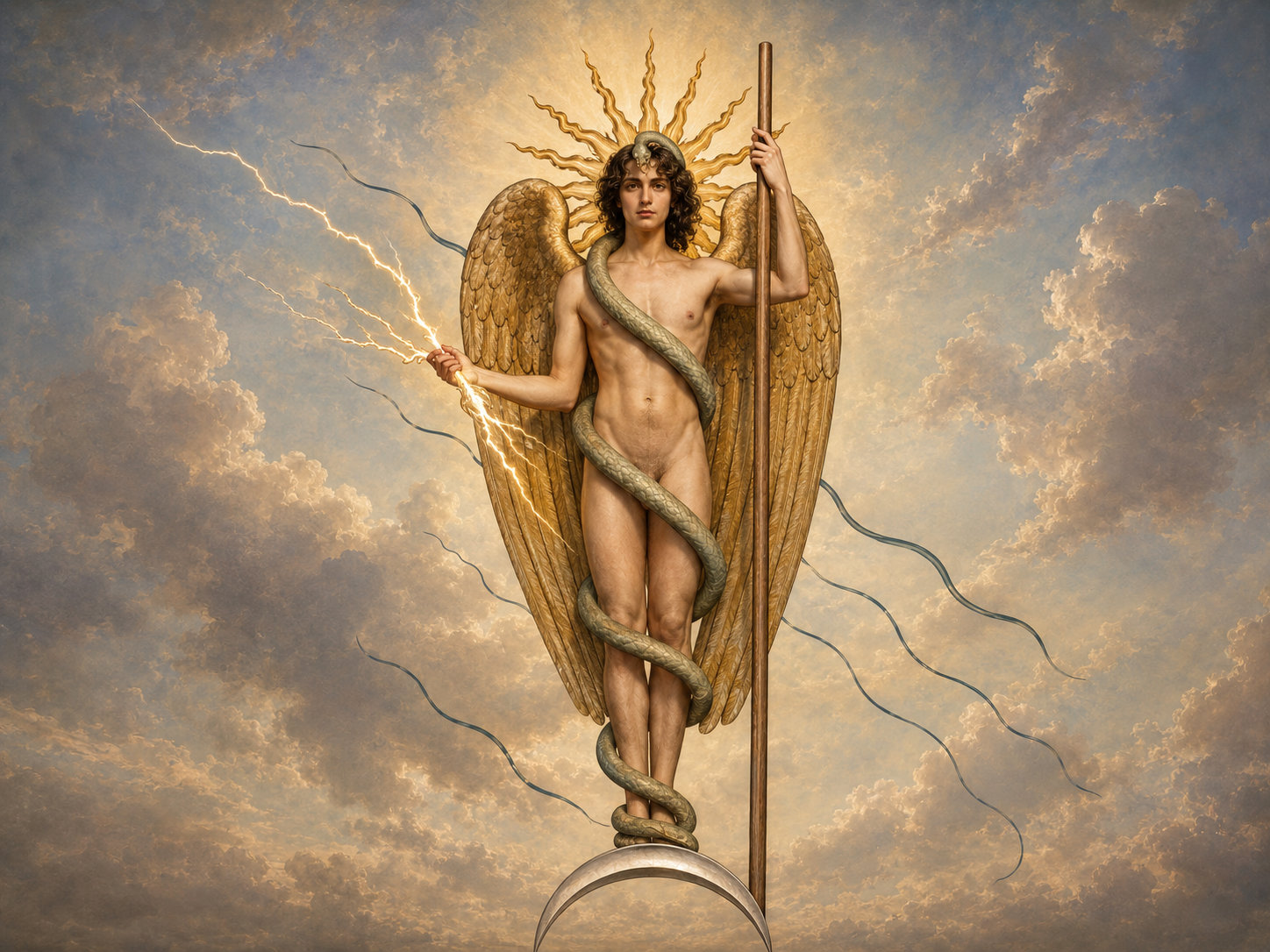
Between rising and setting, between Cautes and Cautopates, Mithras the Mediator fixes his gaze upon Sol Invictus, his expression ardent and even anguished, in the purest Hellenistic and Orientalising tradition. Aion, the winged, lion-headed God entwined by a serpent, represents cyclical Time and cosmic Eternity. This coherent imagery, this “illustrated dogmatics” — to use R. Turcan’s phrase — is identical from Scotland to India, in every mithraeum.
The doctrine
Besides syncretism, universalism and the notion of individual salvation granted by a saviour God, the defining feature of the mysteries is their esoteric character. The neophyte swears an oath — sacramentum — and undergoes initiation, preceded by fasting and purification. Upon entering the community of the mystae, those who know, he is shown the hieros logos, the sacred history, the original and foundational myth in both its esoteric and exoteric interpretations.
The ritual includes an imitatio dei, the death of the old man followed by resurrection and spiritual rebirth: the initiate is twice-born. Secrecy is fundamental in this context, and it was well preserved: we possess no complete first-hand text concerning Mithraic initiation.
An initiatory religion “with cyclical temporality and a pantheistic sensibility” — D. Aranjo — Mithraism has at its centre the magical sacrifice, performed in a cave symbolising the cosmos, of the passage of the seasons and the coming of the spring equinox, 21 March in the solar calendar. Nature, threatened by the evil spirit, is regenerated and saved by a God sent by the cosmic powers: the blood of the bull, comparable to the Stoic pneuma, to the divine life that flows through all things, fertilises the earth.
As a famous Mithraic formula proclaims, “et nos servasti aeternali sanguine fuso”: and us too, thou hast saved by shedding the eternal blood. It is therefore an optimistic and dynamic religion in which justice coincides with necessity and whose foundations, under the influence of Stoic currents, astrology and Indian and Iranian doctrines, include the Eternal Return to the reign of Saturn.
Unlike Orphism and Gnosticism, Mithraic doctrine held a positive view of the cosmos, created and/or regenerated by the Deus salutaris and transcended by the initiate. If Mithraism contains a dualism, it consists in being both within the world and beyond it. One may speak of a “social” dualism opposing the privileged, the initiates, to everyone else 9. To this horizontal opposition must be added a vertical one, between this sublunary world of mixture and change and Aeternitas, to which the Mithraic ladder leads.
This seven-gated ladder enables the initiate’s soul gradually to re-enter the celestial light and become divine fire once more, after retracing the complete cycle of the ages of the world beginning with Saturn. Mithraic dualism is no more than a vertical opposition between the level of the earth and the planets on the one hand and that of Aeternitas on the other. It entails no opposition between heaven and earth and no condemnation of the cosmos or matter. Mithraism might be defined as a vitalist monism or an initiatory pantheism: Mithras belongs to this world, exists in harmony with its elements and, by slaying the bull, animates the cosmos.
The rite
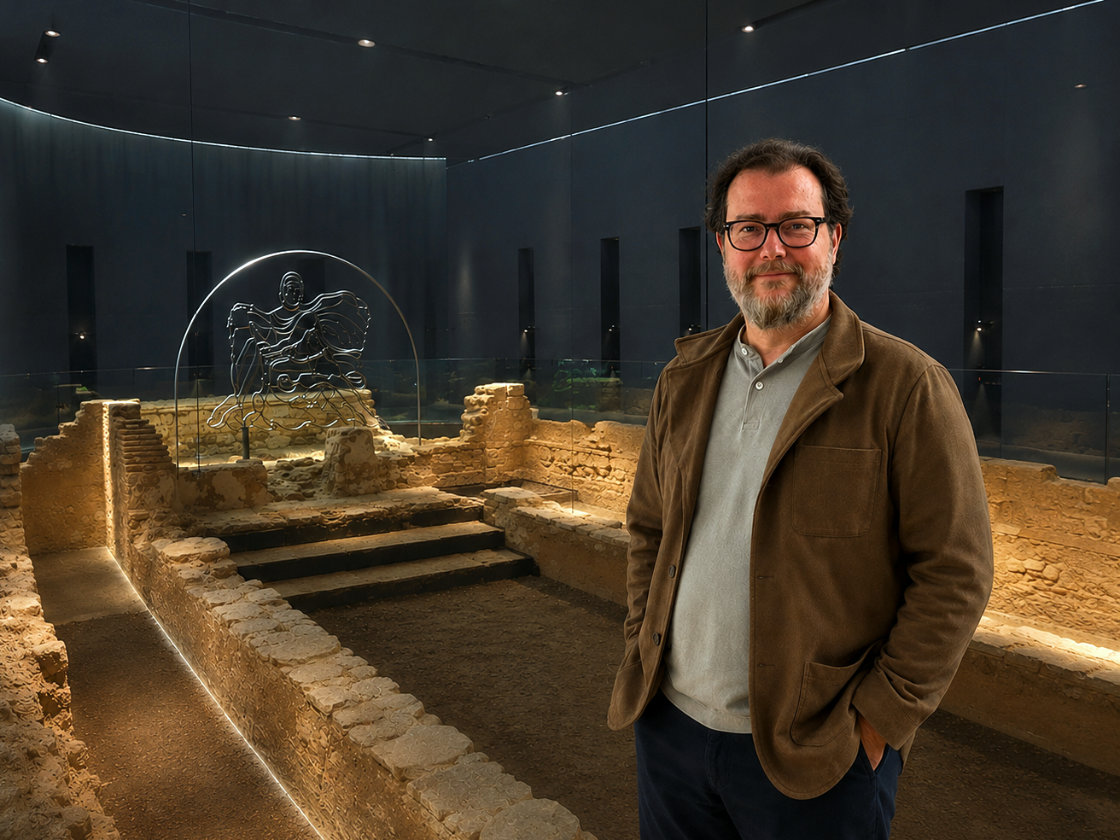
Mithraism is a religion of the crypt. Its worship is practised in what the fierce Tertullian — “What has Athens to do with Jerusalem?” — jestingly called castra tenebrarum, in contrast to the Christian castra lucis. The cave symbolises the cosmos — compare Porphyry 10. The temple of Mithras is accordingly called a spelaeum, a den. It may therefore be a natural or an artificial cave serving as both meeting place and dining hall for the initiates.
The mithraeum or spelaeum differs in this respect from pagan temples: it is subterranean whereas they are raised upon a podium; the altar stands inside rather than in front of the temple; the sacrifice takes place within rather than outside; and both the service and the meal are held intra muros rather than extra muros. In spiritual terms, this amounts to a genuine revolution in the ancient world.
The liturgy consists of animal sacrifices — though not a Tauroctony — and the consecration of bread, meat, water and wine. The sacrificial meal crowns the ceremony and is preceded by a period of instruction and explanation of the myth: catechesis and sacred supper, what Tertullian called blasphemous imitations, ingenia diaboli. The sacrifice takes place on Sunday, the day of the Sun. The most important festivals are, naturally, the equinoxes and solstices.
The grades of initiation
There are seven grades: three lower grades, the servants, and four higher grades, the participants, arranged in ascending spheres of responsibility. Their order is identical throughout the Empire: Corax, Nymphus, Miles, Leo, Perses, Heliodromus and Pater. The last is the highest dignitary and the representative of Mithras on earth. He protects the community, watches over his brothers, recruits and initiates.
Ethics
Mithras is the God of loyalty, friendship and contract. He symbolises personal, social and cosmic harmony. Mithraic morality is a solar morality, an ethic of light in which love of truth and faithfulness to one’s word are central. It is also a religion of energy, for Mithras conquers the bull through his unbending will and the strength of his arms. This enables him to restore the cosmic order, momentarily threatened by the forces of chaos, non-being and death.
Through the dexiosis, the clasping of right hands, Mithras seals his alliance with Sol. In many traditions the right hand symbolises power and will. Here it also signifies a commitment, a pledge to which unwavering fidelity is required.
The success of Mithraism above all in military circles, but also in the higher administration and the business world, may be explained by this sacralisation of an indissoluble fraternal bond, guaranteed by an oath and serving as a pledge of salvation. Loyalty, the Roman fides, a source of happiness and salvation in a difficult world, could only appeal to the juridical and moral outlook of the Roman Empire’s officers and administrators.
Research might usefully be undertaken into the links between Mithraic ethics and feudal and/or chivalric ethics. The similarities are numerous: exaltation of the notion of service; a morality of action and energy; struggle against evil; the necessity of obedience and of freely accepted discipline within a strict hierarchy; exaltation of honour and friendship; not the abstract and universal love of the Christians — whose inevitable corollary is interference in the life of another and “fraternal correction” — but concrete solidarity towards the members of the brotherhood. Finally, the dexiosis is also a guarantee of secrecy, indispensable within the Mithraic “lodges” 11.
Mithras and the Imperium
One scholar has written that Mithraism played a role comparable to that of Freemasonry under the French Third Republic. The Mithraic “lodges” were indeed highly influential in the army, finance and administration, extending even into the imperial entourage 12.
Nero seems to have been initiated into Mazdean rites during the visit of King Tiridates of Armenia, while Commodus “participated” in Mithraic rituals — though in his own fashion. The only certain cases of emperors who were adherents are those of Aurelian, Diocletian, Galerius and Licinius — according to the inscription of AD 307 — and Julian 13. Yet one must avoid falling, as Renan did in his time, into a “pan-Mithraism” caused by confusion with Sol Invictus.
Mithras, like Apollo, Serapis or Jupiter, is an avatar of Sol within a changing Paganism marked by a tendency towards henotheism rather than monotheism. Not every inscription dedicated to Sol Invictus is necessarily Mithraic, although the Mithraists were worshippers of Sol Invictus. If Mithras is assimilated to Sol, the converse is not always true. Several levels therefore existed within the solar cult.
Moreover, Mithraism’s Persian origin — Persia being Rome’s geopolitical enemy — its individualistic and initiatory character, perhaps even its lack of ecumenism, and its esotericism — Mithras always remained a secret God — meant that the emperors, although they discreetly supported the lodges and displayed benevolent neutrality towards them, granted the cult only unofficial recognition. But did the Mithraists seek anything more, when they celebrated their rites even in the camp of the Praetorian Guard, at the very centre of the Urbs? The destiny of the Mithraists within the Imperium seems to have been to be simultaneously everywhere and nowhere, at the centre and on the margins.
Survival
Mithras is still honoured today, from the Rhine to the Indus. Did not a Russian prince of the Belle Époque have a mithraeum built at Lugano? Did not the Marquis Folco de Baroncelli-Javon, Camargue poet, félibre and friend of Montherlant, seek to celebrate a taurobolium on the beach at Saintes-Maries-de-la-Mer, to the great scandal of the local Catholics?
An Englishwoman even published a detailed study of Mithraic references in Tolkien, who is said to have intended The Lord of the Rings as a kind of Mithraic Old Testament for a religion of his own 14. The cult is also practised, without interruption since Antiquity, by Zoroastrians, especially the Kshnoomists, a Zoroastrian initiatory society in Bombay 15.
Celebrated by writers, especially Alain Daniélou, whose Contes du Labyrinthe are a veritable Mithraic breviary, the rock-born God remains faithful to his mission beneath the Sun of an eternal present.
When shall we become Mithraists once more?
Christopher GERARD
Summer Solstice 1994
References
- Multiple authors & Ugo Bianchi (1979) Mysteria Mithrae, pp. XVI–XVII ↑
- Ibid., pp. 873–879 ↑
- Francesco Massa (2023) Les Cultes à mystères dans l’Empire romain. Païens et Chrétiens en compétition, pp. 13–22 et 81–103 ↑
- Robert Turcan (1993) Mithra et le Mithriacisme, pp. 10–23 ↑
- Robert Turcan (1975) Mithras platonicus. Recherches sur l'hellénisation philosophique de Mithra ↑
- Lire aussi la discussion générale qui clôt les M.M., p. 849-870, où l'érudit Gordon parle même de « bricolage » mythico-religieux. ↑
- Leroy A. Campbell (1968) Mithraic Iconography and Ideology ↑
- Robert Turcan (1989) Les Cultes orientaux dans le monde romain ↑
- Robert Turcan (1993) Mithra et le Mithriacisme, p. 47 ↑
- M.M., p. 873-884 ; H. Lavagne, « Importance de la grotte dans le Mithriacisme en Occident », in Études Mithriaques. Actes du IIe congrès international de Téhéran (septembre 1975), Brill, Leiden, 1978, p. 271-278. Ouvrage désormais cité E.M. Voir aussi la grotte de Zoroastre et celle où Mithra attire le taureau avant de le tuer. ↑
- M. Le Glay. La Dexiôsis dans les Mystères de Mithra », in E.M., p. . ↑
- Manfred Clauss (1992) Cultores Mithrae. Die Anhängerschaft des Mithras-Kultes. ↑
- Nous ne suivons pas R. Turcan, qui nous semble hypercritique. Voir à ce sujet W. Belardi, « Il Mithraismo occidentale e i suoi rapporti con il politico », in M.M., p. 385-387. Et M. Simon, « Mithra et les empereurs », in M.M., p. 411-428. Enfin P. Athanassiadi-Fowden, Julian and Hellenism, Oxford, 1981, p. 52-88. ↑
- E. Allen, « Persian Influences in J. R. Tolkien's The Lord of the Rings », in The Transcendent Adventure. Studies of Religion in Science Fiction/Fantasy, Westport, Londres, 1985. ↑
- E. Zolla (1998) Le Soleil dans la crypte ↑