
Biography
of Lucius Agrius Calendius
- Lucius Agrius Calendius, a free citizen, is attested as a member of a Mithraic community (syndexios) at the Mitreo del Palazzo Imperiale.
- Attested at Ostia, Latium, Italia in 162 (TNMM 492).
TNMP 114
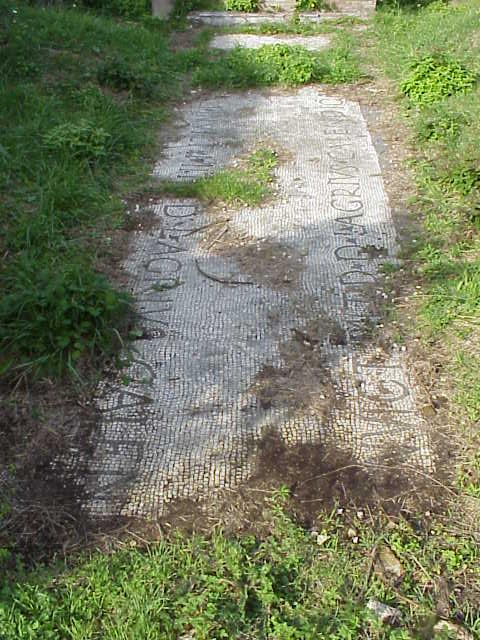
Lucius Agrius Calendius is known from a single inscription incorporated into the floor mosaic of the Mitreo del Palazzo Imperiale, where he records a donation to Sol Invictus Mithras: Soli Invicto Mithrae donum dedit L. Agrius Calendio (TNMM 492). The inscription was repeated on both sides of the central aisle, indicating that Calendius financed or donated a substantial element of the sanctuary rather than a minor votive object. He was therefore a benefactor of the Mithraic community active at Ostia during the late second or early third century CE.
Although virtually nothing is known about his life, family, profession, or rank within the cult, his name has attracted scholarly attention. Raffaella Marchesini, following earlier observations by Licordari, noted that both the nomen Agrius and the comparatively rare cognomen Calendius are particularly well attested in Roman North Africa, especially during the Severan period. On this basis, she suggested that Calendius may have originated from Africa or descended from an African family settled at Ostia. This interpretation remains hypothetical, as no inscription explicitly states his provenance.
Marchesini further observed that several members of the Agrii family known at Ostia appear in collegial and associative contexts and often bear cognomina commonly associated with freedmen. She therefore proposed that Calendius may have belonged to a family of freedmen or descendants of freedmen, possibly connected with the African mercantile networks involved in the grain trade and the annona. If this reconstruction is correct, Calendius would represent an example of the integration of individuals of probable African background into the social and religious life of Ostia’s Mithraic communities.
The evidence, however, remains limited. Beyond his donation to the Imperial Palace Mithraeum, nothing can be established with certainty regarding his social status, occupation, or position within the cult. His significance lies primarily in the possibility that he belonged to the African milieu that played an important role in the commercial and religious landscape of imperial Ostia.
The Agrius family name in Italy is mostly attested in central-southern Latium and in Campania. However, it was most widespread in Africa, especially in the Proconsular province, in the Severan age, although it is known from the 1st century AD.
In Ostia thirteen personages with this gentilitium are known (nine men and four women), four of them with the pre-name Lucius. In addition to the personage mentioned here, Ostiense epigraphy has handed down to us the presence of a L. Agrius Marcianus in CIL, XIV 251, member of the plebs of the professional college of lenuncularii of Ostia in the year 192 AD; of a [L(ucius) A]gris L. f. Priscus, as probably to be integrated, among the patrons of the religious college of the dendrophs of the Magna Mater, CIL, XIV 281, in 203 A° and finally of a L. Agrius Primus granting a locus sepolturae for the late C. Mundicius Felix, CIL, XIV 1383. Excluding this last inscription, which is late, it is interesting to note that the presence in Ostia of the Luci Agrii is concentrated around the final years of the 2nd century AD and the beginning of the 3rd century AD, therefore in the Severan age, and that almost all the persons known from the evidence we have received are involved in collegiate activities. In this regard, it is necessary to point out that within the same chronological range there are two other personages with the same family name but without a prefix, Agrius Chrysion and Agrius Hermes, both registered in 198 AD in the fourteenth decuria of the fabri tignuarii of Ostia (CIL, XIV 4569), a statue base dedicated by the numerus caligatorum to the emperor Septimius Severus).
As for the surname Calendio, of Latin origin, derived from calendar days, it is generally poorly attested even in its variant with the initial K. It occurs in CIL seventeen times, two of which are borne by persons of servile status, mostly in Africa (thirteen times of the total). In Ostia it occurs three times, in the inscription presented here and in CIL, XIV 4569 (with K, fragmentary). Interesting is the personage in CIL, 4569, a member of the fifteenth decuria of the fabri tignuarii of Ostia in the year 198 AD, whose name and family name are not preserved. As Becatti rightly pointed out, it is uncertain, given the fragmentary nature of the name, whether this Calendio can be identified with the dedicator of the floor of the mithraeum. On closer inspection, the presence of the punctuation mark before the surname, the analysis of the spaces and the fact that the family name of the two Agrii mentioned in the same inscription is written in full suggest that this hypothesis should be definitively ruled out, preferring rather a shortened nomen with two or three letters, for example Cl(audius), lul(ius), Ael(ius), the most frequent cases.
On the basis of the epigraphic evidence Licordari has rightly assumed that the persons known in Ostia with this surname were African. This would not be surprising, since the presence of a strong African group in the colony, especially linked to the annona and the grain trade, is well documented, starting from the middle of the 2nd century and in the years of the empire of the African Severan family; visible evidence of these activities can be found in the contemporary mosaics of the so-called Piazzale delle Corporazioni. On the basis of the epigraphic evidence, the presence of a strong African community in Ostia is not surprising. Piazzale delle Corporazioni.
On the basis of the onomastic analysis conducted so far, one could therefore admit an African origin for L. Agrius Calendio. On the other hand, not much can be said about his legal status. The fact that this surname is widespread mainly in the servile sector and that in Ostia the presence of Lucii Agrii is attested for the most part with Grecanic surnames, a possible indication of libertine rank, and enrolled in professional and religious colleges that are concentrated between the second and third centuries AD, may suggest that he was a freedman descending from freedmen, probably linked, like the previous ones, to large African families involved in the ration trade.
—Raffaella Marchesini (2013) Sacra peregrina ad Ostia e Porto.
References
- Alfred Shenington Geden. Mitreo del Palazzo Imperiale in EDCS.
- Ostia-Antica.org (2020) Regio I - Mitreo del Palazzo Imperiale.
- Raffaella Marchesini (2013) Sacra peregrina ad Ostia e Porto..
Attestations
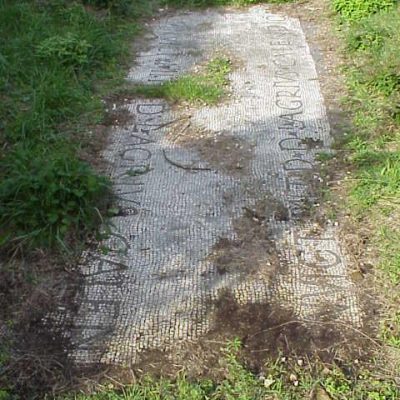
Floor mosaic of Mitreo del Palazzo Imperiale
TNMM 492
It bears an inscription repeated on each side of the podia.
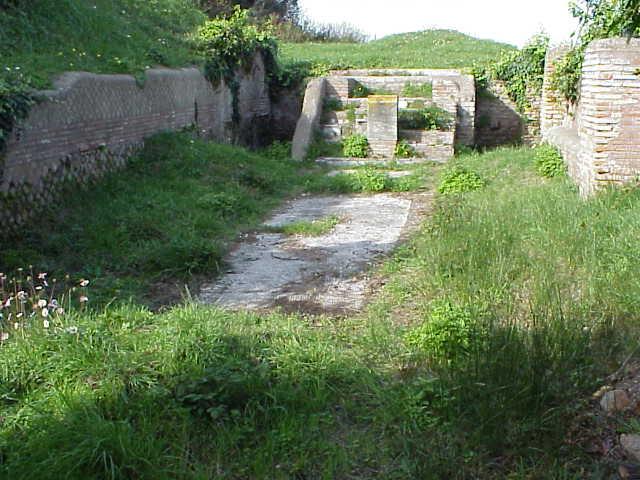
Mitreo del Palazzo Imperiale
TNMM 97
A mosaic of Silvanus, dated to the time of Commodus, was found in a niche in a nearby room of the Mithraeum in the Imperial Palace at Ostia.
