
Biography
of Lucius Agrius Fructosus
- Lucius Agrius Fructosus, a free citizen, is attested as a member of a Mithraic community (syndexios) at the Mitreo di Fructosus.
- Also recorded as Patronus corporis stuppatorum.
- Attested in the 3rd – 4th century.
- Attested at Ostia, Latium, Italia (TNMM 450).
TNMP 33
Fructosus was a prominent member and patron (patronus corporis stuppatorum) of the Ostian guild of stuppatores, craftsmen involved in the preparation and processing of tow, hemp, oakum, and related semi-refined textile materials. His name survives through a monumental inscription discovered in 1938 (TNMM 450) within the so-called Mithraeum of Fructosus, which records that he personally financed the construction of the sanctuary: [—]rius Fructosus patronus corporis stuppatorum templum et spelaeum Mithrae a solo sua pecunia fecit (”…rius Fructosus, patron of the guild of the stuppatores, built this temple and cave of Mithras from the ground up with his own money”). The inscription originally belonged to a marble architrave approximately two metres long and demonstrates that Fructosus acted as the principal benefactor of the sanctuary (Bloch 1953; Becatti 1954; Marchesini 2013; Canciani 2022).
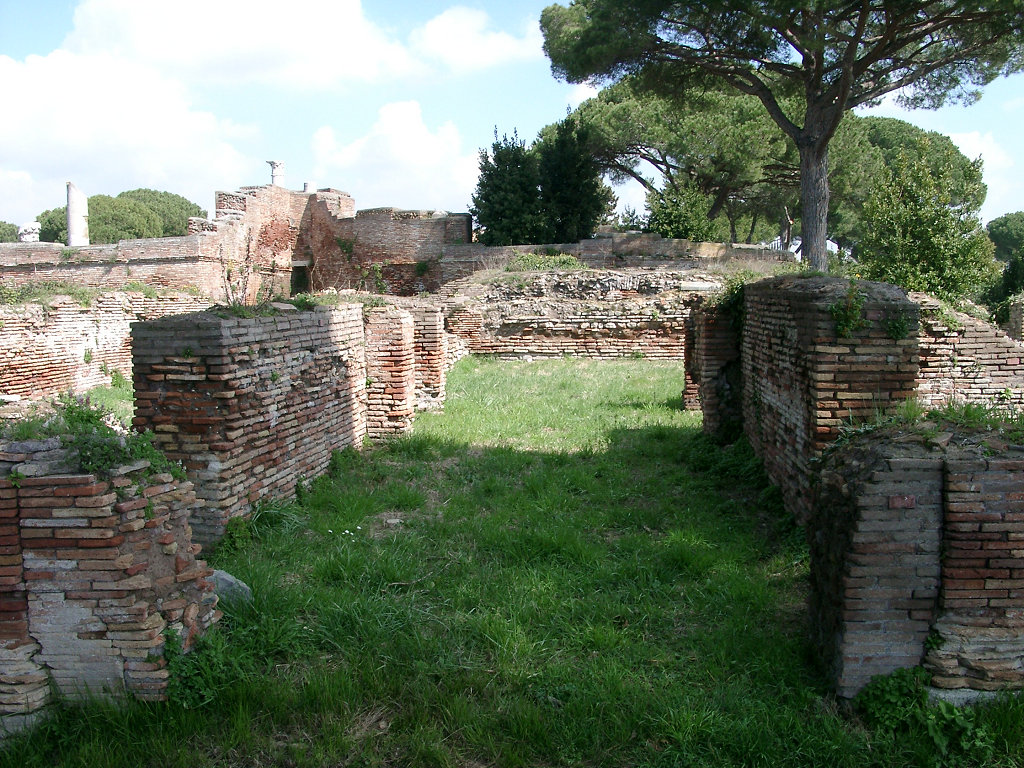
The Mithraeum itself was installed beneath an unfinished temple structure within the headquarters of a collegium, probably that of the stuppatores. According to the archaeological reconstruction, the building programme began during the Severan period but was abandoned before completion. At some point around the middle of the third century CE, Fructosus financed the transformation of the unfinished substructure into a Mithraic sanctuary, adding a vaulted ceiling, vestibule, cult niche, benches and decorative programme. His intervention effectively completed a building project that had previously stalled, creating one of Ostia’s smallest Mithraea, with an estimated capacity of roughly eighteen participants. Both Chalupa and Marchesini regard this sanctuary as closely connected to the guild environment in which it was embedded, making it one of the clearest examples of interaction between a professional association and a Mithraic congregation at Ostia.
Fructosus can be identified with a member of the corpus stuppatorum whose name appears in a guild list dated between approximately 235 and 250 CE, strengthening the association between the sanctuary and the collegium. His title patronus indicates a position of prestige and influence rather than an internal Mithraic rank. In the social hierarchy of Ostian Mithraism, Fructosus belongs to the relatively small group of devotees whose professional or civic standing is explicitly recorded in the epigraphic evidence. Canciani notes that, alongside figures such as <b>Sextus Pompeius Maximus</b>, he represents a category of affluent patrons who financed the construction or refurbishment of Mithraic sanctuaries and whose resources contributed directly to the physical expansion of the cult.
References
- Ostia-Antica.org (2020) Regio I - Insula X - Tempio Collegiale and Mitreo di Fructosus (I,X,4).
Attestations

Inscription of Fructosus in Ostia
TNMM 450
The inscription is carved into two pieces of marble cornice.
Mitreo di Fructosus
TNMM 40
The Mithraeum of Frutosus was in a temple assigned to the guild of the stuppatores.
