
Biography
of Elaine
- Elaine, a slave, is attested as a member of a Mithraic community (syndexios) at the Mitreo de Cabrera de Mar.
- Also recorded as Imperial slave (servus Caesaris).
- Attested at Iluro, Tarraconensis, Hispania in mid-2nd century (TNMM 472).
TNMP 82
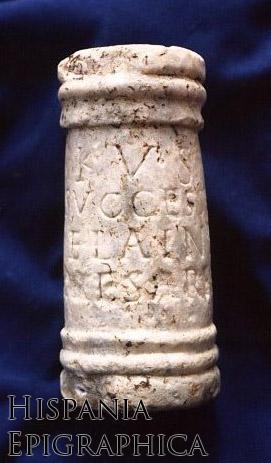
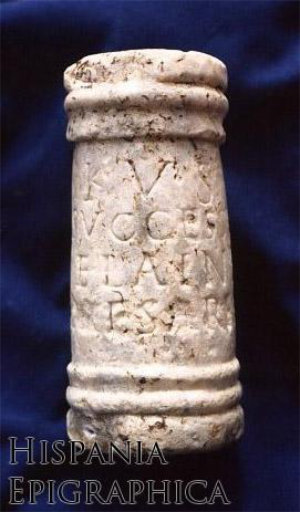
Elaine is known from a small cylindrical marble altar discovered in 1987 in the northern sector of the cryptoporticus at Can Modolell, near ancient Iluro, modern Cabrera de Mar. The inscription records the fulfilment of a vow to Cautes by two individuals identified simply as Successus and Elaine, both described as Caesaris slaves: K(auti) v(otum) s(olverunt) / Successus / Elaine / Caesaris (“For Cautes. Successus and Elaine, slaves of the emperor, fulfilled their vow”). The monument therefore attests the participation of imperial slaves in the religious life of the sanctuary and provides rare evidence for the social milieu connected with the cult at Can Modolell (TNMM 472; Mayer and Rodà 1992; Fabre, Mayer and Rodà 2002; Alvar 2018; Chalupa 2023).
The onomastic evidence strongly suggests that both dedicants belonged to the familia Caesaris. The name Successus is well attested among imperial slaves and freedmen, while Elaine is extremely rare in Hispania and appears otherwise associated with imperial service. For this reason, Alvar considered the identification of both individuals as imperial slaves beyond reasonable doubt. Their presence has been interpreted as possible evidence for an imperial estate in the vicinity of Can Modolell, perhaps connected with the long-lived sanctuary complex that functioned from the early imperial period until Late Antiquity.
The dating of the altar remains debated. While some scholars placed it in the mid-second century on the assumption that Mithraism reached the region only after becoming established at Emerita Augusta, both the original editors and Alvar argued that the inscription may be considerably earlier, perhaps even belonging to the Flavian period. If this earlier chronology is accepted, Elaine and Successus would rank among the earliest known devotees associated with the cult of Mithras in Hispania. Nevertheless, because the identification of Can Modolell as a Mithraic sanctuary and the interpretation of the dedication to Cautes remain subjects of scholarly discussion, the evidence should be treated with appropriate caution.
References
- Aleš Chalupa (2023) Římský kult boha Mithry. Atlas lokalit a katalog nálezů I.
- Jaime Alvar Ezquerra (2018) El culto de Mitra en Hispania.
- Epigraphic Database Heidelberg. Cilindric arula from Cabrera de Mar in EDH.
- Alfred Shenington Geden. Cilindric arula from Cabrera de Mar in EDCS.
- Hispania Epigraphica. Cilindric arula from Cabrera de Marin HE.
- Mitra en Hispania. Cilindric arula from Cabrera de Mar in MEH.
- Mitra en Hispania. Mitreo de Cabrera de Mar in MEH.
Attestations
Mitreo de Cabrera de Mar
TNMM 30
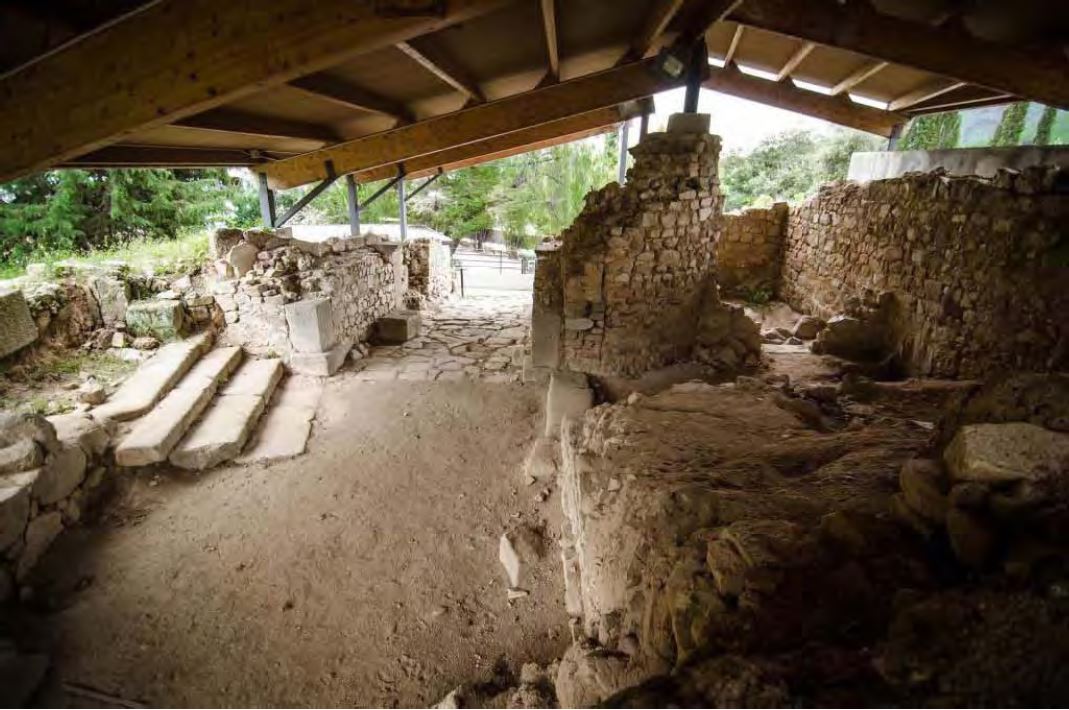
The Roman villa of Can Molodell had a sanctuary that has been related to the cult of Mithras.
