People attested in Emerita Augusta






Inscriptions from Emerita Augusta
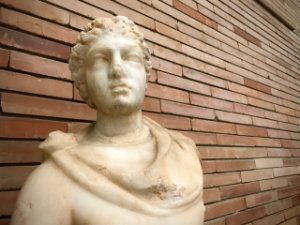
Cautopates from Casa del Mitreo of Mérida
Invicto sacrum C. Curius Avitus / Acci[o] Hedychro pa[tre].
Δημήτριος ἐποίει
Δημήτριος ἐποίει
Dedicated to the invincible. Caius Curius Avitus, Accius Hedychrus being Father.
Demetros made it.
Demetros made it.
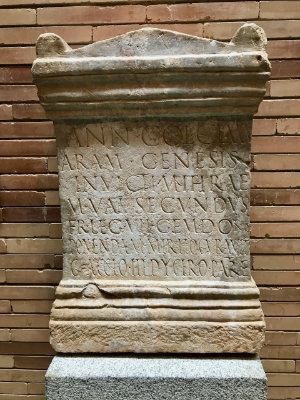
Altar of Merida consecrated by Marcus Valerius Secundus
Ann[o] Col[oniae] CLXXX / aram genesis / Inuicti Mithrae / M[arcus] Val[erius] Secundus / fr[umentarius] Leg[ionis] VII Gem[inae] dono / ponendam merito curauit / G[aio] Accio Hedychro patre.
In the year 180 of the Colony, Marcus Valerius Secundus, frumentarius of the Legion VII Gemina, took care of placing the altar of the birth of the Invictus Mithras, as a due offering, being pater Gaius Accius Hedychrus.
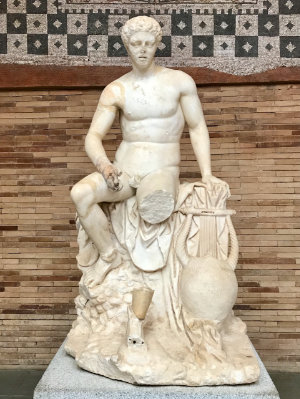
Mercury of Mérida
Ann[o] col[oniae] CLXXX / invicto deo Mithrae / sacr[um] / G[aius] Accius Hedychrus / Pater / a[nimo] [libente] plosuit].
In the colony's 180th year. Consecrated to the invincible god Mithras. Gaius Accius Hedychrus, Father, willingly deposited this.
Altar by Caius Aemilius Superaius of Merida
Deo / Invicto / C[aius] Camilius / Superat[us] / a[nimo] l[ibens] p[osuit].
To the Unconquered God, Caius Camilius Superatus willingly and gladly placed [this].
Altar of Gaius Iulius from Mérida
Deo / Invicto / pro salute / Cai Iuli / […].
Al Dios Invicto. Por la salud de Gaius Iulius […].
Oceaunus of Mérida
G[aius] Acc[ius] Hedychrus / p[ater] patrum
Gaius Accius Hedychrus pater patrum
Altar of Mérida from Quintio
Inuicto Deo / Quintio Flaui / Baetici Conim/brig[ensis] ser[uus] / pro sa[lute] Coutii Lupi
Al Dios Invicto. El conimbrigense Quintio, esclavo de Flavius Baeticus, por la salud de Coutius Lupus.
Base of statue from Mérida
Caute / Tib[erius] Cl[audius] / Artemidoru[s] / p[ater?].
To Cautes, pater Tiberius Claudius Artemidorus
Altar by Hector Corneliorum of Mérida
... Invict[o Mithrae] / Hector Cornelior[um] / ex visu.
To the Invictus [Mithrae], Hector of the Cornelians, by a vision.
References
- Aleš Chalupa (2023) Římský kult boha Mithry. Atlas lokalit a katalog nálezů I
- Alfred Shenington Geden. Altar by Caius Aemilius Superaius of Merida in EDCS
- Alfred Shenington Geden. Altar by Hector Corneliorum of Mérida in EDCS
- Alfred Shenington Geden. Altar of Merida consecrated by Marcus Valerius Secundus in EDCS
- Alfred Shenington Geden. Base of statue from Mérida in EDCS
- Alfred Shenington Geden. Cautopates from Casa del Mitreo of Mérida in EDCS
- Alfred Shenington Geden. Lápida mitráica de San Juan de la Isla in EDCS
- Alfred Shenington Geden. Mercury of Mérida in EDCS
- Alfred Shenington Geden. Oceaunus of Mérida in EDCS
- Csaba Szabó (2026) Mithras in Roman Dacia. Local Appropriations of a Universal God
- Epigraphic Database Heidelberg. Altar by Hector Corneliorum of Mérida in EDH
- Epigraphic Database Heidelberg. Altar of Merida consecrated by Marcus Valerius Secundus in EDH
- Epigraphic Database Heidelberg. Cautopates from Casa del Mitreo of Mérida in EDH
- Epigraphic Database Heidelberg. Mercury of Mérida in EDH
- Epigraphic Database Heidelberg. Oceaunus of Mérida in EDH
- Hispania Epigraphica. Altar by Caius Aemilius Superaius of Merida in HE
- Hispania Epigraphica. Altar by Hector Corneliorum of Mérida in HE
- Hispania Epigraphica. Altar of Gaius Iulius from Mérida in HE
- Hispania Epigraphica. Altar of Merida consecrated by Marcus Valerius Secundusin HE
- Hispania Epigraphica. Base of statue from Méridain HE
- Hispania Epigraphica. Cautopates from Casa del Mitreo of Mérida in HE
- Hispania Epigraphica. Lápida mitráica de San Juan de la Islain HE
- Hispania Epigraphica. Mercury of Mérida in HE
- Hispania Epigraphica. Oceaunus of Mérida in HE
- Jaime Alvar Ezquerra. 1.01.01. Mitreo de la calle Espronceda
- Jaime Alvar Ezquerra (2020) 1.01.02.04. Ara de mármol blanco con inscripción
- Jaime Alvar Ezquerra (2018) El culto de Mitra en Hispania
- Jaime Alvar Ezquerra (1981) El culto de Mitra en Hispania
- Jaime Alvar Ezquerra (2020) Estudio histórico – Mitra en Hispania
- Jaime Alvar Ezquerra (2020) Mitra en Hispania: 1.01.02.14. Fragmentos del relieve de la tauroctonía
- Jaime Alvar Ezquerra (2020) Mitra en Hispania: 1.01.03. Materiales procedentes de la Calle Constantino de Mérida
- Jaime Alvar Ezquerra (2020) Mitra en Hispania: 1.01.04.01. Pequeña ara votiva de mármol blanco
- Javier Alvar (2020) 1.01.04.02. Basa de estatua con inscripción – Mithra en Hispania
- Mitra en Hispania. Aesculapius of Merida in MEH
- Mitra en Hispania. Aion of Mérida in MEH
- Mitra en Hispania. Altar by Caius Aemilius Superaius of Merida in MEH
- Mitra en Hispania. Altar of Gaius Iulius from Mérida in MEH
- Mitra en Hispania. Altar of Merida consecrated by Marcus Valerius Secundus in MEH
- Mitra en Hispania. Base of statue from Mérida in MEH
- Mitra en Hispania. Cautopates from Casa del Mitreo of Mérida in MEH
- Mitra en Hispania. Feast from Mérida in MEH
- Mitra en Hispania. Lion-headed figure of Mérida in MEH
- Mitra en Hispania (2022) Lápida mitráica de San Juan de la Isla in MEH
- Mitra en Hispania. Mercury of Mérida in MEH
- Mitra en Hispania. Naked figure from Mérida in MEH
- Mitra en Hispania. Oceaunus of Mérida in MEH
- Mitra en Hispania. Venus of Mérida small sculpture in MEH
- Mitra en Hispania. Venus pudica of Mérida in MEH
- Nagy Levente (2018) C019. Catálogo. Lusitania. Emerita Augusta - Mérida (Badajoz). Escultura
- House of Mithraeum. Turismo de Mérida
- La Casa del Mitreo. ArcheoAndrea
