This site uses cookies to offer you a better browsing experience.
Find out more on how we use cookies in our privacy policy.

 
Provincia

Mithras in Tarraconensis

Across Tarraconensis, Mithraic evidence appears in diverse urban, military and Mediterranean environments of Roman Hispania.

Material from Tarraconensis reveals the broad geographic diffusion of Mithraic cults across the largest province of Roman Hispania. From coastal cities to inland administrative centres, the corpus illustrates the movement of religious practices through the political and commercial networks of the western Mediterranean.

Mithraic monuments of Tarraconensis


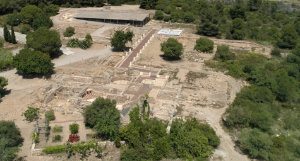
Mitreo dels Munts

The Mithraeum of Els Munts, near Tarragona, is one of the largest known to date.


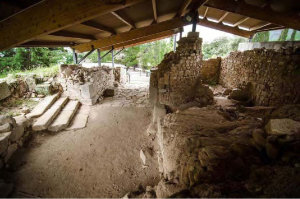
Mitreo de Lugo

The exploration of an old pazo, a manor house, near the Roman wall, in Lugo, led to the discovery of a Roman domus, which existed continuously from the beginnings of the Christian Era until the Late Empire.


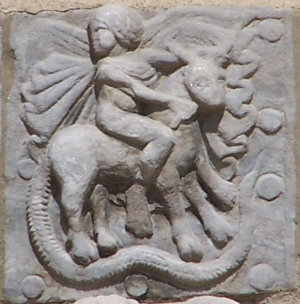
Tauroctony from Santo Domingo de Silos

Mithras slaying the bull appears as the sign of Capricorn in a zodiacal sequence on the Pórtico del Cordero of the Abbey de Santo Domingo de Silos, Burgos, Spain.


Mitreo de Cabrera de Mar

The Roman villa of Can Molodell had a sanctuary that has been related to the cult of Mithras.


Lápida mitráica de San Juan de la Isla

The monument of San Juan de la Isla (Asturias) devoted to Mithras was preserved in the portico of the main church until 1843.

CIMRM 803


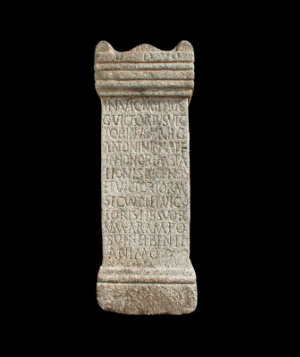
Ara of the Mithraeum of Lugo

Victorius Victorious, centurion of the Legio VII, erected the altar in honour of the Lugo garrison and of the Victorius Secundus and Victor, his freedmen.


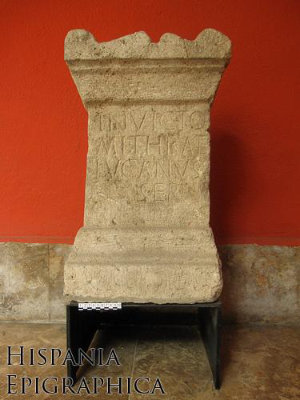
Altar of Benifayó

This altar found in Benifaió, València, was erected by a slave called Lucanus.

CIMRM 807


Inscription of Tarragona

This fragment of the base of a statue from Tarragona, Spain, bears an inscription which appears to be dedicated to the invincible Mithras.

CIMRM 806


Plaque of Astorga

This slab dedicated to the invincible god, Serapis and Isis by Claudius Zenobius was found in 1967 in the walls of the city of Astorga, Spain.


Arula by Lucius Petreius of Cabrera de Mar

Small arula with mithraic inscription and dedication to Cautes from a garlic merchant.


Cilindric arula from Cabrera de Mar

Two slaves sign this small monument to Cautes.

See all Mithraic monuments in Tarraconensis

Places in Tarraconensis


[Santo Domingo de Silos]

Burgos is a city in the autonomous community of Castile and León in Spain.


Asturica Augusta

Astorga is a municipality and city of Spain located in the central area of the province of León, in the autonomous community of Castilla y León, 43 kilometres southwest of the provincial capital.


Baetulo

The area was populated by Iberians, but the origins of Baetulo date back to the 1st century BC, when the Romans founded the city on the Rosés hill. Baetulo was famous for its vineyards, which produced wine for export throughout the Empire.


Barcino

Barcelona is a city on the coast of northeastern Spain. Founded as a Roman city, in the Middle Ages Barcelona became the capital of the County of Barcelona.


Benifaió

The Roman remains of Benifaió, or Benifayó in Spanish, are located on the outskirts of the city. Of particular interest is a rustic villa inhabited between the 1st and 4th centuries according to the numismatic and ceramic remains found.


Iluro

Ituro, now Cabrera de Mar, was an important trading town and the capital of the Laietani, an Iberian people, until Roman times.


La Isla

Colunga is a municipality in the Autonomous community of the Principality of Asturias, Spain.


Lucus Augusti

Today Lugo was the capital of the Capori tribe. It was conquered by Paullus Fabius Maximus and named Lucus Augustus in 13 BC after the positioning of a Roman military camp.


Tarraco

The capital of Hispania Tarraconensis, Tarraco is the oldest Roman settlement on the Iberian Peninsula.


Toletum

Toledo is the repository of more than 2000 years of history.


Valentia

Valencia is one of the oldest Roman cities in Spain, founded in 138 BC under the name 'Valentia Edetanorum' on the site of an older Iberian city.

Inscriptions from Tarraconensis

Lápida mitráica de San Juan de la Isla

Ponit Inv/icto Deo / Au[gu]sto. Po/nit lebien/s Fronto / aram Invi/cto Deo Au/[gu]sto. F[ronto] Leveiu/s ponit, pr[a]e/sedente p[a]/[t]rem patr[um] / [c]um leon[ibus]/ M[onumentum] [h[oc]]
Erects it to the Unconquered God Augustus. Erects, willingly, Fronto, the altar to the Unconquered God Augustus. Fronto Leveius, erect this monument which presides over the father of fathers with the lions

Ara of the Mithraeum of Lugo

Deo / Inuic[to] Mithrae / G[aius] Victorius Vic/torinus [centurio] L[egionis] VII G[emina] / Antonianiae P[iae] F[elicis] / in honorem sta/tionis lucensis / et Victoriorum / Secundi et Vic/toris lib[ertorum] suor/um aram po/suit libenti animo [hedera]
To the undefeated Mithras, Gaius Victorius Victorinus, centurion of Legio VII Gemina Antoniania Pia Felix in honor of the statio at Lucus Augusti and of the Victorius Secundus and Victor, his freedmen, placed this altar willingly.

Altar of Benifayó

Invicto / Mithrae / Lucanus / Ser[vus].
To the invincible Mithras the slave Lucanus.

Inscription of Tarragona

[--- Invi]cto Mithra[e]….
To the invincible Mithras.

Plaque of Astorga

Invicto Deo / Serapidi et / Isidi / Cl[audius] Zenobius / Proc[urator] Aug[usti].
To the Unconquered God, to Serapis, and to Isis. Claudius Zenobius, Imperial Procurator.

Arula by Lucius Petreius of Cabrera de Mar

K[auti] d[eo] / L[ucius] Petre/ius Vic/tor ali/arius / d[eo] K[auti] M[ithrae] / v[otum] s[olvit] l[ibens] m[erito].
To the god Cautes / Lucius Petreius Victor, garlic merchant, to the god Cautes Mithra, has fulfilled his promise willingly and in due form.

Cilindric arula from Cabrera de Mar

K[auti] v[otum] s[olverunt] / Successus / Elaine / Caesaris
For Cautes. Successus and Elaine, Caesar's slaves, fulfilled their promise.

Altar with inscription from Baetulo

K[auti] deo / L[ucius] Valer[ius] Monteius / v[otum] s[olvit] l[ibens] m[erito].
To the god Cautes. Lucius Valerius Monteius fulfilled his promise willingly and properly.

References

Back to Top