The material documented in Aquitania remains modest in scale but geographically important for understanding the spread of Mithraic cults into southwestern Gaul. Urban centres and regional routes connected the province to Atlantic, Iberian and inland Gallic networks through which religious practices circulated.

People attested in Aquitania

Places in Aquitania
Burdigala
Around 300 BC, Burdigala was the settlement of a Celtic tribe, the Bituriges Vivisci. The Romans conquered the area in 60 BC and made Burdigala the capital of the Roman province of Aquitania during the reign of Emperor Vespasian.
Inscriptions from Aquitania
Inscriptions of Eauze
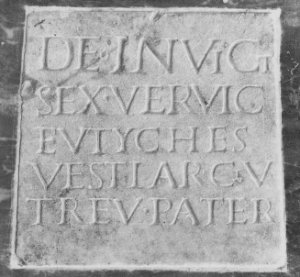
Deo Invict[o] / Sex[tus] Vervic[ius] / Eutyches / vestiar[ius] civ[is] / Trev[er] pater.
V/ervi/cius Eutyc/hes pa/ter.
V/ervi/cius Eutyc/hes pa/ter.
To the Unconquered God, Sextus Vervicius Eutyches, textile merchant, citizen of Treveri, and Father.
Vervicius Eutyches, Pater.
Vervicius Eutyches, Pater.
Forged altar from Soulan
Deo Mitr(ae) Faustus, Modesta v(otum) s(olverunt) l(ibentes) m(erito).
To the god Mithras, Faustus and Modesta willingly and deservedly fulfilled their vow.
