Your search Bu Njem gave 1882 results.

Fragments of a marble relief preserving only the lower part, with Mithras slaying the bull, dog and serpent licking blood, a large scorpion, and Cautopates behind the bull pointing his torch downwards, from the Mithraeum of S. Lorenzo in Damaso.
Ancient marble fragments walled into the staircase of the house at Via Boncompagni 101 (Boarding-house Cosmopolita), including a lower part of a Mithras bull-killing group and a fragment of a low-relief with the bullkilling; not traced by Vermaseren.
Wall-painting on the last column but one of the Palazzo Barberini Mithraeum, showing a standing person in a short tunic with a wreath of ivy, carrying fruits in his left hand.
Relief in plaster, fixed on the wall beside the Mithraic wall-painting (No. 386) in the house of the Nummi Albani on the Quirinal, with traces pointing to a representation of Mithras slaying the bull.
Marble altar found near S. Lorenzo in Piscibus in 1949, dedicated to the Great Mother, Attis, and the Invincible Mithras by Sextus Rusticus, vir clarissimus, pater patrum, proconsul of Africa between 371 and 373 A.D.
White marble slab showing Mithras as a bull-killer on a rocky base, found in 1928 by the Comtesse de Robillant in a cellar of the Palazzo del Grillo behind the Forum of Augustus; Mithras' head, both arms, and the bull's head and tail are lost.
Marble relief with the dressed busts of Sol with five rays, a long-bearded man, and Luna with crescent, found in the camp of the equites singulares near the Scala Santa, now in the Museo Nazionale delle Terme.
Two marble frieze fragments with incised busts of Sol, Luna, Mars, Jupiter, and Venus, one found in 1890 in the outer porticus of the Theatre and one found in 1938 near the Mithraeum at Ostia.
Two marble fragments of a statue of Mithras as bull-killer, preserving the head in Phrygian cap and right hand with dagger, with traces of red paint, from the Mitreo del Palazzo Imperiale at Ostia.
Fresco depicting Cautopates in Eastern attire between two laurels, cross-legged, pointing his torch downwards over a burning altar, from the Mithraeum of Capua.
Damaged statue of Mithras as bull-killer on a rectangular base, found in the piazza of the Fountain of Apollo at Cyrene.
Marble head with locks of hair and Phrygian cap, probably depicting Mithras as bull-killer, found under the threshold of the Iseum at Cyrene.
Fragment of a white marble relief depicting the head of Mithras with Phrygian cap and nimbus, found on the Syrian coast between Lattakieh and Tartous, first half of 2nd century A.D.
Four small painted cups buried in a row under the niche floor at Mithraeum II, Stockstadt, one still containing a piece of sulphur; with coins of Augustus, Hadrian, and Antoninus Pius

Fragment of a silvered bronze plate from Mithraeum II at Stockstadt depicting Mithras grasping the bull for the kill
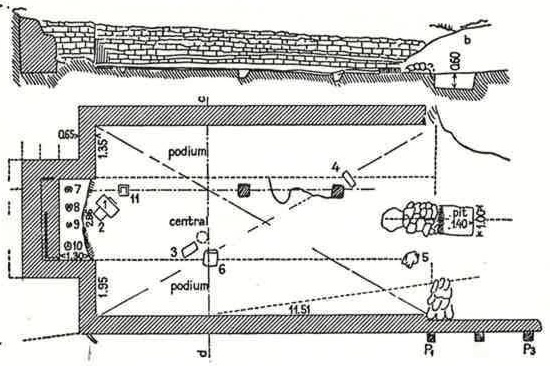
Second Mithraic sanctuary discovered at Stockstadt between 1909 and 1913, situated on a slope near the river Main, with finds at Aschaffenburg
Red sandstone altar from Mithraeum I at Stockstadt decorated with a jug on the right, a tree with a bird on the left, and partially reused for building
Yellow sandstone altar from Mithraeum I at Stockstadt bearing a bust of Sol in radiate crown holding a whip, with a pierced square hole at the base
Fragmentary inscription from the base of a statue at Mithraeum I, Stockstadt, found in context but formerly misattributed to the praetorium
Sandstone stele from Mithraeum I at Stockstadt showing Cautopates in Oriental dress, cross-legged, holding a burning torch down and resting on a pedum
