Your search Cabrera de Mar gave 1568 results.

Large marble base from near Kutyamál at Apulum, Dacia, dedicated ex iussu dei Apollinis and naming the Fons Aeternus — the eternal spring — by Ulpius Proculinus, speculator of Legio XIII Gemina.
Limestone altar from Apulum, Dacia, dedicated to Soli invicto Mithrae by Caius Iulius Marcianus, signifer of Legio XIII Gemina.
Limestone altar from Apulum, Dacia, dedicated to Deo invicto Mithrae as a gift by Titus Aurelius Marcus (tribu Fabia), veteran of Legio XIII Gemina.
Altar from Apulum, Dacia, found in 1715, dedicated to Soli by Quintus Marcius Victor Felix Maximillianus, legatus Augusti of Legio XIII Gemina, together with his wife Pullaiena Caeliana and his son.
Base from Aquincum, Pannonia Inferior, dedicated to Deo invicto Mithrae by Marcus Aurelius Frontinianus, decurio of the Colonia Aquinci.
Sandstone altar from Carnuntum, Pannonia Superior, dedicated jointly to Invicto deo by Baebius Martialis and Ulpius Breucianus.
Marble right hand holding a dagger from Mithraeum II at Ptuj, ancient Poetovio — a fragment of a tauroctony statue or relief.
Small circular marble basin from Mithraeum II at Ptuj, ancient Poetovio, probably used for libations or purification within the sanctuary.
Marble right hand holding a patera from Mithraeum II at Ptuj, ancient Poetovio — a fragment of a cult statue performing a libation.
Upper portion of a marble plate from Mithraeum II at Ptuj, ancient Poetovio, decorated with a central stem flanked by leaf motifs and a small twig — a purely decorative element from the sanctuary.
Marble inscription fragment from Mithraeum II at Ptuj, ancient Poetovio, preserving only scattered letters with no legible text.
Marble lion from Mithraeum II at Ptuj, ancient Poetovio, holding a swine's head under its left fore-leg — a sacrificial animal pairing associated with the Mithraic lion grade.
Large marble water-basin on a column from Mithraeum II at Ptuj, ancient Poetovio, decorated with a central rosette; it probably stood near the entrance of the sanctuary.
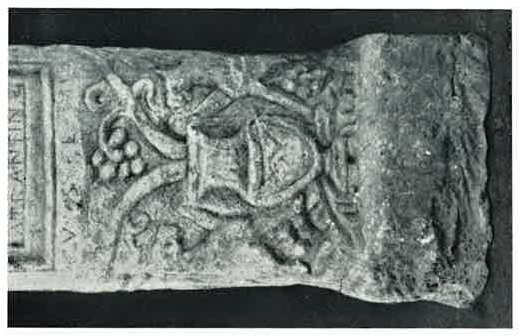
Marble column from the entrance of Mithraeum II at Ptuj, ancient Poetovio, serving as a statue base, its front decorated with a kantharus between panthers and vine tendrils; the inscription names Salvianus, contrascrip of the statio Atrantiana.
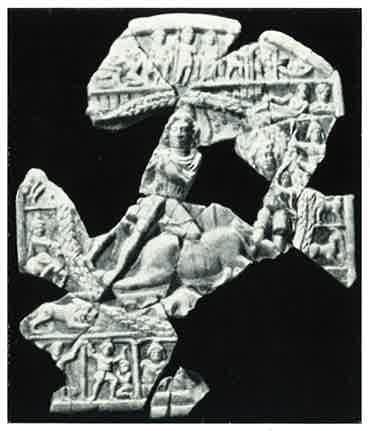
Fragments of a white marble arched tauroctony from Mithraeum III at Heddernheim, ancient Nida, showing Mithras killing the bull in a leaf wreath
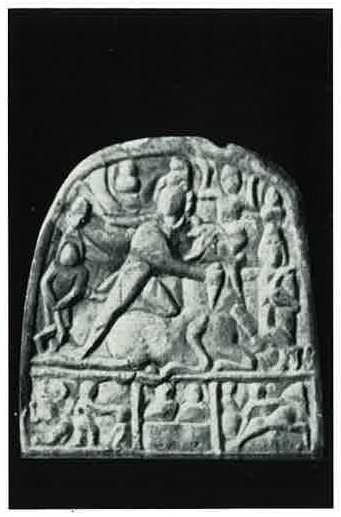
Small tauroctony relief in white marble, preserved in five fragments, from Mithraeum I at Heddernheim, ancient Nida
Mithraic altar inscription set up by the centurion Marcus Iulius Martius in 189 CE.
Two marble heads from Ostia, including a youthful figure wearing a Phrygian cap and another identified as Mithras-Helios.
These twin inscriptions found in the Mithraeum of Tazoult were dedicated by the legate Marcus Valerius Maximianus.

Marino has been inhabited by Latin tribes since the 1st millennium BC. During the Roman Republic it was a summer resort for Roman patricians who built luxurious villas in the area.
