Your search Concetta Luna gave 78 results.

Two stone relief fragments from Interanum (modern Entrains-sur-Nohain) in Lugdunensis: one showing the dressed bust of Luna with a whip and crescent, and another showing the head of Sol with a crown of seven rays and a raven on the cave border.
A large inscription from Olisipo (modern Lisbon), recording a dedication to the Eternal Sol and Luna for the perpetuity of the empire and the welfare of Septimius Severus, Caracalla and Geta, executed under the supervision of Drusus Valerius Coelianus and others, dated to the Severan period…
A great cippus from Olisipo (modern Lisbon), recording a dedication to Sol and Luna by Cestius Acidius Perennis, legate of the Emperor and propraetor of the province of Lusitania.
Fragment of a marble tauroctony relief found between Sinitovo and Tatar-Bazardjik, Thracia, preserving only the upper portion with the busts of Sol and Luna; the Greek inscription in the border names the dedicant.
Limestone tauroctony relief from Virovsko near Vratsa, Thracia, depicting Mithras killing the bull with dog and raven, flanked by torchbearers, with Sol and Luna busts in the upper corners.
Marble tauroctony relief from the surroundings of Küstendil, ancient Pautalia in Moesia Superior, depicting the bull-slaying with torchbearers and Sol and Luna busts in the upper corners.
A medal in the form of a Grecian cross from the Mithraeum at Spoleto, showing busts of a bearded man and a veiled woman each with a radiate crown, identified by Cumont as Sol and Luna.
A badly damaged marble torso from Rome, carved from Luna marble, possibly representing a Mithraic torchbearer dressed in tunic, long cloak and anaxyrides.
Fragment of a small tauroctony relief in the Museo Lateranense, Rome, preserving the bull's head and the upper part of Cautopates pointing his torch downwards with both hands, and the bust of Luna with crescent in the upper corner.
Fragments of a small lamp from the Palazzo dei Musei Mithraeum, preserving the lower part of the bust of Luna set within a crescent.
Marble relief with the dressed busts of Sol with five rays, a long-bearded man, and Luna with crescent, found in the camp of the equites singulares near the Scala Santa, now in the Museo Nazionale delle Terme.
Roof tile found at Portus, with an inscription recording the workshop of L. Aemilius Iulianus, priest of Sol and Luna.
Two small altars dedicated to Sol and Luna by the consul Q. Aradius Rufinus, found at Sidi Adi bel-Kassem near Thuburnica, probably dated 304-321 A.D.
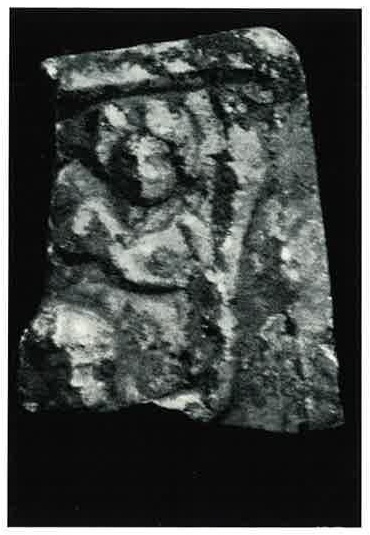
Bluish marble fragment from the Mithraeum at Sarmizegetusa, Dacia, preserving the right upper corner with the head of Cautes and his upraised torch, above which the bust of Luna.
Right portion of a marble tauroctony relief from Mithraeum II at Ptuj, ancient Poetovio, preserving standing Cautes with upraised torch and the bust of Luna above him.
Right lower corner of a marble relief from Mithraeum II at Ptuj, ancient Poetovio, preserving the border of the grotto and, outside it, Luna in a two-horse chariot holding a whip; only the horses' heads are shown.
Complex military inscription invoking Apollo, Sol and Luna under Severus Alexander.

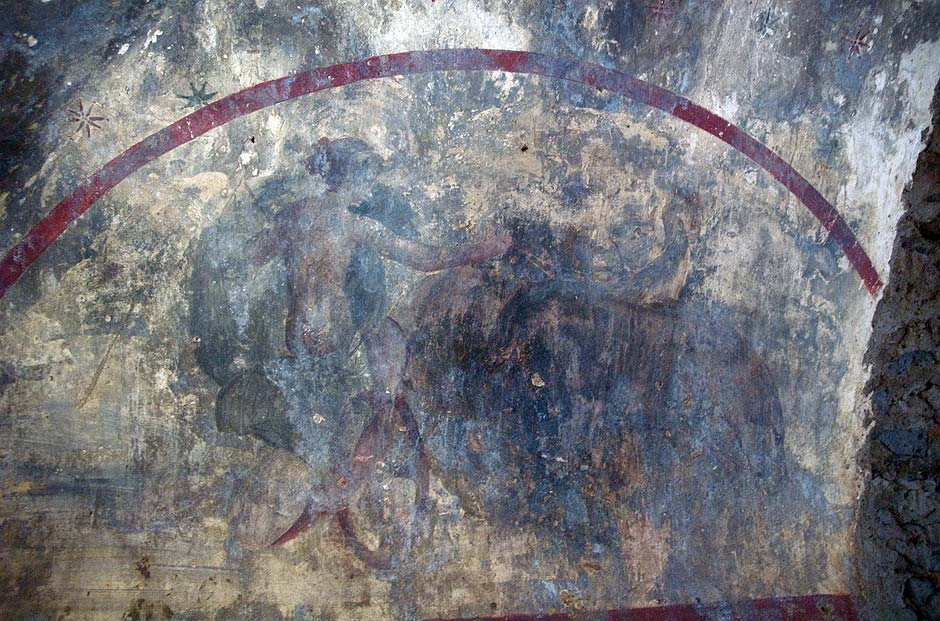
Luna riding a biga in the Mithraeum of Santa Capua Vetere.

