Your search Jabal al-Druze gave 3543 results.

Marble altar from Apulum, Dacia, decorated with leaf ornaments at the top and rosettes between leaves on the sides, bearing an inscription.
Lost limestone altar from Apulum, Dacia, decorated on the sides with a rose and serpent, on the reverse with a bull's head; the front bears a Mithraic inscription.
Limestone altar from Apulum, Dacia, decorated on one side with Medusa, on another with a vase, flowers, a bull's head, and a serpent; the front bears an inscription.
Inscription from a house wall at Apulum, Dacia, dedicated to Cautes by Gaius Herennius Ermes.
Slab from near the Cathedral at Alba Julia, Apulum in Dacia, found in 1725, dedicated to Deo invicto Mithrae by a legionary legate.
Altar from Apulum, Dacia, dedicated to Iovi optimo maximo by Claudius Niger; included in the Mithraic corpus by proximity to other monuments from the same context.
Limestone capital reused as an altar at Apulum, Dacia, its top scraped off, bearing a dedication to Soli Mithrae by Aelius Gordianus.
Limestone altar from Apulum, Dacia, dedicated by Aelius Mestrius.
Top of a limestone altar from Apulum, Dacia, with a rosette in the pediment and palmettes on the sides, recording a dedication to the Numen invicti by a dedicant whose name may be Vallerius.
Limestone altar from Apulum, Dacia, dedicated to Soli invicto Mithrae by Caius Iulius Marcianus, signifer of Legio XIII Gemina.
Top of a limestone votive altar from Apulum, Dacia, preserving only the dedication to Invicto deo.
Limestone altar from Apulum, Dacia, dedicated to Deo invicto Mithrae as a gift by Titus Aurelius Marcus (tribu Fabia), veteran of Legio XIII Gemina.
Fragment of a small altar from Ljubljana, ancient Emona in Pannonia Superior, preserving a dedication to Invicto Mithrae by a dedicant whose name ends in -quartus; the Mithraic attribution is not entirely certain.
Fragmentary inscribed altar dedicated to Mercury from the Saalburg sanctuary area.
Small inscribed plaque invoking Mithras and Mercury attached to a sandstone column inside the sanctuary.
Elongated cult building near the Saalburg fort traditionally interpreted as a Mithraeum but later reconsidered as a possible funerary enclosure.
Altar inscription from Sahin invoking the most high heavenly god and Mithras in the Alawite Mountains.

This votive silver plaque depicting Mithras was found at the site of Pessinus, Ballıhisar, in Turkey.
This supposed Mithraic altar from Soulan in the Pyrenees was later identified as a modern forgery, including both the inscription and the alleged cave context in which it was said to have been discovered.
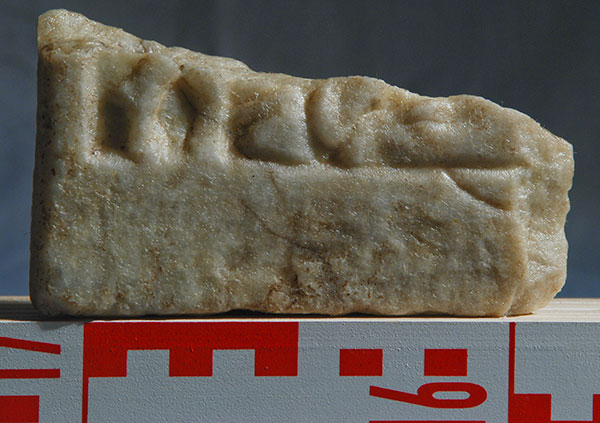
This small marble fragment preserves the crossed legs of a torchbearer, probably Cautopates, beside the hoof of the bull and the foot of Mithras.
