Biography
of Valerian
- Valerian, Roman emperor, may have been associated with a Mithraic community.
- Attested in 199 – 260 or 264.
- Attested at Ostia, Latium, Italia in mid-3rd century (TNMM 557).
- Attested at Roma, Latium, Italia.
TNMP 173
Publius Licinius Valerianus ruled the Roman Empire from AD 253 until his capture by the Sasanian king Shapur I in AD 260. A senator of distinguished background, Valerian rose to power during the turbulent years of the Third-Century Crisis and initially governed jointly with his son Gallienus, who was entrusted with the western provinces while Valerian directed military operations in the East. His reign was marked by mounting external pressures, including Gothic invasions, internal usurpations, and renewed Persian expansion under the Sasanians.
Valerian is particularly remembered for his persecution of Christians. In AD 257 and 258 he issued a series of edicts ordering sacrifices to the traditional gods and targeting Christian clergy and prominent members of Christian communities. These measures led to the execution of several notable figures, including Pope Sixtus II and Cyprian of Carthage. The persecution ended shortly after Valerian’s disappearance from the political scene, when Gallienus adopted a policy of toleration towards Christians.
In AD 260 Valerian led a major campaign against Shapur I but suffered a disastrous defeat near Edessa. He was taken prisoner by the Persian king, becoming the first Roman emperor ever captured alive by a foreign enemy. The event sent shockwaves throughout the Roman world and contributed to the fragmentation of imperial authority during the crisis. Later Roman and Christian authors embellished the story with dramatic accounts of his humiliation in captivity, although the exact circumstances of his final years remain uncertain.
Several late sources associate Valerian with solar religion and mystery cults. The Historia Augusta claims that he never forgot the cave where his mother had once consecrated him, a passage that has often attracted attention because of its apparent resemblance to Mithraic initiation settings. Although Mithras is not mentioned explicitly, the reference to a ritual consecration within a cave has led some scholars to speculate that Valerian may have been familiar with Mithraic traditions.
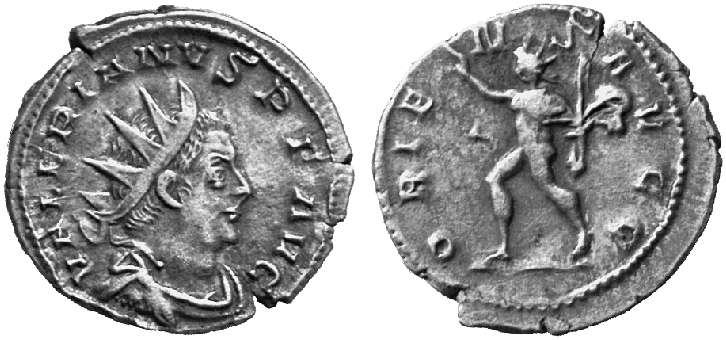
His coinage likewise reflects a strong solar emphasis. Several issues bear the legend SOL DOMINUS IMPERII ROMANI (“Sol, Lord of the Roman Empire”), and later sources credit him with establishing or promoting a college of solar priests at Rome. Whether these elements point to personal involvement in Mithraism or simply to a broader devotion to solar cults remains uncertain, but they place Valerian among the emperors most closely associated with the growing prominence of solar religion during the third century.
Attestations
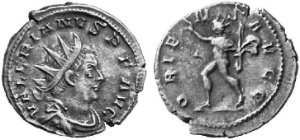
Coin of Valerian and Sol
TNMM 557
This coin was deposited in the upper level of the throne in the cult niche of the Mitreo della Planta Pedis.