Your search Mühltal am Inn gave 1063 results.

Founded on the east bank of the Tigris, Sumere is mentioned in Roman sources as a fortified settlement during the Persian campaign of Julian in 363 CE, notably by Ammianus Marcellinus.
Burham is a village and civil parish in the borough of Tonbridge and Malling in Kent, England.
Samnium occupied a mountainous region of central Italy linked to Rome through military movement and regional urban networks.
Campania preserved a vibrant urban and maritime environment closely connected to the commercial life of Roman Italy.
Mesopotamia formed part of the eastern frontier zone where Roman military expansion encountered long-established Mesopotamian traditions.
Lycia et Pamphylia connected southern Anatolia to the maritime networks of the eastern Mediterranean world.
Mesopotamia preserves frontier evidence from the eastern limits of Roman Mithraic expansion.
Lycia and Pamphylia preserve Mithraic evidence linked to southern Anatolian maritime and urban networks.
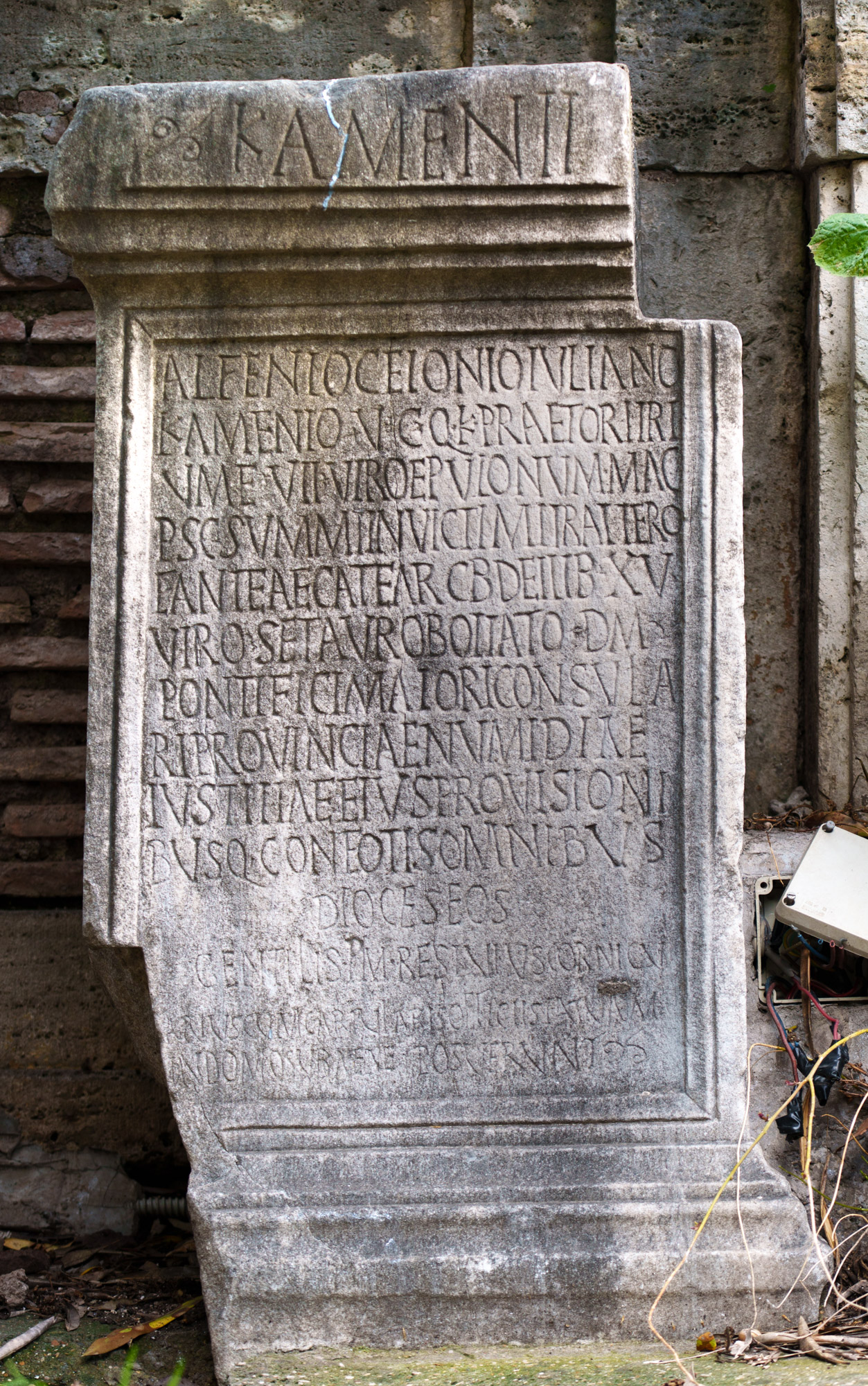
Honorific marble statue base dedicated to the senator and Mithraic pater Alfenius Ceionius Iulianus Kamenius by members of his provincial administration.

Marble altar dedicated at the Vatican Phrygianum in Rome by the Mithraic pater Alfenius Ceionius Iulianus Kamenius in 374 CE.
Tropaeum Traiani became famous for the monumental complex commemorating Trajan’s victories in the lower Danube region.
Stein am Rhein occupied a strategic position near the western limits of the Danubian frontier system.
The Moosham area lies within the Alpine territory historically connected with Roman Noricum.
Limestone stele recording endowments for the feast of the Mithrakana by Antipater and his son Gaios, found at Amorium (modern Hisarköy), Phrygia.
Sandstone altar from Campona, Pannonia Inferior, dedicated to Deo Soli invicto by Claudius Neronianus; the dedication is painted red.
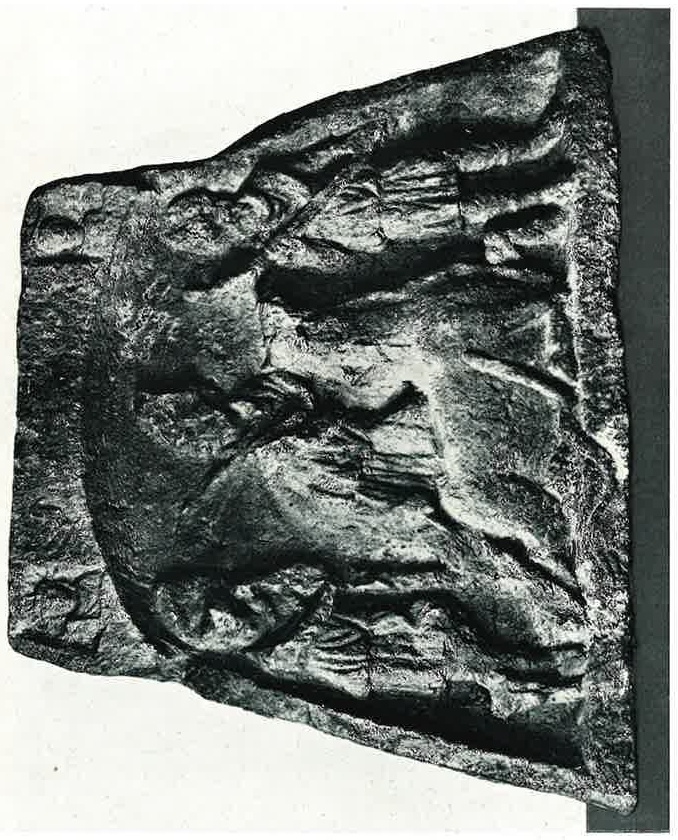
Mithraic sanctuary found in the district of Campona near Nagytétény, Pannonia Inferior, in 1934, yielding three inscribed altars, statue fragments, and other cult objects.
Fragments of an altar and an inscription from the Mithraeum at Moosham, Noricum, preserving only the opening of a pro salute dedication; traces of fire are visible.
Small Phrygian-capped head of Mithras from the Mithraeum at Moosham, Noricum, probably belonging to the cult relief.
Altar from the Mithraeum at Moosham, Noricum, dedicated to Deo invicto Mithrae for the welfare of Lucius Albius Atticus; the dedicant's name has been deliberately abraded.
Marble epistylium in three fragments from the Mithraeum at Moosham, Noricum, decorated with a central tree, a flying hind pursued by a dog and an Amazon, a walking lion, and a horseman; bearing an identical inscription on both lateral tabulae.
