Your search Ostia gave 175 results.

Marble cap mentioned by Visconti, subsequently identified as certainly belonging to the finds of the Mitreo degli Animali rather than the Mitreo del Palazzo Imperiale, Ostia.
The dedicator of this marble basin could be the same person who offered the sculpture of Mithras slaying the bull in the Mitreo delle Terme di Mitra.
Marble head of Helios-Mithras with curly hair and seven holes for fastening rays, from the Mitreo degli Animali at Ostia, Lateran Museum.
The Mithraeum of Sabazeus was found in one of the rooms of the Horrea built in the years 120 - 125 AD. The installation of the shrine may have taken place in the first half of the third century.
A small cippus from the Mithraeum of Sabazeus records the rebuilding of the sanctuary after its collapse.
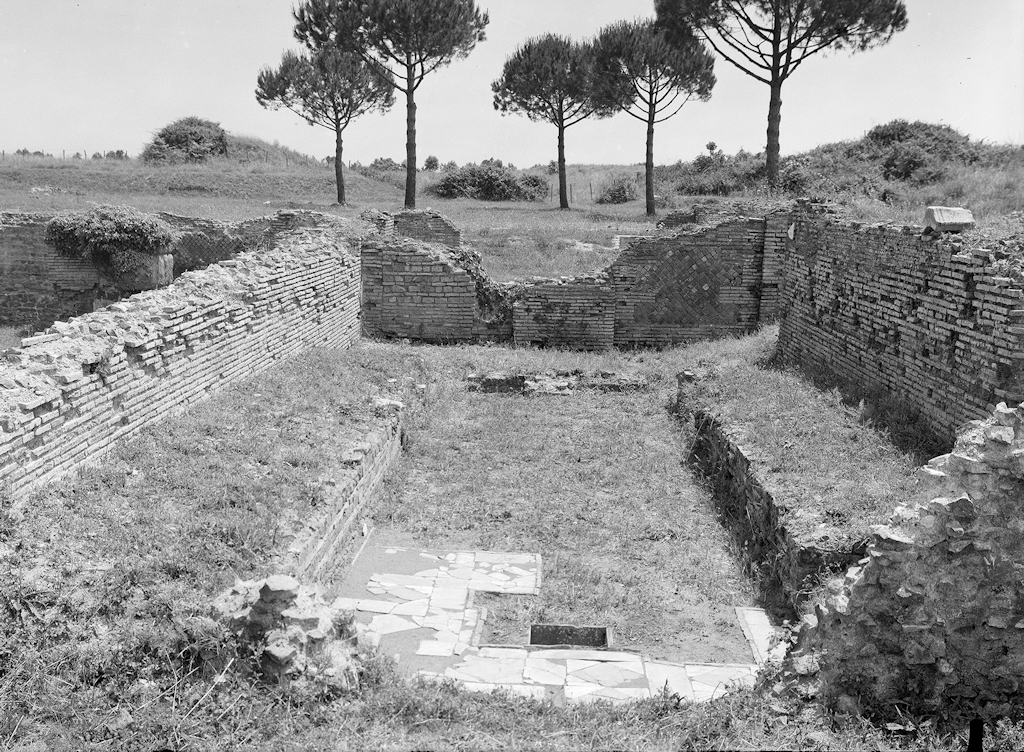
Excavated in 1919, the Mithraeum near the Roman Gate was installed in the 3rd century within a larger building complex.
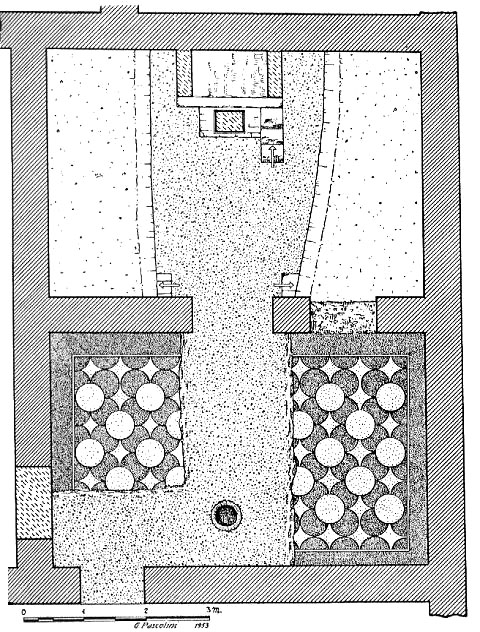
The Mithraeum of the House of Diana was installed in two Antonine halls, northeast corner of the House of Diana, in the late 2nd or early 3rd century.
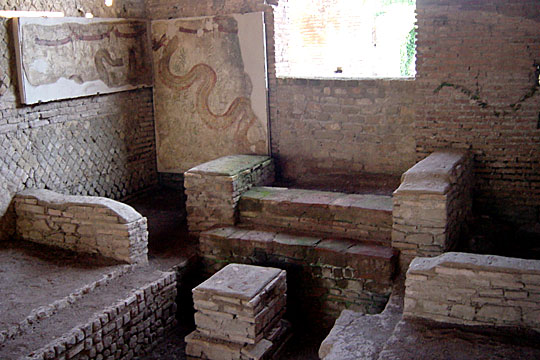
The Mithraeum of the Snakes preserves paintings of serpents, representing Genius Loci, part of an older private sanctuary, which were respected in the temple of Mithras.
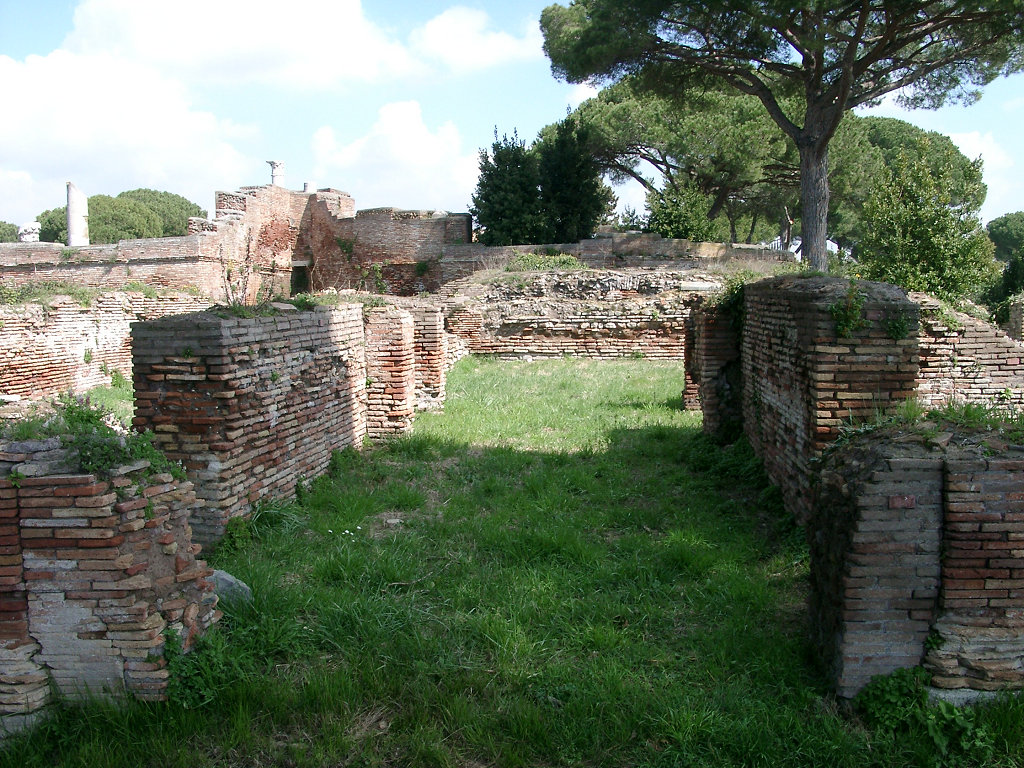
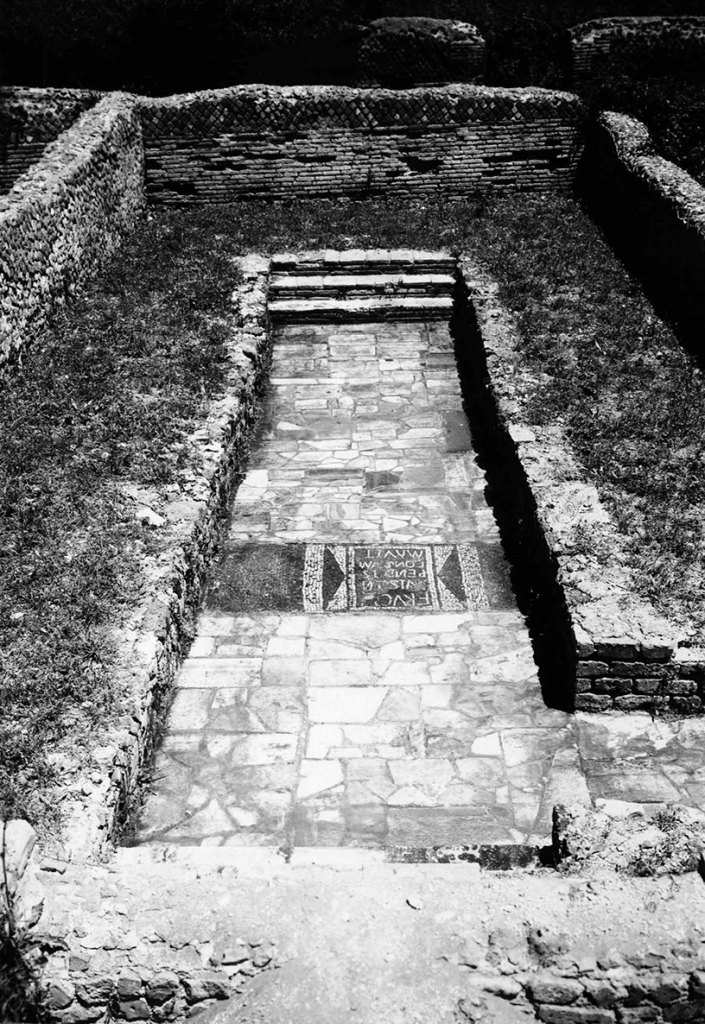
The Mithraeum of Frutosus was in a temple assigned to the guild of the stuppatores.
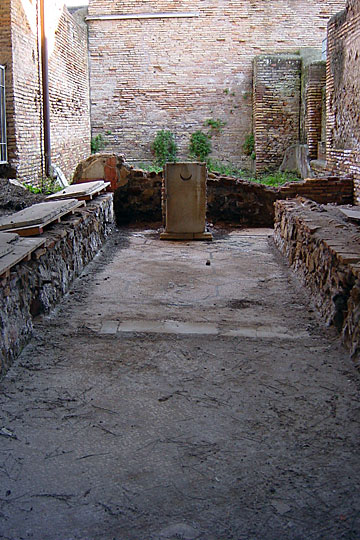
The Mithraeum of Lucretius Menander was installed in the early 3rd century in an alley to the east of a Hadrianic building named after the solar god temple.

Pater of the Mithraeum of Lucretius Menander at Ostia, honoured by a dedication from Diocles in the late second or early third century CE.

A historical role-playing game inspired by the archaeology of Roman Mithraism. Applications are now open and places are limited. The next campaign begins on 24 June.
This marble tablet found at Portus Ostiae mentions a pater, a lion donor and a series of male names, probably from a Mithraic community.
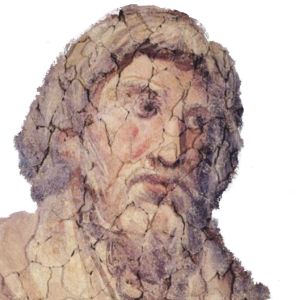
North African author, Platonic philosopher and rhetorician associated with the Mithraic milieu of Ostia.
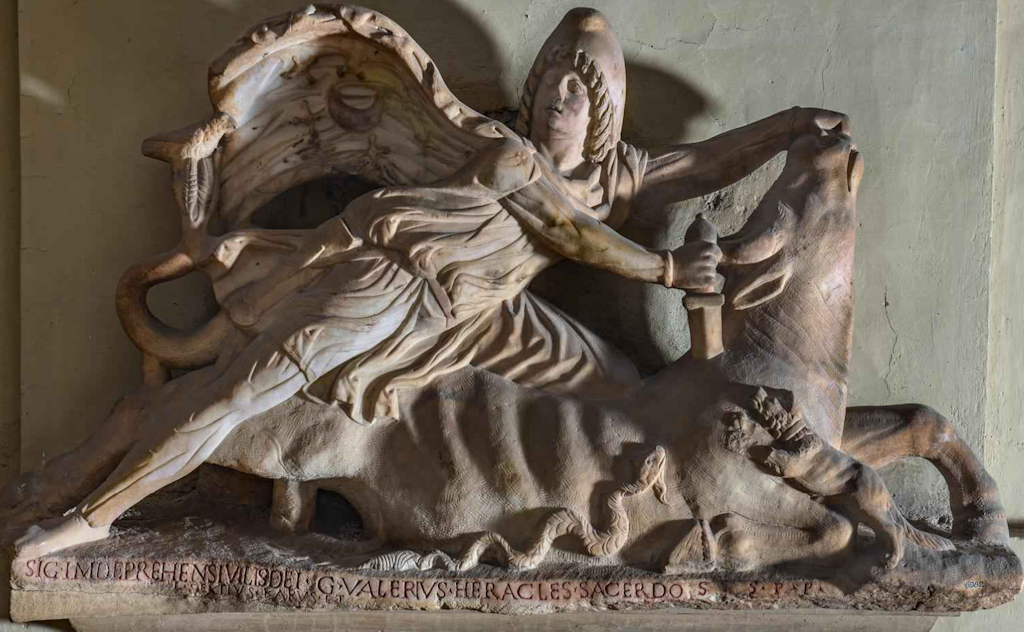
This sculpture of Mithras killing the bull was dedicated to the “incomprehensible god” by a certain priest called Gaius Valerius Heracles.
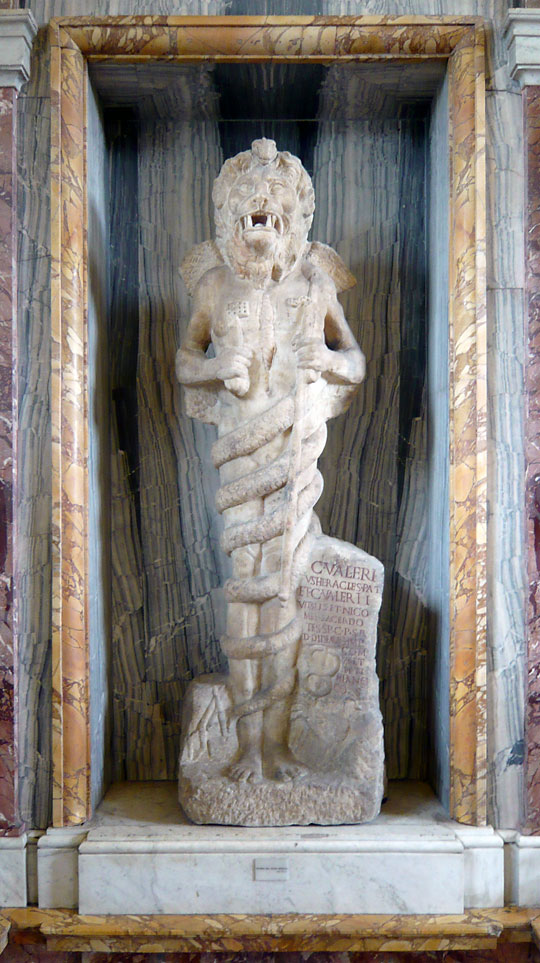
Marble leontocephalic Aion/Arimanus from the now-lost Fagan Mithraeum at Ostia, dedicated in AD 190 by three members of the local Mithraic priesthood.
The Sacello delle Tre Navate near the Therms of the Sette Sapienti at Ostia, whose identification as a Mithraeum remains uncertain, with a decorated cult-niche but lacking typical Mithraic iconography.
Mosaic-paved floor of the central aisle of the Mitreo delle Sette Porte at Ostia, with a krater flanked by serpent and eagle, standing Jupiter and Saturn, torchbearers at the podia, and planetary gods Mars, Luna, Venus, and Mercury.
Two marble frieze fragments with incised busts of Sol, Luna, Mars, Jupiter, and Venus, one found in 1890 in the outer porticus of the Theatre and one found in 1938 near the Mithraeum at Ostia.
Base in the form of an altar with five small bacchic herms and eleven lamps, from the Mitreo Sabazeo at Ostia.
