Your search Ostia gave 175 results.

Inscription dedicated to the Numen Caelesti by P. Clodius Flavius Venerandus, sevir augustalis, who acted in response to a dream, from the Mitreo Sabazeo at Ostia.
Marble slab with a vow to Iuppiter Sabazius made by imperial command, dedicated by L. Aemilius, from the Mitreo Sabazeo at Ostia.
Marble slab recording the exedra of Arpocrates, reused in the pavement of the floor of the Mitreo Sabazeo at Ostia.
Small undecorated altar of travertine without inscription, from the Mitreo dei Serpenti at Ostia.
Lower part of a torchbearer statue, cross-legged in anaxyrides and short tunic, from one of the bases at the beginnings of the podia in the Mitreo delle Sette Porte at Ostia.
Fragments of a green-glazed maiolica krater with silver sheen, probably decorated with a dodekatheon showing Minerva, Jupiter, Dionysus, and Hercules, from the Mitreo delle Sette Porte at Ostia.
Lamp with six wicks, found near the altar before the cult-niche in the Mitreo delle Sette Porte at Ostia.
Marble altar bearing a bust of Sol in radiate crown with Cautopates on the right and Cautes on the left, both cross-legged, from the Mitreo delle Pareti Dipinte at Ostia.
A small two-wick lamp and a larger twelve-wick lamp inscribed Serapiodori inny, from the Mitreo del Palazzo Imperiale at Ostia.
Marble lion's head fastened into a wall, its flat square back indicating it was set into masonry, from the Mitreo del Palazzo Imperiale at Ostia.
A few pieces of tuff worked as rocks, forming a cone representing the remnants of the rock-birth of Mithras, found around the altar in the Mitreo del Palazzo Imperiale at Ostia.
A group of small finds from an Ostia Mithraeum, including three tuff altars, two trapezophores, a column fragment, lamps, vases, and a marble Silen.
The inscription is carved into two pieces of marble cornice.
Relief featuring an enigmatic agricultural implement interpreted either as a scythe or an early type of plough.
This 3rd century marble relief of Silvanus is the only sculpture found in Mitreo Aldobrandini.
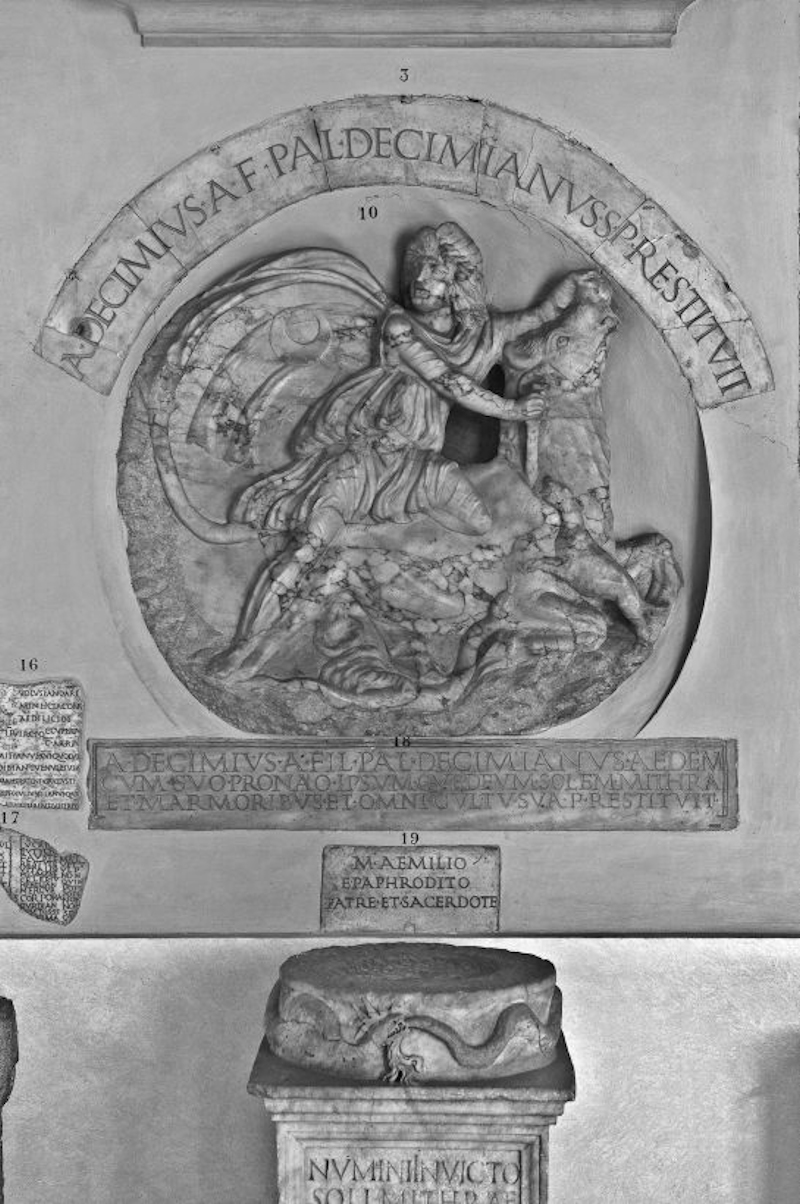
The relief of Mithras slaying the bull from the Mithraeum of the Seven Spheres was discovered in 1802 by Petirini by order of Pope Pius VII.
This inscription found in the Mithraeum of the Seven Spheres mentions the Pater Marco Aemiliio Epaphrodito known from other monuments in Ostia.

The image of the god Arimanius to which this monument refers has not yet been found.
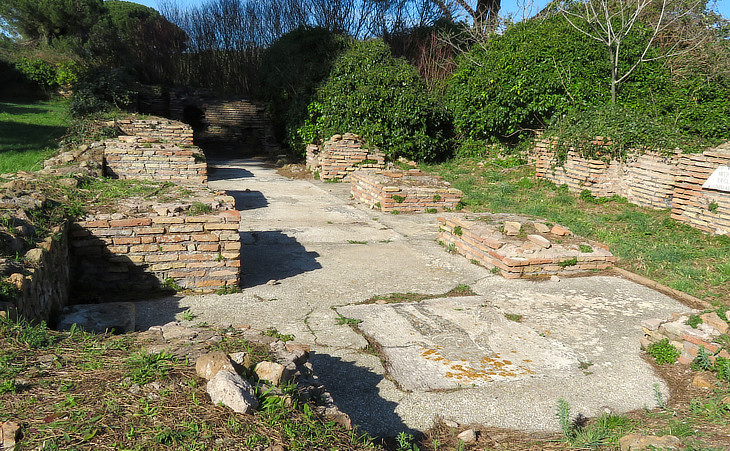
The Mithraeum of the Animals was decorated with a mosaic depicting a naked man, a cock, a raven, an scorpion, a snake and the head of the bull.
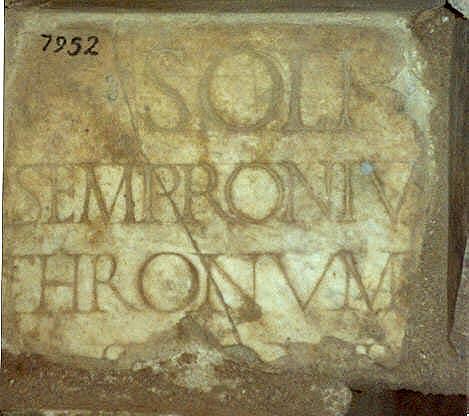
Slab marble indicates that Lucius Sempronius has donated a throne to the Mitreo delle Pareti Dipinte.
