Your search San Gemini gave 586 results.

Group of Mithraic and other cult remains possibly originating from several neighbouring sanctuaries destroyed or abandoned in Late Antiquity.
Series of small bronze plaques depicting zodiac signs and planetary figures discovered in Ostia and possibly connected with the decoration of a Mithraic sanctuary.
Dedication for the safety of the provincial governor erected by an actarius and notarius within the Mithraic sanctuary of Lambaesis.
Architectural and numismatic finds from the Mithraeum at Serdica, Thracia, comprising a door cornice, a capital fragment, two pilaster pieces, a stone water-basin, and two coins of Arcadius deposited when the sanctuary was reused as a cellar.
Lower part of a sandstone altar from Svichtov, probably transported from Novae in Moesia Inferior, dedicated to Invicto by Caius Iulius Maximus, praefectus castrorum of Legio I Italica.
Inscription from Viminacium, Moesia Superior, recording that Caius Iulius Valerius, veteran of Legio VI Claudia, restored a Mithraic sanctuary destroyed by lightning at his own expense.
Sandstone altar from Romula, Dacia, dedicated to Deo invicto Mithrae by Aurelius Rufus ex voto, with the busts of Sol and Luna flanking the text.
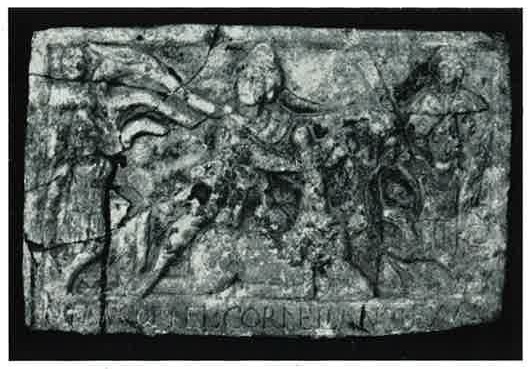
Marble tauroctony relief from Sarmizegetusa, Dacia, in the Deva Museum, depicting Mithras killing the bull; one of several reliefs attributed to the Sarmizegetusa sanctuary that were found elsewhere.
Marble hand and wrist fragments from the Mithraeum at Sarmizegetusa, Dacia, all preserving remnants of torches, belonging to the torchbearer statues of the sanctuary.
Marble relief fragment from the Mithraeum at Sarmizegetusa, Dacia, preserving a very fine head of Mithras in Phrygian cap — described by Kiraly as among the best-executed heads from the sanctuary.
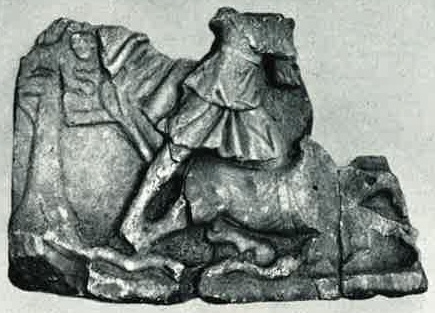
Three fragments of a large yellowish marble tauroctony from the Mithraeum at Sarmizegetusa, Dacia, depicting the damaged bull-slaying scene; at approximately 0.94 × 1.31 m one of the larger reliefs from the sanctuary.
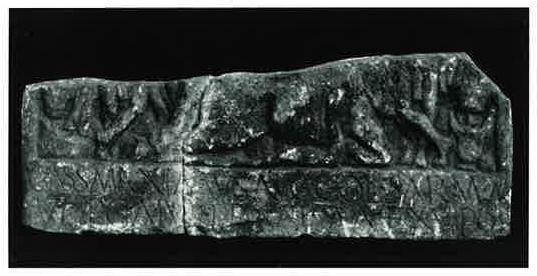
Two sandstone tauroctony relief fragments from the Mithraeum at Sarmizegetusa, Dacia, preserving the lower right portion of the bull-slaying scene.
Group of unpublished marble reliefs found in 1906 at Cinçsor on the right bank of the river Alt, Dacia, probably associated with a Mithraic sanctuary.
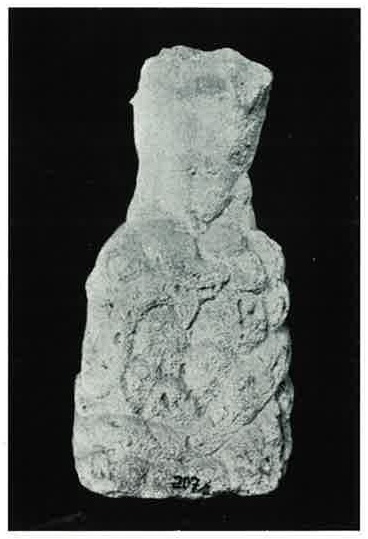
Sandstone rock-birth statue from Apulum, Dacia, depicting the naked Mithras emerging from a rock encircled by a snake; head and arms are lost.

Sandstone head in Phrygian cap from Apulum, Dacia; probably belonging to a torchbearer.
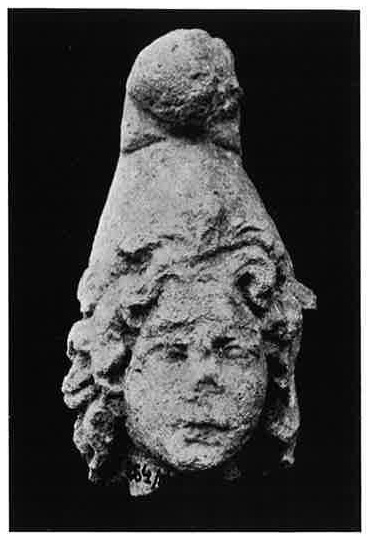
Sandstone head in Phrygian cap from Apulum, Dacia; probably belonging to a torchbearer or Attis.
Author's observation that several inscriptions from Apulum, Dacia (CIL III 1096, 1095, 1154, 1002) may belong to a sanctuary of Diana rather than to a Mithraeum.
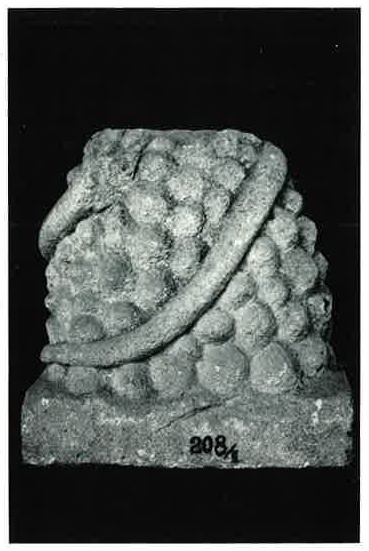
Dark sandstone statue from Mureș Port, Dacia, depicting Mithras's rock-birth with the rock encircled by a serpent; the statue's attribution to Mureș Port rather than Apulum is uncertain.
Foundations of a rectangular building (10 × 6 m) and a front-stone fragment at Golubić near Bihać, Dalmatia, suggesting the existence of a Mithraic sanctuary.
Fourth Mithraic sanctuary discovered near the southern town-wall of Aquincum, Pannonia Inferior, between a rectangular building and an apsidal structure; excavated in 1941–42 and yielding the most complete sculptural assemblage from the city.
