Your search Spittal an der Drau gave 570 results.

Colonia Claudia Ara Agrippinensium, usually just called Colonia, was the Roman settlement in the Rhineland that became the modern city of Cologne, now in Germany. It was the capital of Germania Inferior and the military headquarters of the region.
Tienen is a city and municipality in the province of Flemish Brabant, in Flanders, Belgium.
Caetobriga, now Setúbal of Proto-Celtic *Caetobrix, became a Turdetani settlement which passed under Roman rule. In the time of Al-Andalus the city was known as Shaṭūbar.
Caere is the Latin name given by the Romans to one of the larger cities of southern Etruria, modern Cerveteri, some 50-60 kilometres north-west of Rome.
The Celts are the first known to have settled in this place, which they called Binge, meaning rift. Roman troops stationed here in the first century AD rendered the local name as Bingium in Latin.
Augusta Treverorum, today's Trier in Rhineland-Palatinate, is considered to be the oldest city in Germany.
Aquincum was an ancient city, situated on the northeastern borders of the province of Pannonia within the Roman Empire.
Baetica occupied a prosperous and highly urbanised corner of Roman Hispania where Mithraic cults circulated through Mediterranean exchange networks.

This marble tablet found at Portus Ostiae mentions a pater, a lion donor and a series of male names, probably from a Mithraic community.
This supposed Mithraic altar from Soulan in the Pyrenees was later identified as a modern forgery, including both the inscription and the alleged cave context in which it was said to have been discovered.
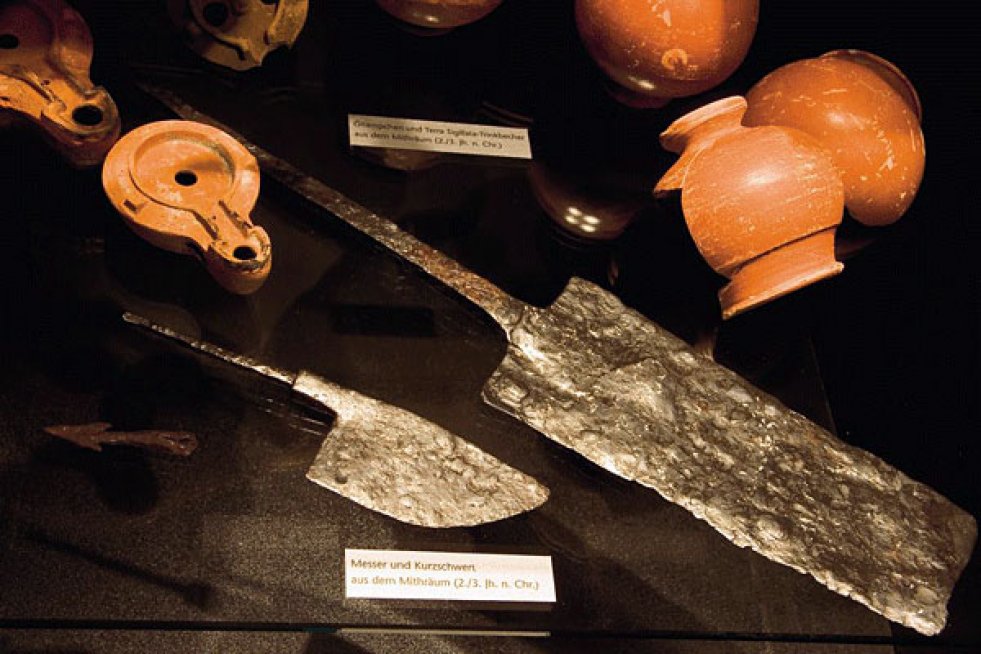
The Mithraeum of Kunzing was an underground building, oriented east-west. The entrance was probably on the east.
Cyrene linked North Africa to the Greek East through long-standing urban traditions and eastern Mediterranean maritime exchange.
Along the northern frontier of Roman Britain, Britannia inferior preserves important evidence linked to military and frontier communities.
Armenia occupied a frontier crossroads between the Roman world, Anatolia and the Iranian cultural sphere.
Etruria formed part of the cultural and religious heartland of central Italy closely connected to Rome and the Tyrrhenian world.
Samnium occupied a mountainous region of central Italy linked to Rome through military movement and regional urban networks.
Lucania connected inland southern Italy to the Tyrrhenian and Ionian maritime worlds through regional communication networks.
Bruttium occupied the southernmost reaches of the Italian Peninsula where maritime mobility linked Italy, Sicilia and the wider Mediterranean.
Corsica et Sardinia occupied an important insular position within the maritime networks of the western Mediterranean.
Mauretania Caesariensis connected western North Africa to Mediterranean trade routes and the provincial networks of the Roman empire.
